How to Boost the ROI of Your Scissor Lift Rental Business
Running a heavy equipment rental firm is not an easy task, particularly in today’s highly competitive industrial market. Whether you are serving commercial builders, event production professionals or warehouse managers, the correct aerial work platforms are vital. But having a fleet of elevators and waiting for the phone to ring won’t ensure profits by boosting the ROI of the Scissor Lift Rental business.
To really be successful and get the most ROI for your Scissor Lift Rental Business, you must choose a comprehensive strategy that combines smart fleet management, perfect maintenance, proactive safety education and dynamic client outreach. The building and logistics industries are increasing and demand for safe and effective elevating solutions is on the rise.
As the operational savings these machines enable are realized at industrial sites, commercial builders are increasingly selecting scissor lifts over conventional scaffolding. Align your services with market demands and optimize your processes to have a prosperous, scalable rental firm.
Understanding How a Competitive Market Works
To increase the ROI of your Scissor Lift Rental Business greatly, you need to have a good awareness of the market forces that are influencing your particular location. Every rental market is different and has its own set of needs based on local infrastructure projects, warehouse developments, and seasonal event productions.
When you operate a rental company, you simply can’t adopt a one-size-fits-all strategy. Instead, you need to discover what your local contractors and facilities managers really need on a day-to-day basis. For example, are you in proximity to large civil infrastructure projects such as bridges and rail systems, or does your major customer base consist of indoor warehouse logistics?
By knowing which client categories are the most profitable, you can adapt your marketing and buying tactics to their needs. And when you keep current on market developments and share that expertise, you become a trusted authority for your customers instead of a plain-vanilla equipment provider.
If you want to remain competitive and aligned with local market requirements, you should concentrate on the following strategies:
- Watch local zoning boards and commercial development permits on a regular basis to stay ahead of your competition by predicting future infrastructure and building projects.
- Stay updated with Scissor Lift Industry News to keep abreast of the latest technology, regulatory developments, and economic trends influencing equipment rentals.
- Regularly solicit direct input from existing customers, such as building maintenance professionals or event production experts, to get deeper understanding of their changing demands and operational hurdles.
How to Choose the Right Scissor Lifts for Your Fleet
The only place a high Scissor Lift Rental Business ROI begins is with the makeup of your equipment fleet. Not all job sites are the same, and your inventory has to reflect the many ways your clients work on their day-to-day.
From the clean floor of a warehouse to the rough, muddy site of a construction project, being able to do it all is the key to getting repeat business for the long haul. A detailed examination of your previous rental data and forecast market demand will be needed to curate a mix of electric and rough-terrain vehicles.
Also, by teaching your customers about the Scissor Lift Capacity Chart, load restrictions, and platform sizes, you guarantee that they are renting the right machine for the task, reducing equipment damage and work site mishaps. Accessorizing with the correct gear may also boost the usefulness of your lifts, giving you great upsell chances that go straight to your bottom line.
If you’re growing or updating your fleet, keep these acquisition tips in mind:
- Invest substantially in electric scissor lift types for businesses working in interior warehousing, HVAC repair and facility management. These machines have zero emissions, silent operation and non-marking tires.
- Purchase rugged rough-terrain scissor lifts with 4WD, heavy-duty tires and self-adjusting stabilizers for outdoor commercial builders and major civil infrastructure jobs.
- Monitor the Scissor Lift Capacity Chart issued by manufacturers and verify that your fleet spans over a broad range of load capacity, from a single maintenance worker to a team of operators with industrial-strength equipment.
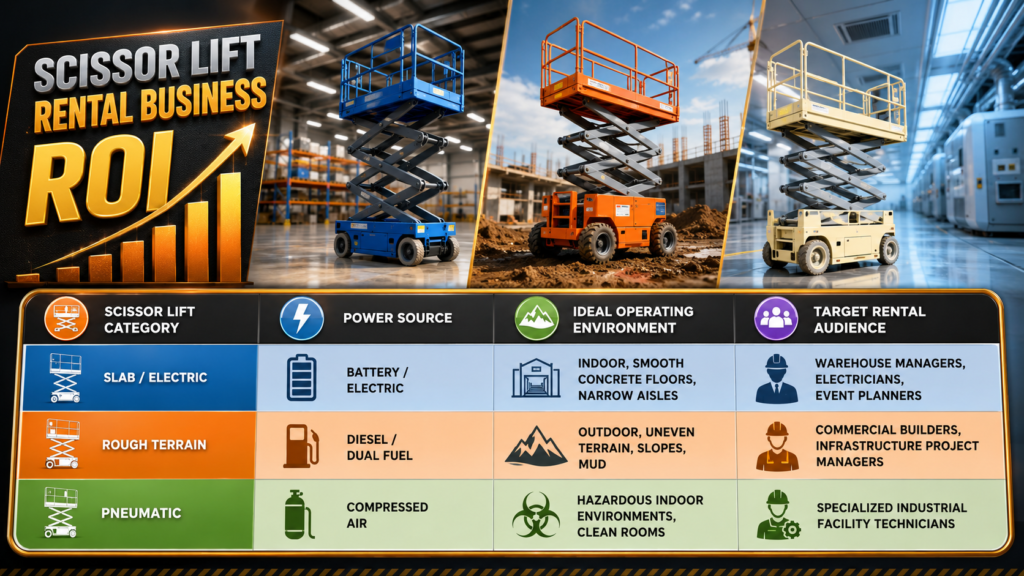
Table: Scissor Lift Rental Business ROI
| Scissor Lift Category | Power Source | Ideal Operating Environment | Target Rental Audience |
| Slab / Electric | Battery / Electric | Indoor, smooth concrete floors, narrow aisles | Warehouse managers, electricians, event planners |
| Rough Terrain | Diesel / Dual Fuel | Outdoor, uneven terrain, slopes, mud | Commercial builders, infrastructure project managers |
| Pneumatic | Compressed Air | Hazardous indoor environments, clean rooms | Specialized industrial facility technicians |
Adopting Proactive Scissor Lift Maintenance Strategies
In the rental business, idle equipment is a stealthy profitability killer. Every day that a lift spends in the repair shop is a day it isn’t making money, which has a direct and serious influence on your Scissor Lift Rental Business ROI.
So, stringent and proactive scissor lift maintenance standards are simply non-negotiable. This is so much more than simply being able to repair things when they fail. We’re talking proactive maintenance that extends the life of your heavy gear and ensures the safety of the end user.
Regular service makes sure that important safety features like emergency stop buttons, tilt sensors, and overload warnings are in perfect working condition. And one of the key financial skills for any rental company owner is recognizing just when to stop throwing good money after an aged equipment. Knowing when to replace a scissor lift rather than always maintaining it will save you thousands of dollars in the long run and keep your fleet current, appealing and dependable.
Enforce these maintenance procedures to keep operations at peak efficiency and actively defend your assets:
- Conduct necessary pre-rental and post-rental multi-point inspections to identify minor wear and tear before it turns into a catastrophic mechanical failure on a client’s work site.
- Develop a uniform calendar-based plan for lubrication of the scissor-like mechanisms, monitoring hydraulic fluid levels and evaluating battery health on all electric versions.
- Train your in-house technicians to apply data-driven methods to establish the precise financial threshold of when to replace a scissor lift vs. another expensive repair.
Methods to Improve Equipment Utilization Rates
If your lifts are sitting in your yard you are losing money in depreciation and storage space. To get the most out of your Scissor Lift Rental Business ROI, you must maintain very high equipment usage rates year-round. That requires looking for inventive methods to keep your machinery on work sites, not in your facility.
One of the best things you can do is broaden your target audience across sectors. If outside construction slows down during the nasty winter months, switch your marketing to inside facility maintenance, warehouse inventory management and indoor corporate event sets.
Also, you should teach your prospective customers why they should use your technology instead of the previous alternative ways. By making it crystal apparent why commercial builders prefer scissor lifts over conventional scaffolding for safety and efficiency, you may assist convert contractors who still use older techniques. The flexibility of the rental terms also encourages consumers to rent more often.
Use these practical techniques to boost your usage rates:
- Design highly focused marketing strategies for particular niches, such as plant managers using scissor lifts in industrial settings to enhance operational efficiency.
- Cross-sell and market different scissor lift add-ons, such as pipe racks, panel carriers or tool trays, that make your rentals much more attractive and adaptable for specialist craftsmen.
- Develop tier-based long-term relationships and loyalty discount programs for high-volume commercial builders needing constant, year-round access to dependable elevated work platforms.
Choosing the Right Pricing Model to Maximize Profits
Pricing your rental equipment correctly is a balancing act that demands ongoing attention. Overprice your day or weekly rates and you lose critical market share to aggressive local rivals. Underprice your daily or weekly rates and you undermine your Scissor Lift Rental Business ROI while intrinsically depreciating your premium equipment.
A good pricing policy takes into consideration the original cost of the equipment, the continuing expenses of maintenance, business insurance and the competitive situation in the local community. But your cash flow doesn’t start and end with basic rental prices. To properly maximize your income, you need have a visible yet smart price structure that factors in delivery logistics, environmental costs and optional damage waivers.
Transparent, digestible quotations immediately develop confidence with your customers. It is essential to make your consumers believe they are getting great value, competent advise and high quality equipment for their money.
Leverage these basics to continually improve your pricing model and optimize your monetary results:
- Conduct quarterly rival pricing analysis to verify your daily, weekly and monthly rates are very appealing, but profitable, within your own geographic market.
- Utilize a dynamic pricing strategy to dynamically modify rental prices in response to seasonal demand surges, like the hectic summer construction period or the Christmas retail warehouse boom.
- Provide premium, packaged service packages that include quick delivery, complete on-site operator familiarization and 24/7 priority maintenance support for an extra premium cost.
The focus is on safety and educational outreach
In the heavy equipment rental business, your brand’s reputation is linked to your customers’ safety and success. One serious mishap on a jobsite using your equipment might create huge liability problems and ruin your firm forever. So, making your firm an authoritative, instructional resource for safety and best practices is a clever approach to grow client loyalty and, in turn, your Scissor Lift Rental firm ROI. Allocate a huge part of your business model to teaching your renters.
At Scissorlifts.org, we are dedicated to providing the latest information, safety procedures and the definitive guide to scissor lift movement to scissor lift users of all skill levels. When consumers realize you care about their physical well-being just as much as you care about their money, they’ll select you over a faceless corporate rental yard every time.
Take these educational measures to enhance your brand’s authoritative voice and safeguard your clients:
- Provide all customers with a complete, easy-to-read scissor lift safety handbook, emphasizing key rules, correct harness use and steady platform operation.
- Give a quick, but complete equipment familiarization walk-through upon delivery, to ensure site operator knows the particular controls and emergency descent capabilities of that particular model.
- Post compelling information regularly to your business blog regarding the latest OSHA laws and best practices for preventing job site risks while working at higher heights.
FAQs – Scissor Lift Rental Business
What is a scissor lift?
A scissor lift is a specific sort of aerial work platform which uses a crisscrossing, scissor-like mechanical connection to elevate and lower a platform exclusively in a vertical direction. They are used extensively in construction, warehouse management, facility maintenance, and event production to safely and effectively move personnel, their tools, and large objects to higher work areas.
How Much Does it Cost to Hire a Scissor Lift?
The precise cost to hire a scissor lift will depend on a number of factors, such as the kind of machine (electric or rough terrain), the size of the platform and maximum load capacity, and the length of the rental agreement. Small electric interior lifts typically start at approximately $100 a day, but heavy-duty, high-reach rough terrain units may cost more than $200 a day. Long term weekly or monthly rents are sometimes more cheaper per day.
What’s the difference between electric and tough terrain scissor lifts?
Electric scissor lifts are battery operated only and emit no toxic fumes, are extremely silent and most have non-marking tires, making them the ideal option for inside usage on smooth, level surfaces. But harsh terrain scissor lifts are powered by diesel or dual-fuel engines, use heavy-duty 4WD traction tires and are built to securely negotiate rugged outdoor terrain, steep grades, mud and gravel.
Can You Operate a Scissor Lift Without a License?
OSHA (the Occupational Safety and Health Administration) does not formally provide a physical “license” for scissor lift operators; however, they do legally require that only properly trained and “authorized persons” may operate the equipment. Ultimately it is up to employers to ensure staff have recorded classroom training and actual hands-on assessments before using the lift on an active working site.
Where to obtain training on operating a scissor lift?
There is no substitute for thorough, professional training as it pertains to work site safety and compliance. Operators are usually certified by construction safety organizations, union training centers, or equipment rental firms that provide OSHA-compliant familiarization and safety certification courses.
How far can a scissor lift reach?
Scissor lifts come in many various heights to meet the demands of very varied projects. The compact class of indoor slab models typically has a maximum operating height of 15 to 25 feet. Standard construction versions usually range from 30 feet to 45 feet, but highly specialized, heavy duty rough terrain scissor lifts may reach an astonishing height of 70 feet in the air.
What size scissor lift do I require?
The best size is determined by three primary operational factors: the maximum working height required (always add about 6 feet to the machine’s platform height for the total human reach), the physical footprint needed to fit through narrow doorways or tight warehouse aisles, and the weight capacity required to safely support the total number of workers and the heavy tools that they’ll bring onto the platform.