
The Ultimate Safety Guide: Can a Scissor Lift Get Wet?
Weather is one of the most challenging factors to control when running an industrial job site. Aerial work platforms, such as scissor lifts, are key elements that enable workers to safely reach heights. But when the skies turn gray and the rain starts falling, operators and project managers wonder can a scissor lift get wet.
If you want to use water as a means of corrosion or damage control for your heavy equipment, this is not just about keeping the machinery running; it is also a fundamental safety element of the work environment. Aerial platform operating or storing under bad weather conditions without proper measures could result in electrical failure, mechanical deterioration, and slip-fall accidents with injuries.
This all-in-one guide looks at the structural engineering, safety protocols, and operational limits when it comes to moisture exposure on aerial lifts. One can also learn about how can a scissor lift get wet with different power sources withstand rainfall, hazards of slippery platform surfaces, and ways to protect your fleet from long-term environmental degradation.
Besides that, whether one has a fleet of battery-powered slab units or heavy-duty diesel rough terrain models, following these standards are sure to help keep the operators safe and the equipment functioning at its best.
Top Safety Tips When Can a Scissor Lift Get Wet:
1. Understanding the Fundamental Technical Limits: Can a Scissor Lift Get Wet?
To start with, the answer to the question can a scissor lift get wet? really depends on the fact that these different models of the same machine are categorized according to the different intended operating environments that each model is designed for. Some are specifically made for outdoor use and therefore have a higher resistance to weather elements while no standard scissor lift is totally waterproof and if not properly handled water can cause serious internal damage in the machine.
- Ingress Protection (IP) Ratings: Electrical components such as the ones commonly found in standard aerial lifts usually have an IP rating which specifies their resistance to dust and moisture. Control panels and junction boxes are generally protected against particles of water like splashes but they are not sealed against water jets from high pressure and especially not against water submersion for a long time as in torrential downpours.
- Mechanical Degradation and Corrosion: When water gets inside unsealed structural points of the machine, it removes the grease inside and brings oxygen to the metal surface which leads to rusting, this process being intensified with frequent exposure to water, deep rust penetrates the metal parts diminishing their mechanical integrity to the point where they may fail to support loads.
- The Danger of Elevated Exposure: A scissor lift that is safely parked and fully lowered handles light rain far better than an elevated unit. When the platform is fully extended, the intricate wiring harnesses, limit switches, and hydraulic valves along the scissor stack become directly exposed to wind-driven rainfall, drastically increasing the likelihood of an active short circuit.
2. Electric vs. Diesel Models: How Power Sources React to Moisture
Each of the different power systems that are being relied upon by your aerial platform corresponds to a very specific way and a very specific set of only a few conditions under which a component or a whole unit can break or malfunction. More importantly, the various electrical elements that make up an electric unit are much more susceptible to water damage than the internal combustion engine counterparts.
- Electric Lift Water Sensitivities: Complex control boards, deep-cycle battery packs, and sensitive onboard charging systems are the main components that make electric lifts dependent on electricity and with which water contacts, the result is usually erratic behavior of the lift, phantom error codes, or even complete system shutdown that can leave an operator stranded at height.
- Diesel or Internal Combustion Engine Water Performance: Diesel and gasoline-powered rough-terrain machines not only include the lift system consisting of hydraulic and mechanical components, but also the operator environment housing delicate engine sensors as well as control boxes -these are the ones that cell with moisture causing short circuits.
- Hybrid and Bi-Energy Systems: Hybrids have the complex electrical system of an electric model while also being heavily built like outdoor rough-terrain models. Despite them being capable of different kinds of operation, the fact that a single connector filled with water can shut off not only the battery but also the engine will most likely come as a surprise.
3. Workplace Hazards: The Immediate Safety Risks of Rain and Water
To answer the question can a scissor lift get wet? or not, it is necessary to focus not only on the mechanical parts but also on the safety risks that rain and water present to people physically standing on the platform. Rain introduces various hazards that with a simple wet work area can transform a low-risk endeavor into a high-risk one within a very short time.
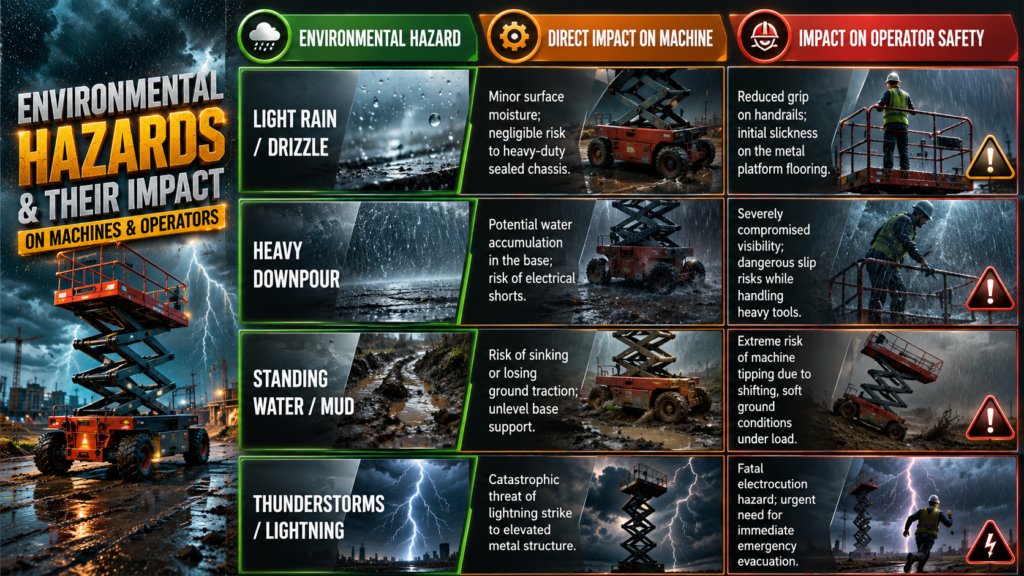
Look at that chart to see the immediate risks involved:
| Environmental Hazard | Direct Impact on Machine | Impact on Operator Safety |
| Light Rain / Drizzle | Minor surface moisture; negligible risk to heavy-duty sealed chassis. | Reduced grip on handrails; initial slickness on the metal platform flooring. |
| Heavy Downpour | Potential water accumulation in the base; risk of electrical shorts. | Severely compromised visibility; dangerous slip risks while handling heavy tools. |
| Standing Water / Mud | Risk of sinking or losing ground traction; unlevel base support. | Extreme risk of machine tipping due to shifting, soft ground conditions under load. |
| Thunderstorms / Lightning | Catastrophic threat of lightning strike to elevated metal structure. | Fatal electrocution hazard; urgent need for immediate emergency evacuation. |
- Falling on a Wet Platform: Scissor lift floorings are made of metal plates having small raised diamonds to provide grip, but the dripping water from lightening paired with the lubricant mixing with dirt and grease that can be found at the job sites together create a very slippery surface that even a person wearing standard work boots can slip and fall if not careful during transitions.
- Slip and Brake Performance Issues: When the lift is moved from one zone to another, wet concrete or asphalt drastically lowers the coefficient of friction of the tires leading to extended stopping distances and increased chances of crashing into structural columns, pillars, or even people on the ground due to lack of control.
- Earth Collapse and Tip-Over Risks: Most of the danger of rain to a lift comes from the fact of ground level. Heavy rain changes the soil and grass and makes them a soft mud, plus the washing off of layers under the soil; thus, an outdoor lift parked on seemingly solid ground can tilt suddenly if the ground collapses under the heavy wheel load.
4. Best Practices for Outdoor Usage and Response to Unforeseen Situations
Outdoor aerial work may be an integral part of your project, so you may be faced with a situation where your outdoor aerial lift is suddenly exposed to foul weather. You need to have a set of strictly enforced procedures and learn how to respond to a rain shower background change in your planning and the way you operate. In doing so, you face only a few minutes of delay and not the costly equipment replacement.
- Immediate Platform Work: Immediate Platform Lower and Shutdown Action at the first moderate/heavy rain indication Shut the task going above and the platform will be lowered to the lowest position; if assistance is needed at this time, you should also get it. Besides lowering the lift, the other reason for doing so is to protect the scissor mechanism that is vulnerable when keeps the wind alone of the throwing the platform.
- Dry control panel: Make the operator console is the most exposed control panel on the entire lift. Covers fitted waterproof or heavy-duty plastic can be used to protect the joysticks and buttons from moisture even if you must leave a lift outdoors temporarily.
- After Rain Pre-Start Inspection: Make a thorough inspection after the scissor lift is subjected to the weather. At first, check the drier/top of the platform, and also the mud should be cleaned. Also, operators should ensure that all functions are operational and test at the ground level before the lifting of personnel back into the air.
5. Proper Storage Solutions: Protecting Your Investment from the Elements
Protecting your equipment from water damage is not something that can be done a single time or two and then considered done. Maintenance and up-keeping have to be carried out annually to prevent rust, corrosion, and water-related frailty in industrial machinery.
- Indoor climate-controlled storage is a priority: The absolute best way to protect your equipment is by storing the scissor lifts indoors in a dry and well-ventilated storage bay or warehouse. This prevents overnight condensation from forming inside the electrical enclosures and corrosion of the battery terminals. Besides, storage in a dedicated space allows for easier access by maintenance personnel and prevents damage from exposure to the elements when not in use.
- Heavy-duty weatherproof covers: When it is logistically impossible for indoor storage, then a high quality, UV-resistant, and waterproof protective cover is a must-have. Also, be sure to make it so that the covers of the machines do not flap in the wind, for that reason the straps should be strong and do not allow water to collect on the platform floor.
- Elevating the machine base: When a lift must be left in the open for a long time, do not put it directly on soil or gravel where water can collect. If there is no concrete around, one can use mud mats to prevent the machine from subsiding into mud or absorbing ground moisture.
6. Long-Term Maintenance and Water Damage Prevention
Regular maintenance including cleaning, lubrication, and waterproofing checks will help prevent costly damage due to water infiltration.
- Regular lubrication of components: Water turns the lubricant of moving parts to wastewater, to ensure your scissor lifts maintenance team frequently applying high-grade marine or industrial grease all the scissor arm pivots, steering linkages, and cylinder pins.
- Electrical terminal cleaning and inspection: Most batteries and electrical junction boxes will require their terminals to be cleaned and inspected for white, green, or rusted corrosion regularly; corroded terminals should be brushed with a wire brush and re-coated with dielectric grease. Keep batteries sealed tightly to prevent water entry and minimize corrosion risk.
- Hydraulic fluid contamination: If the hydraulic oil smells or looks milky, it means water has entered the system.” So routine hydraulic inspections should include a check of the fluid clarity and presence of water exposure.
FAQs – Can a Scissor Lift Get Wet?
Can you leave an electric scissor lift in the rain?
The short answer is no. It is not a good idea even if you think that the rain just won’t get in. Operators should beware of situations where a rapid shower can happen as they are not equipped with waterproofing coatings like houses or cars. After that, lowering the platform and covering the lift properly are the only options, if not, do not use the lift anymore until it is inspected by a professional.
Are outdoor scissor lifts waterproof?
Outdoor rough-terrain scissor lifts are heavily protected against the weather with their sealed components designed to endure a light rain; however, no one can guarantee that they are waterproof. In fact, continuous exposure to a heavy downpour will still cause damage to the exposed circuits, it will wash away the grease in the critical pivot points, and the platform surface when wet becomes highly slippery which is dangerous for workers.
What happens if water gets into a scissor lift battery?
In the case that water enters the main circuits or the terminals of the battery on an electric lift, corrosion will be the first thing to happen, with time the battery will self-discharge rapidly and it is also very risky in terms of short circuiting and consequences. Other than that, the acids in internal batteries can be mixed with the rainwater and this causes the casing to get damaged as well as a destruction of the battery’s ability to hold a charge.
Can a scissor lift tip over on wet grass or mud?
Actually, yes, if you don’t pay attention and leave your heavy lift working on wet grass or muddy ground, you are literally inviting a tip-over accident that can be fatal. The very high and concentrated weight of the machine will most likely cause tires to be submerged non-uniformly into the soft earth and this will destabilize the base and lead to an eventual loss of balance of the elevated platform.
Is it legal according to OSHA to operate an aerial lift in heavy rain?
Although there is no single and very specific clause by OSHA that explicitly bans operating an aerial platform in the rain, in general, OSHA’s provisions for an acceptable working environment which is safe and healthy for employees do include the fact that using an aerial platform in bad weather should not be allowed especially if it can be seen as a risk to employee’s safety. In fact, it is prohibited to work with aerial platforms during high winds, lightning, or when the visibility of the operator or platform footing is compromised by the weather condition.
How do you dry out a water-damaged scissor lift?
If you find the scissor lift completely soaked, take it to a dry indoor covered place as soon as you can, disconnect the main power source, and open all the doors of the side components. Remove any standing water with clean towels, dampen wires with electrical contact cleaner, and the last step is to air dry the unit completely before trying any functions.
How can I protect my outdoor scissor lift from rust?
You will have to remove any hardened mud from time to time, paint metal parts exposed to the environment with a rust inhibitor, keep grease on all pivot points, and have fitted weatherproof tarps ready for cover whenever machines are left outdoors overnight to avoid rust and oxidation to a most extreme degree.