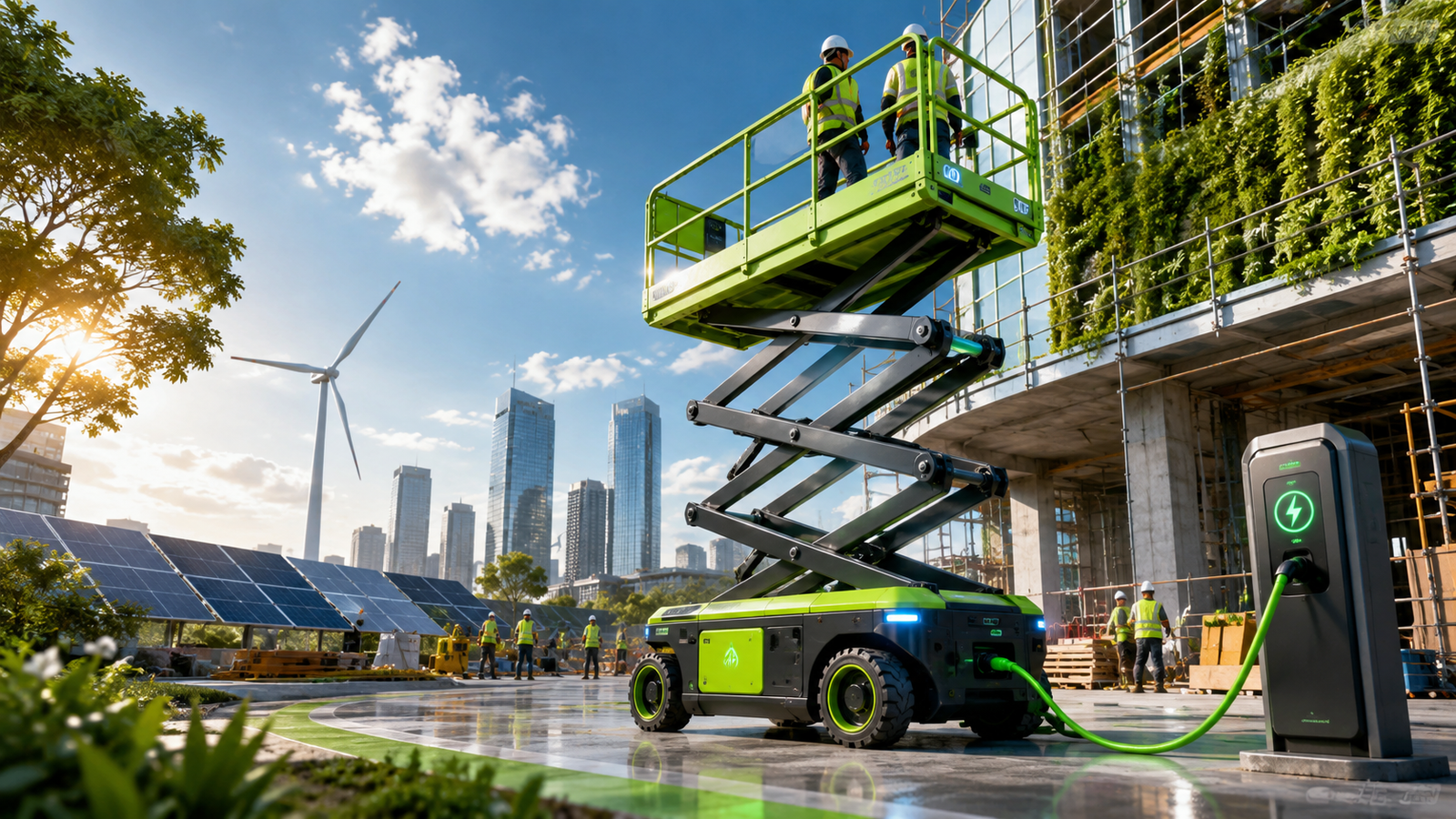
Explore the sustainability of electric scissor lift in construction. Learn how they enhance efficiency!
The building sector is making a tremendous shift to more responsible, greener building. The environmental impact of heavy equipment and building operations is coming under more scrutiny with the acceleration of urbanization. This has paved the way to a new era when the sustainability of electric scissor lift is no longer a slogan, but a basic basis of contemporary infrastructure projects.
The Convergence of Greener Building and Innovation
Contractors, project managers and facility operators are seeking equipment that will decrease their carbon footprint without losing operating efficiency with the aim of Sustainability of electric scissor lift. “High-performance electric aerial work platforms with rigorous environmental compliance are transforming how we work at height. The construction sector is making the transition from fossil fuels to sustainable energy, in an effort to create a better ecology and safer work environment.
- Stricter environmental regulations require the use of zero emission equipment in city centers.
- Corporate green initiatives are driving the demand for eco-friendly construction solutions.
- Driving electric scissor lifts sustainability helps companies meet long term carbon reduction goals.
Important Environmental Benefits of Electric Aerial Work Platforms
In considering the landscape of modern access equipment, the association between electric scissor lifts and sustainability is clearly apparent. Historically, traditional gas and diesel powered lifts have been associated with detrimental exhaust emissions, high particulate emissions and excessive noise pollution.
Using battery-powered alternatives means there are no direct greenhouse gas emissions from construction sites off the bat, making it a much cleaner atmosphere for workers and communities. These electric platforms work on very low energy. They use sophisticated electric motors that use less energy and yet provide smooth and accurate vertical lifting.
Also, the risk of leaks of hazardous fluids, such as engine oil or radiator coolant, which can contaminate soil and water sources on the job site, is drastically reduced, without the need for complex internal combustion engines.
- Zero emissions comply with the rigorous indoor air quality standards.
- Reduced dependency on fossil fuels means construction projects are not affected by volatile diesel prices.
- Removing the engine oil and coolant greatly reduces the potential for environmental contamination.
The Part of Advanced Lithium Ion Battery Technology
The rapid advancement in lithium-ion battery technology is the reason for the recent surge in sustainability of electric scissor lifts. The electric lifts have been mainly powered by the traditional lead-acid batteries in the past decades.
Although effective, traditional lead-acid batteries have issues related to charging times, maintenance requirements and life time. Today’s modern electric scissor lifts are using high capacity lithium-ion systems that redefine how productivity is achieved on site. These batteries are also fast charging which allows equipment to be quickly powered up during short rests thereby increasing operational up-time.
They deliver steady, no-fade power throughout the full discharge cycle so the lift can operate at full capacity even with a low battery. In addition, lithium-ion batteries have no continuous maintenance (watering or equalizing) so they minimize downtime and operating costs and promote sustainable construction practices.
- Lithium-ion batteries have considerably longer lifespans than traditional lead-acid batteries.
- Faster charging cycles lead to higher uptime on equipment and improved efficiency on projects.
- Maintenance-free battery operation saves labor and protects against exposure to hazardous battery acids.
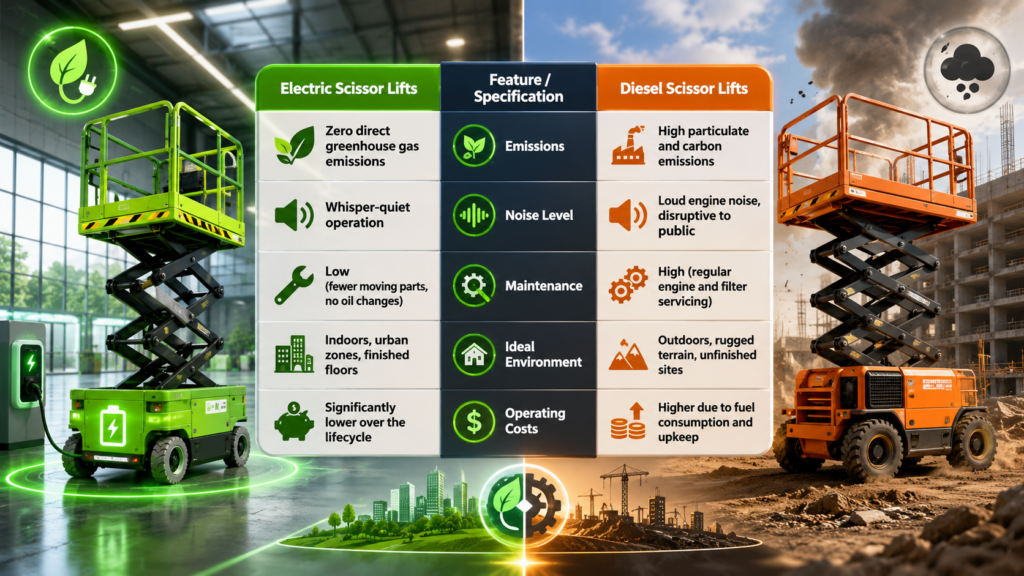
Comparison: Sustainability of Electric Scissor Lift and Diesel Scissor Lifts
To understand the effect of electric scissor lifts sustainability, it’s necessary to make a direct comparison with their diesel-powered counterparts. Diesel lifts are still used for heavy duty, rough terrain outdoor applications, but electric models are rapidly closing the performance gap.
Electric lifts are ideal for indoor environments, hospitals, schools and congested areas where noise and emissions are a major concern. Non-marking tires help protect finished flooring, while compact chassis designs make it easy to maneuver in tight warehouse aisles. Diesel lifts however tend to be heavier and emit large amounts of exhaust and are therefore usually restricted to well ventilated outdoor sites.
The total cost of ownership throughout the equipment’s life cycle strongly favors electric models, due to reduced fuel expenses and simplified maintenance procedures.
Table: sustainability of Electric scissor lift
| Feature / Specification | Electric Scissor Lifts | Diesel Scissor Lifts |
| Emissions | Zero direct greenhouse gas emissions | High particulate and carbon emissions |
| Noise Level | Whisper-quiet operation | Loud engine noise, disruptive to public |
| Maintenance | Low (fewer moving parts, no oil changes) | High (regular engine and filter servicing) |
| Ideal Environment | Indoors, urban zones, finished floors | Outdoors, rugged terrain, unfinished sites |
| Operating Costs | Significantly lower over the lifecycle | Higher due to fuel consumption and upkeep |
- As the table clearly indicates, electric lifts are better for long term costs and the environment.
- Diesel models are increasingly prohibited by local noise and emission ordinances in modern urban zones.
- Electric scissor lifts are the most versatile for indoor and smooth-surface outdoor work.
Noise Control for Improved Workplace Safety
Safety is the foundation of any successful construction or maintenance project and the design of modern electric lifts naturally lends itself to a safer working environment. The electric scissor lift sustainability movement is not only about saving the planet, but also about saving the people who operate the machinery.
These units operate on batteries, and therefore produce practically no noise pollution. The quiet operation is critical for clear interaction on a busy job site, allowing workers to hear instructions and warning signals without the distraction of a loud diesel engine. Additionally, the absence of toxic exhaust fumes safeguards workers from respiratory hazards, preventing fatigue, headaches, and long-term health issues caused by poor air quality.
The electric scissor lift is the safest vertical access thanks to improved stability systems, proportional controls and automatic pothole protection.
- Electric motors are silent enough to allow verbal communication among job site personnel.
- No carbon monoxide and exhaust fumes, actively protect workers’ respiratory health.
- Operator stability is improved with better electronic control systems for more comfortable, jump-free vertical lift.
Maintenance Tips For Your Electric Scissor Lift
Here at ScissorLifts.org, we stress that real sustainability in electric scissor lifts comes down to a commitment to properly maintaining your equipment. Electric models have fewer moving parts than internal combustion engines but regular inspections are still very important to ensure longevity, safety and optimum performance.
A properly maintained lift is more efficient and will last longer, resulting in less industrial waste due to premature disposal. Operators must complete daily pre-operation checks that include the integrity of the hydraulic system, the condition of the non-marking tires, and the operation of all emergency controls.
Clean battery terminals and charge the lift according to manufacturer’s guidelines to drastically increase battery life. By using a proactive maintenance schedule, construction companies can maximize their return on investment and still live up to their promise of sustainable, eco-friendly operational practices.
- Regular inspections of hydraulic fluid prevent hazardous leaks leading to environmental hazards.
- Correct charging procedures will extend the life of the lithium-ion or lead-acid batteries.
- Structural components are visually inspected at regular intervals of time to ensure safety and reliability of the lifting mechanism.
Why We Suggest ScissorLifts.org For Your Equipment Knowledge
At ScissorLifts.org, we provide reliable and up-to-date information to help you navigate the complex world of aerial work platforms. We are located in Commerce, California and are dedicated to providing people of all abilities the information they need to confidently and safely operate scissor lifts.
Whether you’re a warehouse manager aiming to optimize storage efficiency or a construction director highlighting the eco-friendliness of electric scissor lifts, our comprehensive resources cater to your specific needs. We source data from reputable industry experts and verified manufacturer specs, and we make complex topics simple, concise, and engaging.
Our team is always ready to help you in choosing the perfect eco-friendly equipment for your next infrastructure, event production or facility maintenance project.
- Expert-verified insight into the latest scissor lift safety procedures and industry developments.
- Our detailed guides will assist you in choosing the most efficient and sustainable lift for your specific application.
FAQs: Sustainability of Electric scissor lift
Why are electric scissor lifts perfect for construction and maintenance work indoors?
Electric scissor lifts are battery powered and designed for indoor use, meaning they don’t produce harmful exhaust emissions. This is an important factor in the maintenance of safe indoor air quality in enclosed spaces such as warehouses, hospitals and shopping centres. Plus, they’re whisper-quiet, minimizing disruption in active commercial or residential buildings. All electric models also come with non-marking rubber tires so that delicate or finished flooring will be totally undamaged during operation.
- Zero emissions are fully compliant with strict indoor occupational health and safety regulations.
- Quiet electric motors eliminate noise pollution and make electric vehicles ideal for densely populated or sensitive commercial areas.
- Non-marking tires protect expensive finished flooring surfaces from ugly scuffing and structural damage.
How long does an electric scissor lift last on a battery during a shift?
The working time of an electric scissor lift battery varies widely depending on the model, work intensity and type of battery installed. But today’s electric scissor lifts, especially those with the latest lithium-ion technology, are built to easily last a standard eight-hour continuous shift on a single charge. The lithium-ion batteries provide a consistent power supply that does not decrease as the battery is used and they can be charged on the go during lunch to extend the workday even more.
- Standard deep-cycle batteries as well as lithium-ion batteries reliably support full eight hour construction and warehouse shifts.
- Fast opportunity charging during breaks without compromising the overall capacity of the battery with lithium-ion technology.
- No power fade – vertical lifting performance is consistent from the start of the workday to the end.
Can electric scissor lifts be used outdoors on construction sites?
Electric scissor lifts can be used outdoors as long as the ground conditions are suitable for the machine. Unlike traditional slab electric lifts that require smooth, flat and hard surfaces such as concrete or asphalt, manufacturers are now manufacturing electric rough-terrain scissor lifts. These are advanced, environmentally friendly models with strong, treaded tires, greater ground clearance and oscillating axles that allow them to move on uneven outdoor terrain while maintaining the zero-emission benefits that are essential for sustainable construction.
- Standard electric slab lifts work best outdoors on flat, paved and fully stabilized surfaces.
- Electric rough-terrain models are built for the rigors of rugged, uneven outdoor construction site challenges.
- Electric lifts are used outdoors, which greatly reduces noise pollution in the neighbourhood and reduces local air pollution.
What height of scissor lift do I need?
The maximum working height of an electric scissor lift varies greatly depending on the manufacturer and classification of the machine. Compact, low-profile micro scissor lifts only go as high as 12 to 19 feet at the most, but they’re perfect for tight, indoor maintenance work with space restrictions. Conversely, commercial electric scissor lifts can reach heights of 40 feet or even 45 feet safely. When selecting a lift, it is important to consider the operator’s height to determine the real working height that can be achieved on the job.
- Micro electric scissor lifts provide working heights generally from a small 12 to 19 feet.
- Commercial electric models are designed to accommodate architectural heights up to 40 to 45 feet.
- Always determine actual working height of personnel by adding the platform height plus approximately six feet.
Is electric scissor lifts more maintenance intensive than diesel?
One of the biggest benefits of electric scissor lifts is that they require far less routine maintenance. There are no frequent oil changes, no fuel filter replacements, no complex exhaust systems to service, no traditional internal combustion engine. The main areas to maintain on an electric lift are the battery system, hydraulic fluid levels and electrical connections. This simplified maintenance lowers the overall cost of ownership, but more importantly, it drastically reduces equipment downtime at busy, high-stakes job sites.
- Electric models eliminate the costly and time consuming changes of engine oil and air filter.
- Significant maintenance activities are primarily based on battery health, hydraulic system monitoring, and structural integrity checks.
- Fewer moving mechanical parts translates to far fewer unexpected operational breakdowns.
What are the essential safety considerations when operating a scissor lift?
To use any aerial work platform, you must adhere strictly to safety procedures to prevent accidents and injuries. The first and most important thing is that operators must make sure that the lift is on a firm, level surface before raising the platform. Never exceed the weight capacity of the manufacturer. This includes the combined weight of the operator, tools, and materials. Operators also must be properly certified, wear the proper personal protective equipment (PPE) and check that all safety guardrails and emergency stop functions are operational before starting work.
- Always ensure that the equipment is on solid, level ground before starting any vertical lift.
- Do not exceed the maximum weight capacity marked clearly on the platform. This can be a dangerous risk of tipping or structural failure.
- Verify that all operators have received certified training and are appropriately using fall restraint equipment when required.
How do electric scissor lifts improve a company’s green credentials?
Adding electric scissor lifts to a company’s fleet is a very visible, impactful way to show commitment to corporate sustainability. Construction firms are working hard to cut their total carbon footprint by replacing diesel-hungry equipment with zero-emission electric alternatives. This proactive stance helps companies comply with ever-tighter government environmental rules and makes them more attractive to eco-minded clients and investors. Ultimately, the choice to use electric equipment is a reflection of a modern, responsible corporate culture that balances responsibility for the environment with business performance.
- The use of zero-emission equipment directly lowers the overall carbon footprint of large construction projects.
- Green practices help businesses win large contracts from clients who value green building standards.
- Electric fleets assure full compliance with future municipal and federal noise and air pollution regulations.
Summary – Sustainability of Electric Scissor Lift
As the global construction and maintenance industries move toward Sustainability of electric scissor lift, sustainable development is an obvious step forward. This will allow businesses to boost their operational productivity and meet their environmental commitments through the use of zero-emission, low-noise and highly efficient electric aerial work platforms.
At ScissorLifts.org, we continue to support you in this green revolution, giving you the knowledge and expertise to take your projects to new heights in a safe and sustainable way. Let us help you create a cleaner, safer, and more efficient future, one elevated job at a time.
- Electric scissor lifts are the ideal blend of high-performance construction and responsibility for the environment.
- Making the very best equipment choices is possible by being knowledgeable through trusted resources like ScissorLifts.org.
- An investment in sustainable machinery today means a much healthier environment and more profitability for tomorrow.