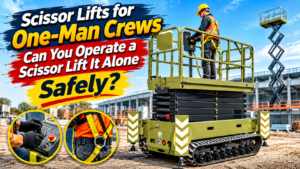
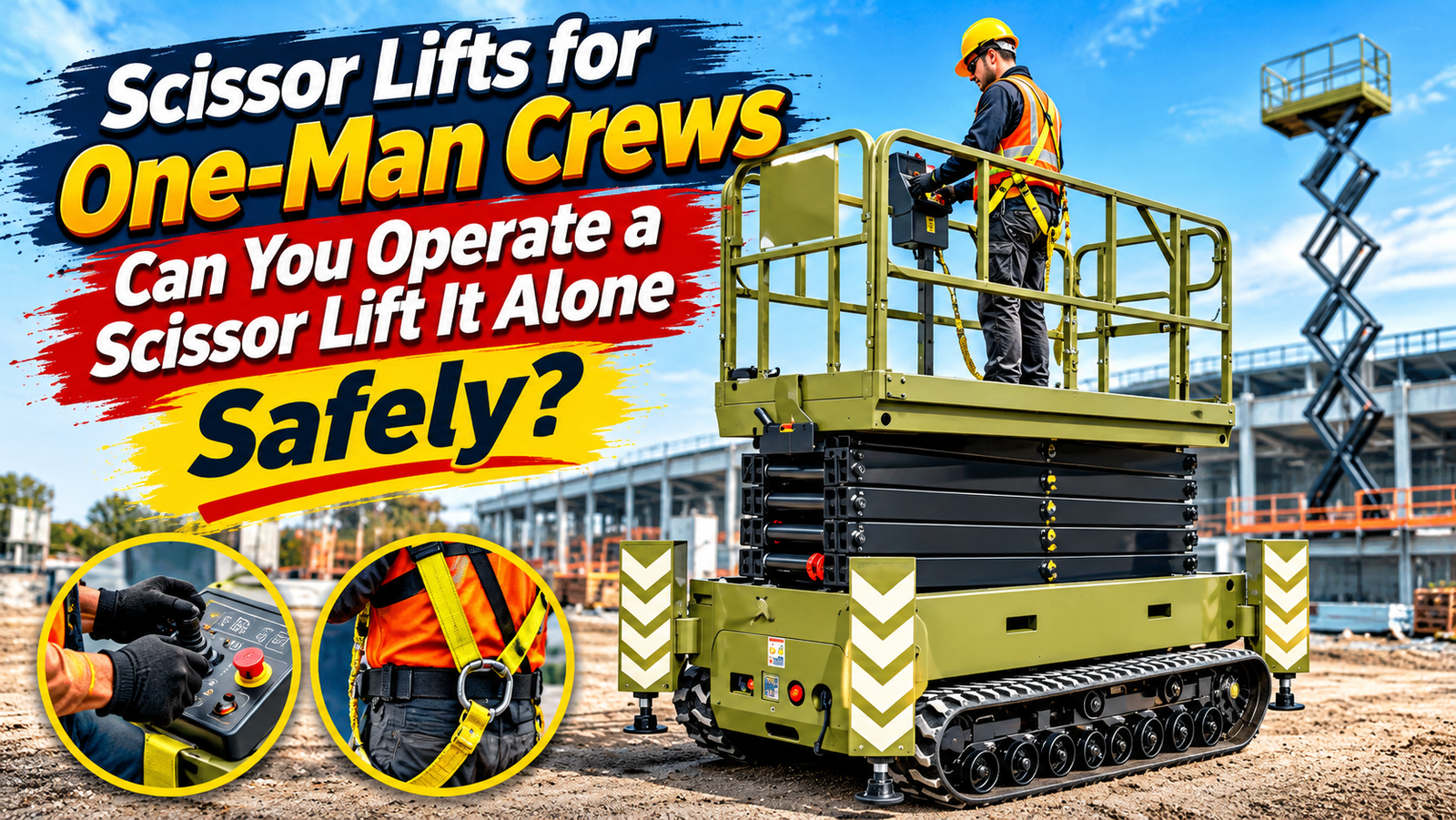
Scissor Lifts for One‑Man Crews: Can You Operate a Scissor Lift It Alone Safely?
Have you ever wondered whether you can securely operate a scissor lift on a construction site without a second person? You’re not alone. Contractors, maintenance technicians, warehouse managers, and individual tradesmen in every field ask that question. The truth is that it depends on your training, the equipment you’re using, the ground under you, the circumstances above, and your employer’s safety standards.
We can guaranty that you can operate a scissor lift alone if every safety box is checked. Skip one, and a productive day might become a catastrophe. We at ScissorLifts.org want to prevent that from happening to you or your staff.
This article covers everything you need to know about solo scissor lift operation, from OSHA regulations and certification requirements to pre-operation checklists, risk factors specific to one-man crews, the best scissor lifts for solo use, and the non-negotiable safety practices that keep solo operators safe at elevation. This tutorial is for first-time renters and experienced operators who want to refresh their skills before entering that marketplace alone.
Can One-Man Crews Operate a Scissor Lifts Safely?
Yes, most scissor lifts may be operated by one trained and qualified individual without a second crew member on the platform. You must comprehend the many requirements before soloing up since ‘legally’ has several.
OSHA regulates scissor lifts under 29 CFR 1926.451 for mobile scaffolds and 1910.29 Subpart D for general industry. Both requirements require single operators to be fully educated, authorized by their business and follow manufacturer guidance. The law may not be your largest obstacle as a one man crew, but rather your preparedness deficiencies.
Solo operation of scissor lifts to be lawful and safe must meet:
- OSHA needs proper training from a qualified person with recognized skills and extensive knowledge on the subject matter concerns. This is mandatory. Online training does not fulfilll the hands-on assessment requirement.
- You must have business approval for the particular scissor lift model. Even if qualified on another model, unauthorized people can not drive a lift.
- Make sure the scissor lift is appropriate for the terrain, weight and the work environment. Even with full accreditation, employing the wrong technology in the wrong setting may have legal and safety repercussions.
- You will do a documented pre-operation check before every shift without fail. Employers must keep records as required by OSHA.
Knowing the law is merely the first step. What is more important is how you utilize that framework each time you run a scissor lift by yourself at a building site. Scissor lifts must be recertified by OSHA after three years. When your certification expires, never believe you are safe—knowledge, habits and technology change.
Solo Scissor Lift Specific Risks
Most scissor lift operators know this painful reality but seldom mention it: operating alone at elevation is riskier than working with a companion. Having someone to contact for aid if anything goes wrong isn’t enough; eliminating every redundancy a second person naturally offers is cumulative.
Solo scissor lift operators lose the additional pair of eyes checking for above dangers, the person who can see unstable ground, the partner who observes you’re exhausted or distracted, and the team member who can react instantly if you become immobilized at height. Over a year, OSHA reported ten avoidable deaths and over twenty preventable injuries employing scissor lifts, many of which were solo operators or reduced-crew situations with delayed reaction time.
The following dangers increase greatest for one-man crews:
- Ground-level observers are necessary to detect tip-over and instability threats, such as uneven terrain or the scissor lift drifting toward a soft patch of ground that cannot hold its weight. Tip-overs are a common cause of scissor lift accidents and may happen unexpectedly.
- Medical crises at elevation – In case of abrupt medical events like heart attacks, seizures, or acute dizziness, there is no one on the platform to call for aid or conduct an emergency descent. Even a small delay in reacting may kill in this circumstance.
- Scissor lifts may cause crush zones between the platform and overhanging structures. Focused on your job, you may overlook a structural beam or pipe above you. Ground crew members often give vital clearance second opinions.
- Load miscalculation – Never exceed the rated platform capacity of a scissor lift. Working alone with your own equipment and materials on the platform makes it easy to underestimate the accumulating weight. Too much weight is unsafe and causes tip-overs.
Understanding these hazards shouldn’t deter you from solo scissor lift operation; it should raise your awareness so you can reduce them all before you leave the ground. Safe scissor lift operators are methodical, not reckless. They always approach hazards systematically, without shortcuts.
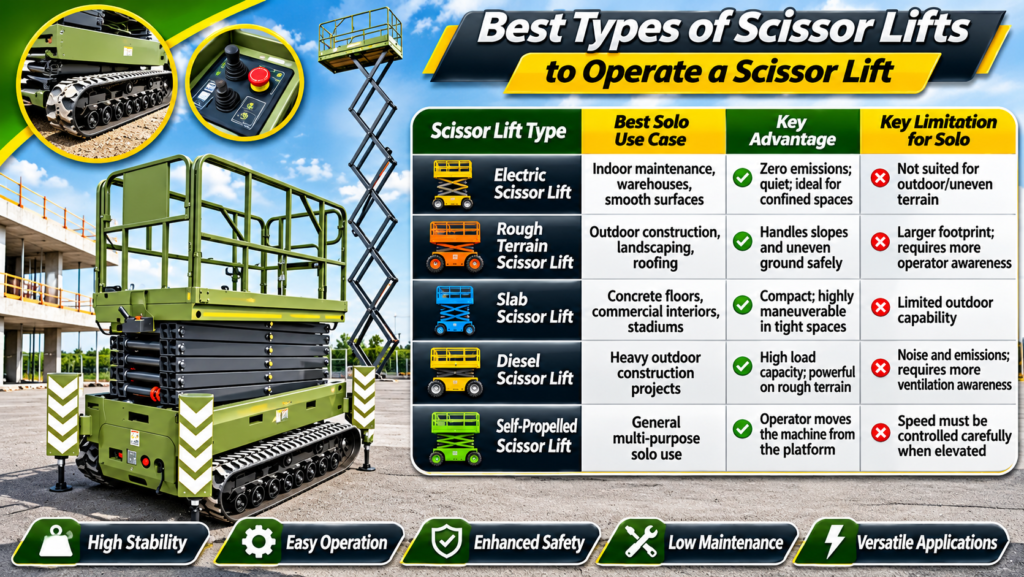
Best Types of Scissor Lifts for a one-man crew to Operate a Scissor Lift:
Not all scissor lifts are solo-operable. The correct machine may make the difference between a smooth, productive solitary working and a dangerous situation. ScissorLifts.org helps contractors, facilities managers, and solo tradesmen choose the proper scissor lift for their requirements.
Machine selection is one of the most important choices a one-man team can make. Working alone requires a machine that’s easy to use, sturdy, tailored for your load, and equipped with safety measures that compensate for the lack of a second pair of eyes.
Table: Best Types of Scissor Lifts to Operate a Scissor Lift
| Scissor Lift Type | Best Solo Use Case | Key Advantage | Key Limitation for Solo |
| Electric Scissor Lift | Indoor maintenance, warehouses, smooth surfaces | Zero emissions; quiet; ideal for confined spaces | Not suited for outdoor/uneven terrain |
| Rough Terrain Scissor Lift | Outdoor construction, landscaping, roofing | Handles slopes and uneven ground safely | Larger footprint; requires more operator awareness |
| Slab Scissor Lift | Concrete floors, commercial interiors, stadiums | Compact; highly maneuverable in tight spaces | Limited outdoor capability |
| Diesel Scissor Lift | Heavy outdoor construction projects | High load capacity; powerful on rough terrain | Noise and emissions; requires more ventilation awareness |
| Self-Propelled Scissor Lift | General multi-purpose solo use | Operator moves the machine from the platform | Speed must be controlled carefully when elevated |
An electric slab scissor lift is usually best for a one-man team conducting inside maintenance, electrical repair, or HVAC work in a warehouse or commercial complex. A rough terrain variant with a broad base and roll-out extension deck is suitable for solitary outside tasks including roofing support, exterior building repair, and construction site work. Never use an indoor electric model on hard outside surfaces—it will topple over.
Solo operator needs a pre-operation checklist:
One habit distinguishes safe solo scissor lift operators from unsafe ones: pre-operation inspection. OSHA requires a recorded pre-operation inspection before every shift. Before every shift, not every job or week.
This assessment is more important when you work alone since you are your own safety net. Before you go up, no one will notice the hydraulic fluid leak, flat tire, or broken railing lock. You must always catch it yourself.
Before taking off, solo scissor lift operators should complete this pre-operation checklist:
- Platform integrity check: Inspect platform deck, guardrails, mid-rails, toe boards, and gate latch for evident damage, corrosion, or missing hardware. Guarding system defects are instant do-not-operate. Not negotiable.
- Hydraulic system inspection: Performed hydraulic system inspection, checking fluid levels and inspecting lines, hoses, and cylinders for leaks or wear. An thorough ground-level assessment may reveal several hydraulic faults at elevation, which are disastrous.
- Tire and wheel condition: Inspect tires and wheels for correct pressure, equal tread wear, and secure lug nuts. For electric versions, verify drive wheel engagement. Worn or underinflated tires reduce stability.
- Battery or fuel level: Check battery or fuel level to provide sufficient power for the full work session. Power outage at elevation on a solitary work is a significant emergency. Start with a full tank or charge.
- Emergency descent and alarm systems: Test emergency descent and alarm systems manually from the ground control panel. All audible alarms should work. If disabled, the emergency descent mechanism may be your only route down as a single operator.
- Work zone survey: Conduct a work zone reconnaissance before ascending the lift, inspecting for overhead dangers, electrical wires, ground softness, slope, and foot traffic patterns. When feasible, use cones or barriers to mark your work area.
Document every pre-operation inspection using your operator’s handbook or employer’s standardized form. This paperwork is your legal and safety record, not menial tasks. In case of an occurrence, recorded inspections show thoroughness. If done, undocumented inspections provide little protection.
Fall Protection for Solo Scissor Lift Operators
Fall protection is the most important safety feature for scissor lift operators, especially when there is no second crew member to notice an issue before it falls. Scissor lifts include incorporated guardrails on all four sides, mid-rails, and toe boards, making them one of the safest aerial work platforms for fall protection.
All of these systems offer considerable passive fall prevention without operator intervention when intact and properly maintained. Passive protection has limitations, therefore competent solo operators take extra safeguards.
- Ensure all guardrails are erect and the platform gate is locked before rising. OSHA mandates that the guardrail system be operational at all times during elevated operation. A broken rail takes the lift out of operation until rebuilt.
- Be aware of your state’s fall arrest rules before operating. Scissor lift operators must wear harnesses and lanyards in certain jurisdictions even with undamaged guardrails. The Michigan OSHA requires fall arrest devices to have 5,000-pound attachment points. Know your local laws.
- Avoid leaning over guardrails, standing on mid-rail, or using planking or ladders to acquire height on the platform. This is one of the most frequent scissor lift falls and is prevented. If you can’t reach your job from the platform’s standing position, you need a greater lift.
- If feasible, position yourself centrally on the platform, especially at maximum height. Edge loading—concentrating weight and equipment on one side of the platform—decreases lift stability and increases fall risk.
Many experienced experts advocate wearing a personal fall arrest harness linked to a certified anchor point for single operators working at large heights, especially outdoors or in hazardous locations, regardless of legal constraints. When working alone at 20 or 30 feet with no one to call for aid, the few minutes it takes to put on a harness are worth it.
Situations That Determine Solo Operation Safety
Even the most skilled and trained scissor lift operator might meet situations that make solo operation risky, regardless of equipment quality. A good solo operator can analyze the task site environment and make an honest, impartial decision regarding whether circumstances are suitable for single-person operation. Experienced operators improve situational awareness, but everyone should consider key criteria before rising alone.
Safety for Solo Operation: Reconsider
| Factor | Safe for Solo | Reconsider Solo Operation |
| Terrain | Level, firm, paved or compacted surface | Soft soil, slope >3°, mud, gravel, uneven ground |
| Weather / Wind | Calm, clear conditions; wind below manufacturer limit | High wind, rain, ice, lightning, extreme heat |
| Overhead Hazards | Clear overhead space with generous clearance | Low ceilings, pipes, beams, power lines nearby |
| Foot Traffic | Controlled or restricted zone beneath lift | Active pedestrian or vehicle traffic below |
| Health & Alertness | Fully rested, alert, no impairing medications | Fatigued, ill, on medications affecting balance/judgment |
| Communication | Phone or radio access while elevated | No communication device; no one knows you are on site |
| Emergency Access | Ground personnel on site who can assist | Completely isolated with no one else on premises |
If your work site circumstances fall into more than one or two categories in the right column of this chart, examine whether solo scissor lift operation is acceptable for that activity on that day. When experts realize the risk calculation has changed beyond what a single operator can safely handle, they reschedule or wait for a coworker.
Solo Operators Need OSHA Scissor Lift Certification
Never operate a scissor lift alone without current certification. This is not a recommendation; federal OSHA rules mandate it and OSHA’s inspection and punishment system drastically boosted infraction penalties in early 2024.
Solo operators must complete both training and hands-on examination for scissor lift certification. Fall risks, electrical dangers, scissor lift operation, load capacity restrictions, safe operating methods, pre-use inspection standards, and emergency procedures must be included in the training.
- Qualified individuals must conduct training, as defined by OSHA as those with expert knowledge and experience in the subject area. This implies your company cannot provide you a handbook as training.
- In-person assessment is necessary, since online training cannot replace it. You must be evaluated on your competence to properly operate the scissor lift employed at your job, not a comparable one.
- Certification is model- and employer-specific. A 19-foot electric scissor lift certification does not guaranty a 32-foot rough terrain model certification at another manufacturer. You need employer approval for each machine.
- Recertification is necessary every three years, following dangerous equipment operation, accidents, near-misses, or when operating a new scissor lift type. Never assume a former employer’s expired certification counts.
- Qualified personnel must examine operators with medical issues affecting balance, coordination, depth perception, or response time before allowing solo operation. Same goes for operators using judgment- or motor-impairing drugs.
If you need certification, equipment rental firms, construction safety training groups, and employer-sponsored programs provide classes. At ScissorLifts.org, we always urge single operators be certified before touching a scissor lift’s controls.
Communication and Emergency Protocols for One-Man Crews
The lack of communication when things go wrong in solo scissor lift operating is a major danger issue. In a two-person or bigger group, communication is automatic. Someone on earth knows where you are, what you’re doing, and when you’ll descend. When you work alone, you must plan and construct your communication structure before each assignment. Not being excessively cautious—ensuring that if you are harmed, aid comes in minutes, not hours.
- Carry a charged phone or two-way radio on the platform. Before climbing, check signal and notify your emergency contact of your elevation work. Establish a 30-minute check-in period and adhere to it.
- Notify your supervisor or authorized contact before and after solo scissor lift operation. The check-in accountability loop assures that someone will notice and react if you don’t check in on time.
- Before each task, get familiar with the emergency lowering function, not simply the first time using a machine. If you become immobilized, passersby or facility workers may utilize the ground control panel to lower the platform. Maintain access to this function and the override panel.
- Ensure you have the work site address and the closest emergency services location readily available. In a scissor lift emergency, seconds count, so never look for an address while hurt or terrified.
- Display visible warning signs at all work zone access points indicating aerial work platform use. This warns other workers, tourists, and vehicle operators to your presence above and lowers the chance of moving equipment or vehicles hitting your lift.
Top solo scissor lift operators regard communication like a pre-operation inspection: a non-negotiable routine that occurs before every lift, not only on difficult assignments. Unfortunately, you don’t always know which occupations will seem unsafe from thirty feet above.
Operate a Scissor Lift – FAQs
Can you operate a scissor lift by yourself?
So if you are fully trained and competent, your employer has authorized you to operate the equipment, you execute a documented pre-operation check, and site conditions are safe, you may operate a scissor lift alone. Solo scissor lift operators are subject to all OSHA training, inspection and safety practice standards. When alone there are no backups hence all needs are more vital.
Do scissor lifts require a spotter?
OSHA does not require a scissor lift spotter, yet many firms and work places do for safety policy reasons. A ground spotter is very helpful, and often essential, when operating near overhead hazards, in areas of busy automobile or pedestrian traffic, on soft or uneven ground, or while moving the lift around a site with limited platform sightlines. If you are working alone, you should really consider if having a spotter could reduce your danger, especially if your site is sophisticated enough.
What are the OSHA regulations for operating scissor lifts?
OSHA regulates scissor lifts under 29 CFR 1926.451 (construction mobile scaffolds) and 1910.29 Subpart D (general industry). Proper training of the operator by a qualified person, pre-operation inspections documented before to each shift, manufacturer-recommended use, maintenance of guardrail systems, safe distances from overhead electrical lines, and adherence to load capacity are important. The certification has to be renewed every 3rd year. Early in 2024, OSHA raised penalty levels, making compliance more expensive for companies.
Do you require harnesses for scissor lifts?
Federal OSHA does not require a personal fall arrest harness on scissor lifts that have undamaged guardrails, since the guardrail system provides fall protection. MIOSHA in Michigan has more standards yet many businesses still need harnesses. Use outdoors or in areas where the risk of platform tip-over is increased. For single operators on the platform at heights, use of a securely secured fall arrest harness is recommended. Know your state laws.
How high do scissor lifts lift?
The operating height of a scissor lift varies a lot depending on the type. Electric interior scissor lifts are generally 19-32 feet, however certain hard terrain models may be 40 feet or more. Working height is platform height plus the assumed 6-foot standing height of the operator. Solo operators must remember that fall severity and response time to incapacitation are related to height. Always use the shortest lift to safely finish your operation and never exceed the maximum working height specified by the manufacturer.
What is the weight limit for a scissor lift?
A typical scissor lift can take 500 to 1,500 pounds, however there are high-capacity versions that can handle more. Solo operators must consider their personal weight and any tools, equipment and supplies when determining platform capacity. Overloading is a primary cause of scissor lift tip-overs and a serious OSHA violation. Check the capacity placard on the machine before loading. If you have to carry more than rated capacity, use a higher-rated equipment.
What is the duration of scissor lift certification?
OSHA certifies scissor lifts for 3 years. To remain compliant, operators must complete full recertification, which includes training and practical testing, every three years. Recertification should also be required if the operator is found to be operating the equipment in a hazardous manner, is assigned to a scissor lift they have not been trained to operate, or has had an accident or near-miss. A solo operator has no co-worker to fill up gaps in training, therefore they need to maintain their certification current.
Conclusion: Operate a Scissor Lift Safety Is Always an Individual Responsibility
Solo scissor lift operating is safe if you always prioritize safety. Professionals who had operated scissor lifts alone for years without incident weren’t lucky. They succeeded by mastering their equipment, respecting the limits of the machines and the conditions they work in, religiously maintaining their certifications, performing thorough pre-operation inspections without shortcuts, and creating communication protocols to ensure someone always knows when to rise and when to descend.
At ScissorLifts.org, we believe that accurate knowledge underpins all safe elevation decisions. We offer expert advice to contractors choosing a scissor lift for a solo maintenance job, facilities managers creating a training program for a one-person team, and solo tradespeople looking to improve their safety practices. Always reach new heights properly.
Check out the ScissorLifts.org blog for expert tips on scissor lift types, safety, maintenance, accessories and industry news. If you have questions about working alone on a job site, contact us. We’re here to help.