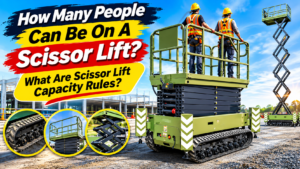
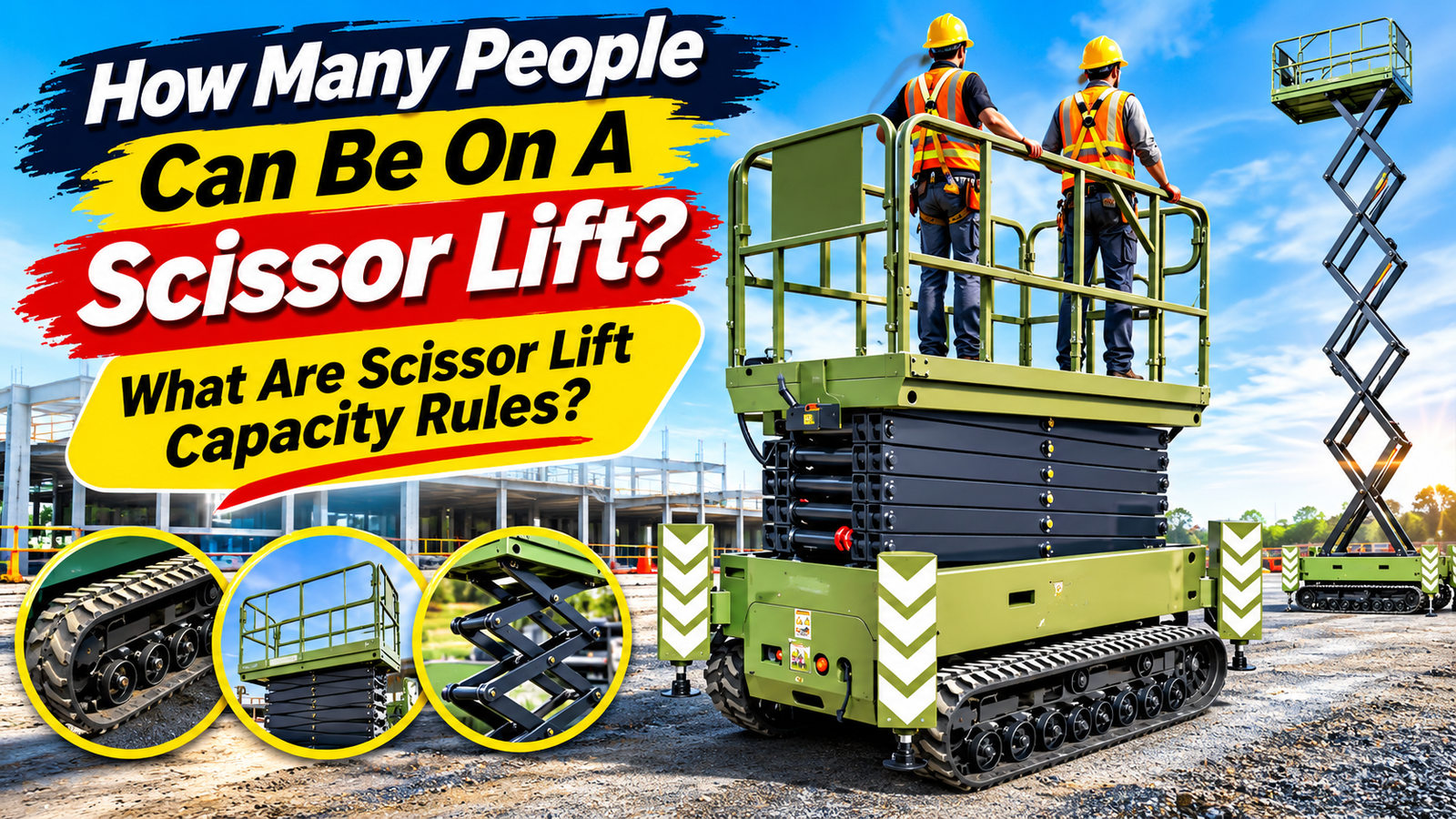
How Many People Can Be On A Scissor Lift? What Are scissor lift capacity Rules?
If you work in construction, warehousing, maintenance or event production, one of the most crucial questions you need to answer before stepping onto a scissor lift platform is: how many personnel can fit on a scissor lift? What is the scissor lift capacity?
There is no easy solution, yet one size does not suit all and getting it wrong may cost lives. The number of people authorized on a scissor lift platform will vary based on the rated capacity of the machine, platform size, kind of lift, environmental conditions, and rules imposed by OSHA and the equipment manufacturer. This book covers all you need to know about scissor lift occupancy laws, weight limitations and how to be compliant and safe on any work site.
Scissor Lift Capacity: The Essentials Every Worker Must Know
When people inquire about scissor lift capacity, they generally conceive of it as one figure – a weight restriction engraved on a plate someplace on the machine. But scissor lift capacity really includes a few criteria that all come together to decide how many people may be on the platform at any given moment safely.
The rated load capacity is the entire weight the platform is allowed to carry including all workers on board, including equipment, materials and any debris that may gather. Failure to observe this number is not only a safety infringement, it may result in automatic cutouts, the machine tipping over or catastrophic failure at height.
All scissor lifts have a data plate located in a visible location on the equipment. This plate shows the maximum weight the platform can hold, and the maximum number of people. These two values are hard requirements, not recommendations, and OSHA recognizes them as such.
- Platform weight capacity is the total weight of all people, tools, materials and equipment on the platform – this is the absolute limit.
- Maximum passenger count is determined by the manufacturer and must be adhered to, even if the combined weight is still below the rated capacity.
- Must be data plate compliant. All scissor lifts must have their capacity plate read and followed before any worker gets on the platform.
- Most scissor lifts are classified as mobile scaffolds by OSHA 29 CFR 1926.451 and 1926.452(w), hence occupancy limitations are subject to scaffold safety requirements.
How Many Workers Can Be on a Scissor Lift? The Truth
The actual answer to how many personnel may be on a scissor lift is that it relies only on the particular type and its manufacturer-rated occupancy. The platform of a scissor lift is usually 24 to 36 inches deep and 48 to 72 inches broad. They can securely transport one to four people at a time depending on the model. Most small scissor lifts accommodate two people inside.
Some larger platform commercial lifts accept up to four workers if the combined weight is within the authorized limitations. Smaller platform size and lesser weight capabilities mean that push-around micro scissor lifts are often rated for only one or two persons.
The atmosphere makes a big influence as well. Many versions that enable two people inside will drop that to one person outside owing to wind exposure and stability problems. For example, the Genie GS-1932m, a popular slab scissor lift rental, fits two people inside and one person outside. Always verify the data plate for the indoor and outdoor occupancy ratings before putting the unit into use.
- Compact/mini scissor lifts (up to 20 ft) often carry 1-2 employees with platform capabilities ranging from 500-800 lbs. Push-around types are generally restricted to one worker only.
- 20–32 ft mid-range scissor lifts typically hold 2–3 workers and capacity ranges from 700–1,200 lbs depending on platform size and model specs.
- Large-platform scissor lifts (32 ft and beyond) can hold up to 4 workers with capacities up to 1,200 to 2,500 lbs, however each additional person lowers the permitted weight for equipment and supplies.
- Outdoor vs. indoor occupancy is sometimes down to one person outside even on models certified for two or more inside, always check both values on the manufacturer’s data plate.
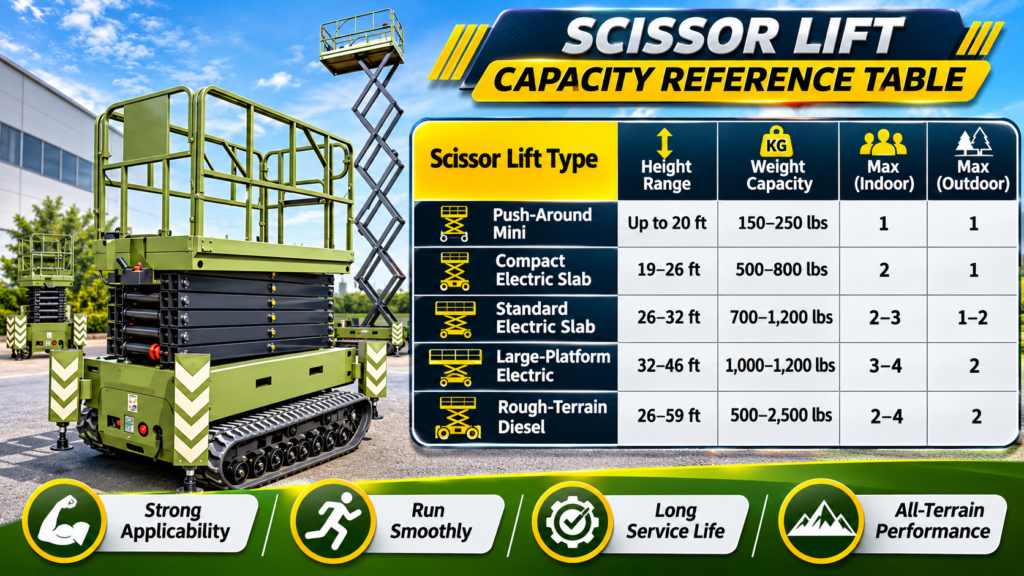
Scissor Lift Capacity Reference Table
| Scissor Lift Type | Height Range | Weight Capacity | Max (Indoor) | Max (Outdoor) |
| Push-Around Mini | Up to 20 ft | 150–250 lbs | 1 | 1 |
| Compact Electric Slab | 19–26 ft | 500–800 lbs | 2 | 1 |
| Standard Electric Slab | 26–32 ft | 700–1,200 lbs | 2–3 | 1–2 |
| Large-Platform Electric | 32–46 ft | 1,000–1,200 lbs | 3–4 | 2 |
| Rough-Terrain Diesel | 26–59 ft | 500–2,500 lbs | 2–4 | 2 |
Note: Check the manufacturer’s data plate for your individual equipment for accurate restrictions.
OSHA Scissor Lift Occupancy and Worker Safety Rules
OSHA’s scissor lift capacity method is precise, strong and legally enforceable. OSHA states that most scissor lifts are considered mobile scaffolds under 29 CFR 1926.451 and 1926.452(w), rather than aerial lifts under 1926.453. This classification places scissor lifts under the scaffolding standard, which has stringent requirements for rated capacity, training, guardrail integrity and load control.
The basic guideline is easy to remember: Always stay within the manufacturer’s rated design capacity for the number of persons or the overall weight on the platform.
OSHA rules prohibit only trained personnel to use or ride on scissor lifts. Training must be provided on the dangers associated with the operation of a scissor lift, safe operating methods as defined in 29 CFR 1926.454, and the operating and maintenance instructions of the manufacturer.
The employer must ensure that each worker on the platform has received this training and can demonstrate safe operation.
- 29 CFR 1926.451 and 1926.452(w) – OSHA’s scaffold regulation covers scissor lifts. Never exceed rated capacity for weight or number of people.
- Required worker training under 29 CFR 1926.454 – only trained personnel may operate or be on a scissor lift, and training must be recorded and verified.
- Guardrail integrity – all top rails, mid rails and toe boards must be installed, undamaged and compliant; workers must not stand on guardrails under any circumstances.
- Outdoor operation limits – OSHA advice and most manufacturer manuals suggest just one person on a scissor lift while operating outside or in gusts higher than 25 mph.
What determines how many people may ride a scissor lift?
Beyond the data plate numbers, real-world conditions on any particular construction site will dictate how many personnel may be on a scissor lift at one time safely. The first and most apparent reason is the weight of the workers themselves coupled with whatever they put on the platform.
A worker weighs 180 lbs and carries 40 lbs of tools . This is really a 220 lb burden . Put two such people on a 500-lb lift and you are already at 440 pounds, leaving just 60 lbs for supplies and equipment.
The second big element is the size of the platform. Narrow scissor lifts, generally 32 inches or less in width, simply do not provide the physical space necessary for numerous persons to work side-by-side efficiently and securely.
And even if the weight capacity would allow it, the confined space on platforms may make workers bump into each other, lose their balance or lean over the guardrails. The wider decks of the bigger versions mean two or four people may work together more effectively.
Sum up the entire weight of the workers with tools and supplies. This must not exceed the overall rated capacity of the platform. A typical error is to count just the workers and neglect their gear.
- Platform dimensions are important – narrower platforms under 32 inches wide are naturally safer with one worker no matter what the weight limit could theoretically be.
- Extension Deck Restrictions – Many scissor lifts feature a fold out extension deck with a much reduced capacity (typically just 250 lbs); this deck should be handled as a distinct, more limited load zone.
- Wind and outdoor circumstances diminish safe occupancy; most manufactures and regulatory guidelines recommends just one person on the platform while working outside or in windy conditions.
- Ground and surface conditions – Working on soft ground, slopes or uneven surfaces affects stability, thus reducing the safe working capacity even if the stated limit is not reached.
How to Choose the Right Scissor Lift Capacity for Your Team
If you want to make the appropriate selection on any job site, you have to match the scissor lift you are utilizing to the number of personnel the task truly demands. This tiny 19-foot electric scissor lift, rated for 500 lbs and with a two-person interior limit, is suitable for jobs like changing light fixtures or working on ceiling tiles with two people and minimum supplies.
But if you need to transport heavy items, tools and two workers at the same time, you need to move up to a model with a greater platform capacity — possibly a wide-platform model rated at 1,000 to 1,200 lbs with a three- or four-person occupancy rating.
- Light-duty duties (1-2 workers): For most interior maintenance, electrical, and finishing work, tiny electric scissor lifts with 500-800 lb capacity are suitable.
- Medium-duty activities (2–3 workers): Standard slab scissor lifts with 800–1,200 lb capacity effectively support teams undertaking installation, inspection or multi-step overhead work.
- Heavy-duty jobs (3-4 people): large-platform versions rated at 1,000-2,500 lbs are perfect for construction, industrial maintenance or any job needing a crew and a lot of supplies on the platform at the same time.
Table: Worker Capacity vs. Recommended Scissor Lift Capacity
| Workers | Min. Capacity | Platform Width | Suitable Lift Type |
| 1 worker | 500 lbs | 24–30 inches | Compact electric, push-around mini |
| 2 workers | 700–800 lbs | 32–46 inches | Standard slab scissor lift |
| 3 workers | 1,000–1,100 lbs | 46–60 inches | Wide-platform electric or diesel |
| 4 workers | 1,200+ lbs | 60+ inches | Large-platform commercial/rough-terrain |
What Happens When You Exceed Scissor Lift Capacity? It’s Never Worth the Risk
Every year workers are wounded or killed in scissor lift events that may be traced right back to overloading the platform. Overloading a scissor lift, whether by weight, number of passengers or both may be catastrophic and quick.
The center of gravity of the machine is moved, stability is lost and even a little imperfection of the surface or a modest movement by a worker is enough to upset the whole platform. A tip-over from 20, 30 or 40 feet is nearly invariably catastrophic for everyone on the platform. The scissor mechanism itself may also break under severe loads allowing the platform to slide downwards without warning.
⚠ CRITICAL SAFETY WARNING Don’t ever think the scissor lift is OK for “just one more person.” In one reported incident, a scissor lift rated for 500 lbs had three people plus supplies placed onto it, taking the total considerably above the stated limit. The foreman saw the trouble but went on and the platform came loose. There are capacity limitations because engineers have worked out just how much stress these devices can safely take. That equation leaves little room for hope.
- When over capacity, the danger of tip-over rises considerably — the changed center of gravity, along with any irregularity of the surface or movement of the worker might topple the machine.
- Under extreme loads, mechanical failure of the scissor mechanism might cause a rapid collapse of the platform, leaving workers little time to react.
- OSHA penalties and legal liabilities for capacity breaches may be substantial, including fines, operational shutdowns, civil litigation, and rejection of insurance claims from a single event.
- Newer scissor lifts include modern safety cuts that may prohibit them from operating if they are overloaded, while older machines do not have this feature and manual capacity checks are needed on every shift.
How to Check Scissor Lift Capacity Before Each Use
Checking your scissor lift capacity before every usage should be as easy as buckling your seat belt before driving. It just takes a moment, needs no special gear and immediately avoids the most frequent and dangerous scissor lift occurrences on construction sites across the globe.
The first step is to find the data plate, which is normally found at eye level on the platform frame or on the base of the machine. This plate indicates the maximum platform load in pounds or kilograms and the maximum number of passengers. If the plate is missing, broken or not readable, the machine should not be used until a replacement plate is received from the manufacturer or requirements are verified in writing.
- Before each usage, locate and read the data plate to determine the total weight capacity and maximum number of passengers. If the plate is missing, grind the machine until specifications can be acquired.
- Calculate the exact load weight by adding the weight of all personnel and all tools, supplies and equipment on the platform – use real values, not imprecise estimations.
- Indoor vs. outdoor occupancy rating – If the task is to be performed outdoors or in exposed circumstances, check the indoor vs. outdoor rating. Outdoor rates are sometimes lower than inside values for the same equipment.
- Inspect the work area for soft places, slopes, drains or uneven terrain that might affect stability even if the weight limitations are followed.
- If your lift is equipped with a fold-out extension platform, check the extension deck limit separately – this portion usually has its own, much lower weight restriction that has to be respected on its own.
Best Practices for Scissor Lift Safety and Managing Occupancy on the Job Site
It’s not enough to manage scissor lift occupancy properly by merely reviewing the numbers on a data plate. You need to develop a culture of discipline and responsibility on your job site where every worker knows their role in keeping the platform safe.
“Site managers and foremen need to be out there actively supervising the use of scissor lifts, not leaving it up to individual workers under production pressure to comply.” When teams are racing to meet deadlines, it might be tempting to add “just one extra person” to the platform – and that’s when accidents happen.
Training is a big part in building this culture. Workers who understand why capacity regulations exist, not simply that they exist, are considerably more likely to regularly obey them.
Scissor lift safety training has to include the physics of tip-over danger, the mechanics of how overloading affects the equipment, and genuine case studies of accidents caused by capacity breaches.
At scissorlifts.org, we provide complete safety tools to give workers and site managers the deep, practical knowledge that leads to safer daily actions.
- Assign an operator who checks capacity every time it is used. ▸This person is in charge of checking the data plate, calculating the load and that no worker walks on without being counted.
- Post occupancy limitations are visible at the bottom of the scissor lift and at the entry gate on the platform as a continual reminder for all personnel on site.
- Conduct pre-shift safety briefings that highlight the scissor lift capacity restrictions for the individual machines being utilized that day —stress that the standards are non-negotiable regardless of schedule pressure.
- Don’t attempt to cram too many workers into under-sized lifts – use high-capacity versions proactively. It’s cheaper and easier to hire or deploy the correct equipment up front than dealing with an issue.
- Document all scissor lift capacity training for each worker who operates or occupies a platform – appropriate documentation protects the firm in the case of an OSHA inspection or post-incident inquiry.
Frequently Asked Questions – Scissor Lift Capacity
How many persons can be on a scissor lift at a time?
The number of persons permitted on a scissor lift at any given time is solely dependent on the manufacturer’s rated capacity for that particular type. Indoors, most tiny scissor lifts can take 1-2 workers, standard versions can take 2-3 people, while large-platform commercial models can take up to 4 workers. Always verify the data plate for your individual equipment since this is the permissible limit of occupancy for that particular machine. Generally, outside usage decreases the allowable occupancy by one person compared to indoor limits.
How much weight can a scissor lift hold?
Each type and size of a scissor lift has a different weight capability. Narrow-platform compact variants usually have a capacity of 500–800 lbs, ordinary slab scissor lifts have a capacity of 700–1,200 lbs, and big rough-terrain or commercial models may have a capacity of 1,200–2,500 lbs. This total capacity represents the weight of all personnel, tools, materials and equipment on the platform at any one time. The capacity is given on the data plate on each machine and must be checked before each usage.
What are the OSHA regulations for scissor lift capacity?
Most scissor lifts are considered movable scaffolds under 29 CFR 1926.451 and 1926.452(w) by OSHA. The overall weight of the passengers must never exceed the rated design capacity of the manufacturer as required by OSHA standards. 29 CFR 1926.454. Only trained employees may operate or be passengers on scissors lifts. OSHA requires guardrails to be intact and workers are not to stand on guardrails. The exact number of occupants is determined by the manufacturer, but OSHA demands strict adherence to those restrictions.
How safe is it for one person to utilize a scissor lift outdoors?
Yes, most scissor lifts are designed for single-person usage outside, but you need to check the outdoor occupancy rating on the data plate of that particular equipment. Many versions that allow two persons inside, decrease the occupancy to one person outside owing to higher danger of tipping over from wind, uneven ground and other outdoor risks. The instructions of several machines specifically say that while working outside, only one person should be on the platform at any time. Do not exceed the outdoor occupancy rating under any wind or ground conditions.
What if you overload a scissor lift?
Overloading a scissor lift might cause tip-overs, structural failure of the scissor mechanism, or sudden platform collapse – all potentially disastrous at height. Newer machines generally have overload sensors that will not let the machine operate if it is overloaded. Older machines may not have this safety. Overloading is not just a physical hazard, but also exposes companies to OSHA penalties, shutdowns of operations, legal responsibility if there is an accident or death, and possible rejection of insurance claims.
Do tools and equipment add to scissor lift weight capacity?
Yes, definitely. The rated weight capacity of a scissor lift platform covers all things that will be on the platform: workers, hand tools, power tools, supplies, buckets, boxes and any debris that may collect throughout the job. This is one of the biggest capacity errors workers make – counting the people and forgetting the gear. The 180-lb worker with 50 lbs of tools and a 20-lb material load is basically a 250-lb unit.
How to know the capacity of my scissor lift?
You may find the capacity of your scissor lift on the manufacturer’s data plate, which is usually installed on the platform frame or the base of the machine where it is visible. The data plate will display the maximum platform weight capacity in pounds or kilograms, the maximum number of people (often with separate inside and outdoor ratings), and other important operating details. If the data plate is missing or unreadable, do not use the equipment. Contact the manufacturer or rental firm to receive the official specifications in writing before continuing.
The bottom line: Scissor lift capacity is a rule, not a recommendation
Knowing the number of personnel who may be on a scissor lift is one of the most important safety duties in any sector that employs aerial work platforms. The answer is always located on the machine’s data plate, dictated by OSHA scaffold standards and real world considerations like as worker weight, tool load, platform size and ambient conditions.
The regulations apply identically, no exceptions, whether you are a site manager with a huge construction team or a lone maintenance worker doing a fast ceiling repair.
At scissorlifts.org, our objective is to provide workers and managers of all levels of experience with the information they need to operate scissor lifts safely, effectively and in complete accordance with industry norms.
The scissor lift capacity standards we’ve discussed here are not bureaucratic red tape; they are the result of genuine technical calculations and, sadly, real incidents that taught the industry bitter lessons.
So take the time to examine the data plate, compute your real load and validate your outside rating if required. Never allow schedule pressure drive you onto an overloaded platform. One behavior, applied regularly, may save lives.