Unlocking Scissor Lift Rentals: Sizing Tips and Cost Realities You Need Now!
If you have ever had a crew standing around on a jobsite waiting for scaffolding to be built pipe by pipe, you already know why an aerial work platform is worth every penny. Whether you are running electrical conduit through a newly roofed tilt-wall warehouse, hanging fire suppression lines, or dealing with commercial drywall, getting a scissor lift rental lined up is usually the fastest way to get your people up to the work face safely.
But anyone who has spent time running commercial jobs knows that ordering the wrong machine turns into an expensive headache within ten minutes of the flatbed driver dropping the ramps. You end up with an electric slab unit that sinks into the dirt, or a machine with rails that will not clear a double doorway.
Making the most of your scissor lift rental comes down to knowing your numbers before you pick up the phone to call dispatch, understanding how rental yards price their fleets, and making sure the machine delivered actually matches your jobsite ground conditions.
At scissorlifts.org, we look at aerial equipment from the contractor’s perspective. It is not just about grabbing the cheapest daily rate listed on a website; it is about keeping your workers off rickety ladders, dodging frustrating freight surprises on your final invoice, and making sure you have the lifting muscle to hold two workers plus a deck full of pipe, heavy tools, and hardware without tripping an overload sensor every twenty minutes.
Why Renting a Scissor Lift Beats Tying Up Your Capital
Buying heavy equipment sounds great until you look at your yard during an off-month and see half a million dollars of steel sitting in the weeds collecting rust and weather damage. For most specialty trades, general contractors, and facility teams, locking into a scissor lift rental makes far more practical sense than sinking twenty to sixty grand of working cash into a single machine.
Unless you have continuous, back-to-back projects that keep that platform elevated every single workweek of the year, ownership costs will quietly eat your margins alive through preventive maintenance schedules, annual ANSI certifications, and replacing dried-out batteries.
- Say goodbye to surprise maintenance invoices: Rental houses have to carry the headache of mandatory 90-day servicing, annual ANSI inspections, blown hydraulic hoses, and dead battery cells. If a hydraulic line bursts at 8:00 AM on a Tuesday, you simply call the rental desk and demand a mechanic on-site or a replacement swap.
- Get the exact machine your current bid calls for: Construction jobs rarely look identical from one month to the next. Renting lets you run an ultra-narrow 19-foot electric slab lift through carpeted office hallways this week, then turn around and book a wide-deck 43-foot diesel rough-terrain lift for structural exterior framing on next month’s tilt-up project.
- Cleaner books and immediate tax write-offs: Equipment purchases sit on your balance sheet as depreciating assets that claw back capital over years, whereas a scissor lift rental counts directly as an operating expense (OpEx) tied straight to the project invoice, giving you clean tax deductions and leaving your bank credit lines open for payroll and raw building materials.
Electric Slab vs. Rough Terrain: Getting the Drive System Right
The quickest way to ruin your day on a new project is dropping an electric slab lift off the trailer onto crushed aggregate or wet topsoil. Electric slab lifts and rough-terrain rigs are two entirely different animals designed for completely different physics.
A standard indoor machine relies on small, rock-hard, non-marking rubber tires built to roll smoothly across finished, cured concrete without leaving black skid scuffs everywhere. The second those small tires hit loose dirt, mud, or uncompacted gravel, the machine drops right down to its belly pans and tilt-sensor alarms start screaming.
- Electric slab lifts for clean, indoor builds: Powered by quiet 24V or 48V battery systems, these compact lifts emit zero exhaust fumes, making them mandatory inside tight warehouses, active hospitals, schools, and enclosed commercial spaces. They roll on solid rubber tires, have narrow chassis profiles, and offer smooth proportional steering for weaving between pallet racks and tight interior framing.
- Rough-terrain workhorses for raw exterior earth: Powered by tough diesel, gas, or dual-fuel (LPG) engines, rough-terrain models come equipped with deep-lugged foam-filled tires, heavy 4WD axles, high ground clearance, and hydraulic outriggers that level the machine automatically on uneven dirt banks or slope-graded pads.
- Bi-energy and hybrid units for transitional builds: If your job involves pulling exterior cable runs before driving straight into an enclosed high-bay dock, look for hybrid or bi-energy scissor lifts. These machines let you burn diesel outdoors to cover rough ground, then flip a switch over to pure electric drive once you cross the threshold into the building.
Sizing Your Machine: Working Height vs. Platform Capacity
One of the most frequent mistakes rookie project managers make when booking a scissor lift rental is mixing up platform height and working height. If a spec sheet says a lift has a 26-foot platform height, that means the floor of the basket tops out at 26 feet off the deck.
The industry standard “working height” adds 6 feet to that number, assuming an average worker standing flat on their feet reaching overhead. If you have to hang ductwork from a 32-foot ceiling, a 26-foot lift will get you there, but if your work involves reaching into a 38-foot ceiling truss, you will find yourself dangerously short unless you step up to a 32-foot platform.
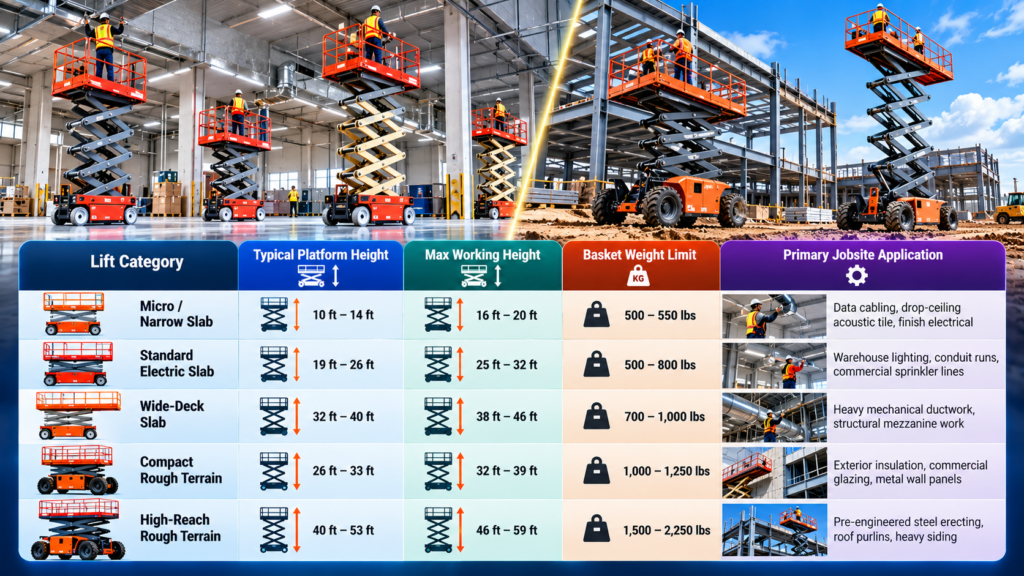
Table: Scissor Lift Rental Job Applications
| Lift Category | Typical Platform Height | Max Working Height | Basket Weight Limit | Primary Jobsite Application |
| Micro / Narrow Slab | 10 ft – 14 ft | 16 ft – 20 ft | 500 – 550 lbs | Data cabling, drop-ceiling acoustic tile, finish electrical |
| Standard Electric Slab | 19 ft – 26 ft | 25 ft – 32 ft | 500 – 800 lbs | Warehouse lighting, conduit runs, commercial sprinkler lines |
| Wide-Deck Slab | 32 ft – 40 ft | 38 ft – 46 ft | 700 – 1,000 lbs | Heavy mechanical ductwork, structural mezzanine work |
| Compact Rough Terrain | 26 ft – 33 ft | 32 ft – 39 ft | 1,000 – 1,250 lbs | Exterior insulation, commercial glazing, metal wall panels |
| High-Reach Rough Terrain | 40 ft – 53 ft | 46 ft – 59 ft | 1,500 – 2,250 lbs | Pre-engineered steel erecting, roof purlins, heavy siding |
- Do not guess your total payload weight: Always add up the weight of both workers, heavy hammer drills, extension cords, spools of wire, and steel hangers before deciding on capacity. If you exceed the basket limit, modern ANSI-compliant machines will lock out all lift functions completely until you dump the extra weight off the platform.
- Keep roll-out deck limits in mind: That slide-out extension deck is a lifesaver for reaching past permanent piping or over deep machinery, but remember that the cantilevered extension always carries a significantly lower weight limit than the center of the main platform floor.
- Double-check physical door and elevator clearances: Before ordering, pull out a tape measure and physically verify hallway choke points, overhead door headers, and freight elevator capacities. Many 19-foot and 20-foot slab units feature fold-down guardrails that allow them to squeeze through standard 32-inch commercial doorways without having to dismantle the cage.
The Real Cost Breakdown: Reading Your Rental Invoice
When you scan through quotes for a scissor lift rental, the flat daily or weekly rate on the page is rarely the total number that ends up billed to your credit card or trade account. Equipment yards have overhead, trucking expenses, and asset protection fees to cover, which means you need to look at the entire invoice structure before signing off. Knowing how the billing cycles work can save your company hundreds of dollars on a single project.
- Understanding rate tiers and contract periods: A daily rental typically runs from $100 to $200 for a standard indoor slab lift, but weekly rates usually cost only about three to three-and-a-half times the daily charge. If you think you might need the machine for four full days, booking the weekly rate is almost always cheaper and gives you a buffer for weather or jobsite delays.
- Delivery and pickup freight fees: Hauling an 8,000-pound piece of equipment requires a dedicated flatbed or rollback trailer, professional drivers, and fuel. Expect delivery freight to add $150 to $350 each way depending on your project’s distance from the dispatch yard, meaning your mobilization and demobilization costs alone will average $300 to $700 total.
- Environmental fees, fuel, and damage waivers: Rental companies routinely add a 10% to 16% physical damage waiver unless you provide a valid Certificate of Insurance (COI) listing them as an additional insured and loss payee. If you rent a diesel or gas unit, make sure your crew tops off the fuel tank before the pickup driver arrives, or you will pay steep fuel surcharges per gallon compared to pump prices.
Jobsite Safety, OSHA Compliance, and Real-World Hassles
It is easy to get complacent on a scissor lift because the platform feels as solid as a structural balcony, but gravity does not cut breaks on a jobsite. The Occupational Safety and Health Administration (OSHA) and the American National Standards Institute (ANSI) have strict rules regarding aerial work platform operation under 29 CFR 1926.451 and ANSI A92.22/A92.24 standards. Taking safety shortcuts with your scissor lift rental will bring steep OSHA fines, insurance headaches, and life-threatening fall risks straight to your door.
- Do a thorough morning walkaround every day: Before anyone flips the key switch, check the tires for cuts or embedded debris, look beneath the chassis for fresh hydraulic puddles, verify that the potholes-protection skids drop and lock properly, and test the emergency lowering valve at the base to ensure workers can be brought down if control power fails.
- Know your jobsite ground and gradient limits: Never try to drive an elevated scissor lift across floor trenches covered by thin plywood, unanchored metal plates, or loose gravel ramps. Tilt sensors are calibrated to shut down lift functions if the machine tilts past just 2 or 3 degrees, and hitting a small floor depression while moving at full elevation can create enough centrifugal momentum to tip the entire machine over.
- Harness rules and overhead hazard awareness: While OSHA allows standard guardrails as primary fall protection on scissor lifts, many site safety directors enforce a mandatory 100% tie-off policy requiring a full-body harness and a short restraint lanyard attached to the factory-certified anchor point. Always look up before you squeeze the joystick; overhead busways, bare electrical cables, and crane rails have caught far too many distracted operators off guard.
Step-by-Step Checklist Before You Call the Rental Yard
A little preparation goes a long way when coordinating equipment deliveries. If you call the dispatch desk without clear specifications, they will send whatever machine is sitting clean in the staging lane, which might not fit your job at all. Running through a quick pre-order checklist ensures you get the exact scissor lift rental you need, right when your trades are ready to start working.
- Measure your site access route from trailer to work area: Trace the exact path the machine will take from the delivery drop-off point to the work floor. Check slope angles on loading dock ramps, verify that floor load limits can support a heavy 3,000 to 12,000-pound machine, and confirm that your site has accessible 110V power outlets so your crew can plug in the onboard charger every night.
- Check that your operators hold current ANSI credentials: Handing the control joystick to an untrained sub or laborer is a massive liability. Verify that every worker who plans to step onto the lift platform has completed formal ANSI A92-compliant classroom training and a hands-on practical machine evaluation within the required regulatory timeframe.
- Document the equipment condition upon arrival: When the flatbed driver drops the ramps and unchains the lift, take three minutes to walk around the machine with your phone camera. Take clear, timestamped photos of any existing frame dents, torn control boots, scraped handrails, or worn tires, and make sure the driver notes pre-existing damage on the delivery bill of lading so your company does not get blamed for it later.
FAQs: Scissor Lift Rental
How much does a scissor lift rental cost on average?
Rental costs depend directly on the machine’s platform height, power system, and rental duration. For standard 19-foot to 26-foot electric slab lifts, prices generally run between $100 and $180 per day, $275 to $450 per week, and $650 to $1,100 per four-week monthly cycle. Larger rough-terrain scissor lifts with 33-foot to 53-foot reaches cost more to maintain and haul, typically averaging $250 to $480 per day, $600 to $1,100 per week, and $1,600 to $3,200 per month. Always remember to factor in round-trip delivery freight, state taxes, and rental damage waivers when calculating your total project budget.
Can you rent a scissor lift without a formal license or certification?
Yes, rental companies will gladly rent equipment directly to businesses, contractors, or independent homeowners without asking to see an operator license at the counter. However, federal OSHA regulations place full legal responsibility on employers to ensure that every individual operating an aerial platform on a commercial work site is properly trained and certified under ANSI A92 standards. If an accident occurs or an OSHA compliance officer visits your jobsite and discovers an uncertified operator running a rented scissor lift, your company can face substantial citations, stop-work orders, and severe liability claims.
Do you have to wear a safety harness while operating a scissor lift?
Under federal OSHA construction standards (29 CFR 1926.451), scissor lifts are categorized as mobile scaffolding rather than boom-supported aerial platforms. Because scissor lifts move strictly on a vertical plane within the footprint of their wheelbase, their certified 39-inch to 45-inch top guardrails and mid-rails serve as the primary fall protection system, meaning personal fall arrest systems (PFAS) are not federally required. However, many general contractors, industrial plant owners, and military jobsites enforce stricter rules that mandate full-body harnesses with short travel-restraint lanyards connected to the designated floor anchor point at all times.
What is the difference between working height and platform height?
Platform height measures the exact vertical distance from the floor surface up to the metal deck plate of the raised basket. Working height, on the other hand, is an industry-standard calculation that adds 6 feet to the platform height to account for the physical reach of an average worker standing upright inside the platform cage. For example, if you rent a machine with a 26-foot platform height, your crew will be able to comfortably work on equipment, lights, or conduit mounted at a 32-foot working height without having to stand on guardrails or prop themselves up on toolboxes.
Can electric scissor lifts be used outside on unpaved ground?
Electric slab scissor lifts are specifically engineered for smooth, solid, and level surfaces like finished warehouse concrete or flat asphalt pads. You should never attempt to operate an electric slab unit on unpaved exterior ground such as loose gravel, mud, bare earth, or uneven landscaping turf. Slab lifts have small, hard, non-marking tires with very low ground clearance; bringing them onto soft ground will quickly cause the drive wheels to spin out, sink into the soil, and lock up the machine’s tilt sensor. For unpaved exterior jobs, always rent a designated four-wheel-drive rough-terrain scissor lift.
How do I transport a rented scissor lift to my jobsite?
Unless you own a heavy-duty commercial truck and a high-capacity equipment trailer with rated deck tie-downs and heavy binder chains, you should never try to haul a scissor lift yourself. Even compact 19-foot electric slab lifts weigh around 3,000 pounds, while large 40-foot rough-terrain lifts easily weigh between 9,000 and 14,000 pounds due to their massive structural counterweights. Most contractors choose to have the rental yard deliver and retrieve the equipment using their own rollback trucks or tilt-bed trailers, which keeps your team focused on project execution instead of trailering logistics.