7 Trends in Scissor Lift Technology That Will Impact Construction in 2026
Welcome to the new world of aerial work platforms. As we go through the complex and challenging architectural landscape of 2026, the need for contemporary, efficient and highly safe elevating equipment is crucial. Traditional scaffolding is increasingly being superseded by high-tech robotic alternatives. Today, the productivity of the site is driven by trends in scissor lift technology, allowing workers to reach new heights while adhering to safety and environmental standards.
Whether you are managing a large commercial project, helping to build smart city infrastructure or handling complicated interior warehouse operations, recognizing these improvements in scissor lift technology is essential to maintain a competitive edge. The construction industry is changing fast and scissorlifts.org has created an in-depth guide on the 7 largest technologies disrupting the construction industry in 2026, with useful information for fleet managers, contractors and heavy equipment enthusiasts alike.
Top 7 Trends in Scissor Lift Technology That Will Impact Construction in 2026
1. Electrification & the rise of Lithium-Ion Batteries
The construction business is fast moving away from fossil fuels and complete electrification is one of the most important scissor lift technology developments for 2026. Diesel engines have long ruled the roost on heavy-duty rugged terrain, but the new generation of electric scissor lifts can match their internal combustion counterparts for sheer power and torque.
These revolutions all rely heavily on modern lithium-ion and lithium iron phosphate battery technology. These power sources are the latest technology and give far longer cycles, enabling teams to operate non-stop without the continual interruption of mid-shift recharge.
Electric lifts also do away with the dangerous exhaust emissions and work with whisper-quiet accuracy, the required level for interior jobs, city building sites with tight noise restrictions and ecologically sensitive areas. The total cost of ownership has also dropped dramatically since electric drivetrains need significantly less maintenance than sophisticated hydraulic and diesel systems.
- Zero-Emission Compliance: New electric scissor lifts are designed to fulfill the world’s most stringent environmental standards and eliminate localized carbon footprints, while enabling safe inside operation without ventilation.
- Ultra-Fast Charging Capabilities: New lithium-ion battery topologies provide ultra-fast charging capabilities, allowing exhausted loads to be charged back to 80% in a fraction of the time it takes older lead-acid batteries.
- Lower Operating Costs: These electric vehicles provide substantial long-term savings to rental fleets and contractors by removing the need for pricey diesel fuel, frequent oil changes and conventional engine maintenance.
2. Fleet Management and IoT Telematics Integration
By 2026, a scissor lift won’t simply be a piece of physical lifting gear. It will be a highly intelligent, data-gathering node linked to the wide Internet of Things (IoT). The transformation of advanced telematics from a luxury option to a vital need has utterly changed how construction managers supervise their aerial access fleets.
These intelligent control systems constantly provide real-time data to cloud dashboards, allowing total insight on equipment location, battery condition, operating hours and operator behavior. This detailed data helps project managers maximize the use of every equipment on a large construction site, ensuring that no crane is idle while another crew waits for access.
Companies also have the option of setting stringent virtual borders using geofencing that may instantly shut down the computer if it is moved beyond the approved work zone, essentially preventing theft and illegal use.
- Real-Time Data Tracking: Fleet managers may remotely monitor battery charge levels, load capacities and active run durations via a dashboard for very accurate optimization of site logistics.
- Virtual Geofencing Security: IoT-enabled lifts are digitally secured around a specified set of geographic coordinates, notifying authorities promptly and disconnecting the motor if an attempt is made to steal the equipment.
- Optimized Fleet Utilization: Telematics software may help managers identify underutilized lifts on large construction sites and deploy equipment effectively to save excessive rental costs.
3. Advanced Safety Systems & Anti-Collision Technology
Worker safety is the number one priority in the construction sector and the trends in scissor lift technology of 2026 show a huge step forward in accident avoidance. The manufacturers have very advanced smart safety suites that really intervene to keep the operator safe.
One of the most revolutionary aspects is the use of proximity sensors and anti-collision radar that continually monitor the area for overhead obstructions, nearby machines and workers. If the lift senses a possible hit, it will instantly stop moving up or down or side to side, thus there will be no catastrophic mishaps.
The load detecting technology is also very accurate, sensing the real weight on the platform quickly and shutting down the lift system if the safe operating load limit is exceeded. Such smart safety nets do not allow any human mistake and guarantee the full compliance of any occupational safety norms of the world.
- Proximity Radar and LiDAR: The latest sensors continually monitor the lift surroundings, triggering autonomous braking systems to avoid accidents with scaffolding, ceilings or other vehicles.
- Automatic Load Sensing: Advanced load cells determine the combined weight of personnel and material, automatically stopping a lift in a dangerously overloaded situation.
- Pothole Protection Systems: Active sensors that measure ground clearance trigger mechanical guards when the lift is raised and fully prevent the machine from tipping over in the event that a wheel dips into an undetected pothole.
4. Remote-Control & Automation Capability
One of the most notable trends in the construction industry in 2026 is the incorporation of automation in heavy machines. Semi-autonomous scissor lifts are emerging that can maneuver themselves across difficult work sites. These smart elevators can follow pre-set routes and even position themselves correctly for repeated operations, all without needing a human driver, using a mix of machine vision and programmable logic controllers.
Remote-control capabilities are a regular feature when working in very dangerous locations, such as chemical factories, high-voltage electrical zones or unstable demolition sites. Operators may completely operate the scissor lift, raise and lower the platform, and accurately position the equipment from a safe distance using a smartphone app or a specialized wireless controller. This keeps the crew out of harm’s path and also greatly increases operating accuracy in tight, inhospitable locations.
- Wireless Remote Operation: Operators may operate the scissor lift from the ground using Bluetooth connected devices, helping to improve safety in difficult or dangerous situations.
- Autonomous Navigation: Programmable lifts may go to a location using pre-mapped site data, which improves the efficiency of repeated material handling and installation work.
- automatic Material Positioning: The scissor lift is equipped with integrated robotic arms and automatic leveling systems to accurately position heavy items for installation without the need for operator involvement.
5. Small and Zero-Emission Designs for Urban Agility
As the world becomes more urbanized, building sites in the main metropolitan regions are getting more crowded and physically constrained. One of the most important advancements in scissor lift technology is the evolution of ultra-compact, very agile micro-scissor lifts.
The turning radii of these machines are exceptionally tiny so that they may easily cross short warehouse aisles, ordinary office doors, and busy passenger elevators without disassembling them. These little versions are rather impressive in terms of lifting capacity, due to developments in the use of lightweight, high-strength alloys.
They’re powered by completely encapsulated, zero-emission electric drivetrains, making them the ideal answer for late-stage interior finishing work, HVAC installs and retail maintenance, where conventional, clunky equipment would create catastrophic interruptions.
- Micro-Footprint Engineering: With custom-designed chassis, these lifts can easily fit through normal single entrances and into typical business elevators, boosting inside accessibility greatly.
- Zero-Degree Turning Radius: Advanced dual-wheel drive systems provide enhanced agility, enabling the lift to pivot on its own axis in narrow passageways and dense metropolitan areas.
- Non-Marking Terrain Tires: These large machines use special rubber compositions to guarantee they leave virtually no scuffs or damage on sensitive inside surfaces such as polished concrete or delicate tile.
6. Predictive maintenance AI diagnostics
Downtime is the mortal enemy of profitability in construction. In 2026, trends in scissor lift technology have transformed the maintenance landscape, moving from reactive repairs to proactive, AI-driven predictive maintenance.
Today’s scissor lifts include solid-state control boards and hundreds of micro-sensors that continuously monitor structural integrity, hydraulic pressure, battery deterioration and motor temperature. Artificial intelligence systems examine this constant stream of data and precisely anticipate exactly when a certain component is going to break.
Maintenance teams now get automatic notifications weeks in advance instead of waiting for a breakdown to stop work on a major project, enabling them to arrange part replacements during scheduled off-hours. This unique method to equipment maintenance increases the life of the scissor lift, substantially cuts down on expensive emergency service visits and ensures optimum up-time.
- AI-Based Component Tracking: Smart algorithms track wear-and-tear patterns on crucial moving parts and predict precise dates for failure before they influence production on site.
- Automated Service Alerts: Fleet management software automatically sends diagnostic fault codes to technicians, ensuring that replacement parts are ordered well in advance of a mechanical failure.
- Extended Equipment Life: Predictive maintenance identifies small friction or voltage variations early, avoiding total breakdown and enabling the equipment to operate for many more years without problems.
7. Variable Tilt Technology & Enhanced Stability
Traditionally, scissor lifts have been confined to use on absolutely flat, level ground, thus limiting their usefulness in rough, unimproved outdoor building sites. This constraint has been entirely destroyed with the launch of Variable Tilt Technology in 2026, one of the biggest technical advances in the industry.
These complex technologies with upgrading Uncover the trends in scissor lift technology constantly measure the angle of the machine relative to the ground, using sophisticated gyroscopes and inclinometers. When the lift is installed on an uneven slope, the onboard computer dynamically determines the maximum safe lifting height according to the actual load and the angle of inclination.
Self-leveling hydraulic outriggers may also deploy automatically and make micro-adjustments to provide a perfectly level foundation, even in mud, gravel, or on extremely inclined terrain. This invention gives workers total confidence and stability in the most demanding outdoor settings.
- Dynamic Slope Compensation: The lift’s onboard computer immediately assesses load weights vs inclination angles, securely permitting elevated work on slopes up to three or four degrees.
- Auto-Leveling Outriggers: Smart-sensing hydraulic stabilizers automatically extend to counteract uneven ground, delivering a rock-solid, perfectly level platform in seconds.
- Active Chassis Oscillation: Advanced suspension systems enable the wheels to move independently over deep ruts and rocky terrain, keeping the main chassis in place when traveling over tough task sites.
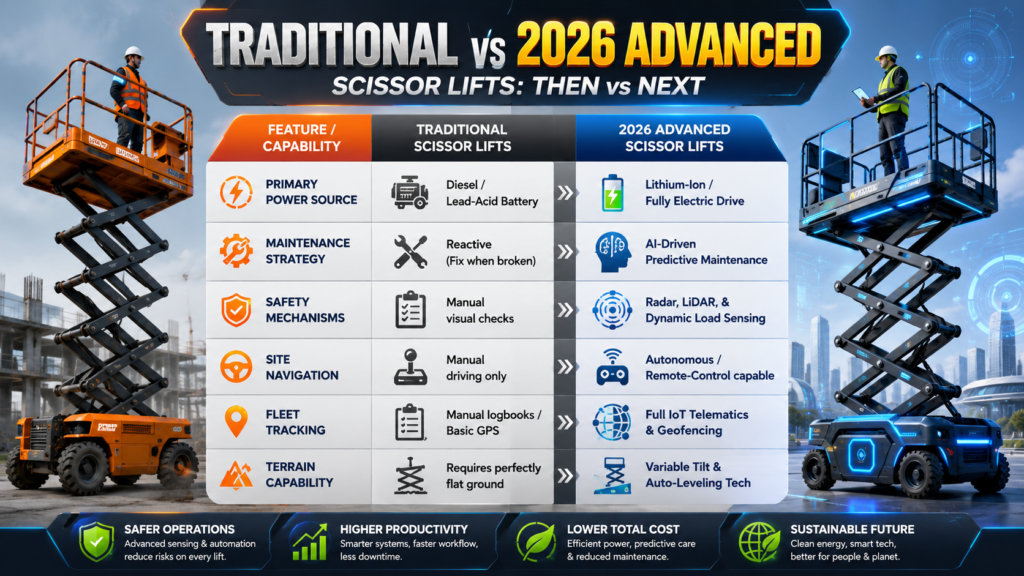
Classic Vs. 2026 Scissor Lifts A Tabular Comparison
To understand the scope of these trends in scissor lift technology, we may examine the current 2026 models vs previous aerial platforms:
| Feature/Capability | Traditional Scissor Lifts | 2026 Advanced Scissor Lifts |
| Primary Power Source | Diesel / Lead-Acid Battery | Lithium-Ion / Fully Electric Drive |
| Maintenance Strategy | Reactive (Fix when broken) | AI-Driven Predictive Maintenance |
| Safety Mechanisms | Manual visual checks | Radar, LiDAR, & Dynamic Load Sensing |
| Site Navigation | Manual driving only | Autonomous / Remote-Control capable |
| Fleet Tracking | Manual logbooks / Basic GPS | Full IoT Telematics & Geofencing |
| Terrain Capability | Requires perfectly flat ground | Variable Tilt & Auto-Leveling Tech |
FAQs – Trends in Scissor Lift Technology
What is the newest technology in scissor lifts?
The latest innovations include complete IoT telematics and remote tracking, AI-based predictive maintenance, lithium-ion battery integration for quicker charging and enhanced anti-collision radar. Modern lifts also have Variable Tilt Technology, which enables them to function safely on uneven slopes.
how long do scissor lift batteries last on a charge?
Scissor lifts are powered by sophisticated lithium-ion or lithium iron phosphate batteries that can operate continuously for 8 to 10 hours. Also, these batteries are quick charging and the batteries may be charged up to 80% in a fraction of time as compared to the conventional lead-acid systems.
Are electric scissor lifts more efficient than diesel?
Yes, for most current apps. Electric scissor lifts have no emissions, are silent, need much less maintenance, and have equivalent or better torque than diesel scissor lifts. These are required for interior usage and are quite popular in urban building sites where environmental rules are severe.
What safety characteristics do contemporary scissor lifts need to have?
2026 incorporates advanced safety systems like dynamic load-sensing systems to avoid overloading, automated pothole prevention devices, and proximity sensors to prevent collisions with above obstructions or persons.
How to control a scissor lift remotely?
Yes, one of the big technical advancements is the introduction of Bluetooth and wireless remote control. This allows operators to operate, steer and raise the machine off the ground, an important function in confined places or dangerous settings.
What is Variable Tilt Technology in aerial lifts?
Variable Tilt Technology employs gyroscopes to measure the angle of the machine. It enables the operator to securely lift the platform on modest slopes (up to 3 degrees in most cases) by dynamically determining the maximum safe height depending on the load and slope angle.
Why is telematics vital for scissor lift fleets?
Telematics solutions link the lift to the internet and enable fleet management to monitor location, battery health and operating hours in real-time. This data increases equipment usage, eliminates theft via geofencing, and decreases downtime significantly by notifying technicians before parts break.
Conclusion – Trends in Scissor Lift Technology
The construction business is changing rapidly and to remain ahead of the game, you need to be using the most efficient, safe and high-tech equipment on offer. The 2026 trends in scissor lift technology – AI diagnostics, lithium-ion power, remote operation, and improved telemetry – are not just fleeting fads, they are the new industry norms.
Construction organizations will be able to reach better production levels, substantially cut down overhead costs and provide an unrivalled level of safety for workers by adopting these advances. To know more, keep reading us at scissorlifts.org for in-depth discussions on aerial work platforms and the greatest equipment reviews.