Why Aerospace and Warehousing Are Switching to Specialized Scissor Lifts
The industrial environment is evolving swiftly and the aerospace and warehousing industries are at the forefront of implementing specialized machinery. A major evolution has been the change from using multipurpose aerial platforms to specialized scissor lifts.
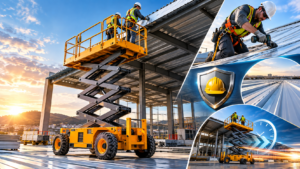
These highly engineered piece of equipment no longer merely serve as “elevated platforms”, but are fundamental tools manufactured to face the specific needs of high-end production and densely packed storages. Whether it is the flawless assembling of a plane’s parts or the long narrow aisles of today’s distribution centers, these specialized scissor lifts are becoming the fundamental pillars of operational effectiveness and employee safety.
The Strategic Shift in Aerospace Maintenance and Assembly
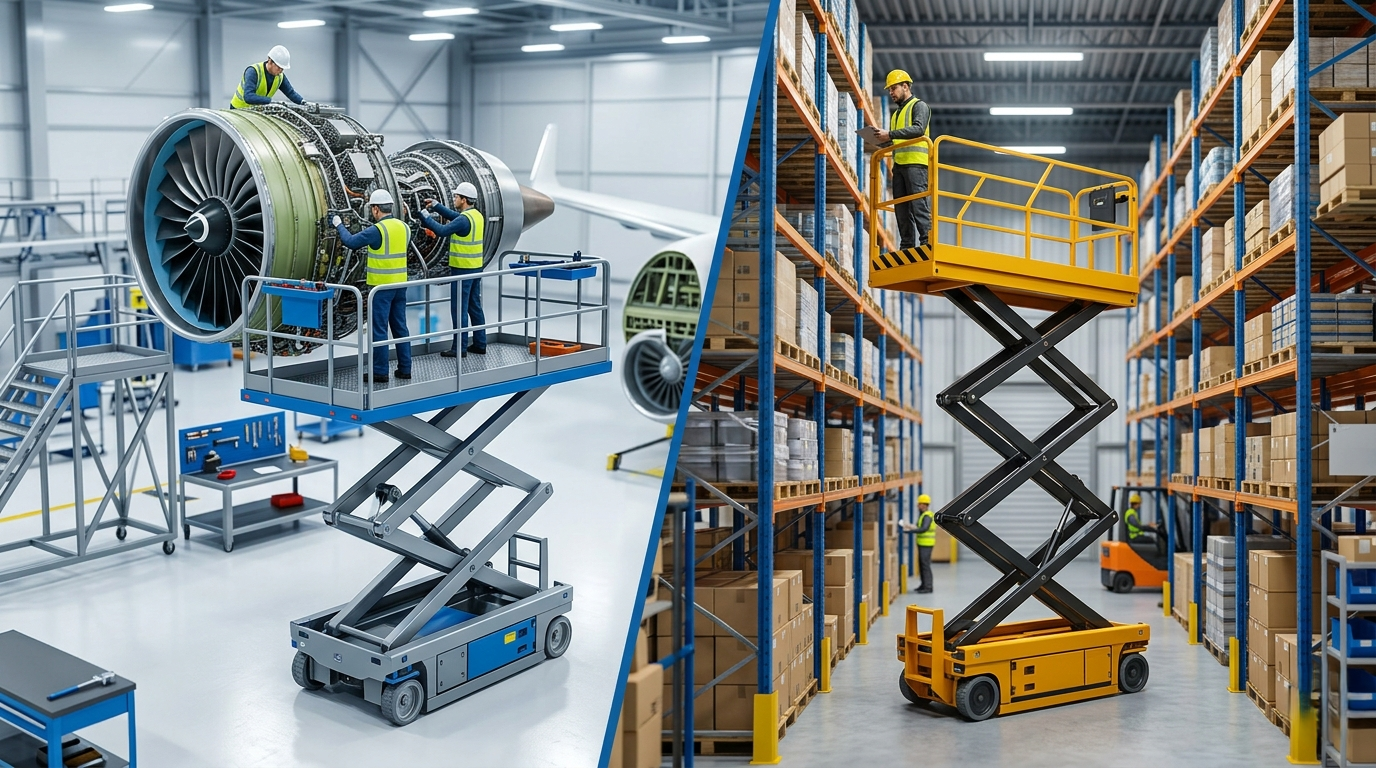
In the aerospace sector, the tiniest mistake can have fatal consequences. Maintenance, Repair, and Overhaul (MRO) tasks force the ones performing them to reach very accurately the complex shapes of aircraft’s fuselages and wings.
Therefore, specialized scissor lifts for aerospace incorporate features such as non-marking tires, hard protectors on guardrails to prevent accidental damage, and large platforms that permit several technicians to work simultaneously.
- Precision Positioning: These specialized aerospace lifts allow operators to come extremely close to the delicate aircraft skin without the fear of collision because they have a micro-adjustment control which is absent in usual models.
- Large Platform Capacities: Since tasks in the aerospace sector usually entail the use of heavy tools and personnel counting up to more than one; thus, specialized lifts offer the required spaciousness as well as weight-bearing capacity to safely manage such heavy loads.
- Contamination Control: Many aerospace plants maintain “clean environments” where being careless with hydraulic leaks can be disastrous. By switching to electric and “clean-leak” hydraulic systems, these plants are ensuring that the production of aircraft components is not compromised.
Revolutionizing Warehousing with High-Reach and Narrow-Aisle Solutions
With the continuous growth of e-commerce, warehouses are now extending upwards instead of outwards. This “sky-high” storage method calls for equipment that, apart from maneuvering in extremely tight spots, can also reach heights that were until now only achieved using huge, unwieldy machinery.
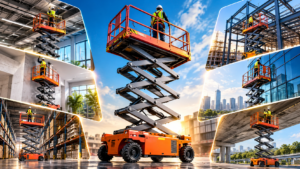
Specialized scissor lifts, especially the micro and slim-chassis varieties, have been adopted as the preferred tools by facility managers.
- Maximizing Vertical Space: State-of-the-art specialized lifts are capable of heights that even exceed 40 feet thereby enabling warehouses to make use of the up-to-the-ceiling space for storing inventories.
- Zero-Turn Maneuverability: In fact, most specialized lifts are now equipped with a zero-inside turning radius, which factor makes them an excellent choice when it comes to maneuvering the “Very Narrow Aisles” (VNA) typical in modern distribution hubs.
- Increased Battery Uptime: These lifts that have Lithium-ion technology integrated can be worked through several shifts with “opportunity charging”, which means that they do not have downtime due to charging that is typical of lead-acid batteries.
Enhanced Safety and Ergonomics for the Modern Workforce
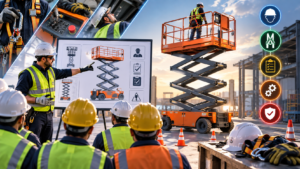
Workforce safety is the major reason why companies are investing in specialized scissor lifts. It is a fact that manual climbing, ladders, and scaffolding are the riskiest methods which contribute to falls and musculoskeletal injuries.
Besides investing in the long-term health of their workers, the adoption of specialized scissor lifts also entails reduction of insurance premiums and short periods of inactivity.
- Stable Working Platforms: They are equipped with steel pantographs that have been reinforced, and with outriggers that automatically level, so one can stand on the platform safely and sturdily without any rocking even when the platform has been fully extended to its maximum height.
- Ergonomic Height Adjustment: This feature of lifts enables the worker to perform his or her task at a comfortable waist level without having to constantly bend, stretch or adopt an awkward posture that causes fatigue.
- Integrated Safety Sensors: These state-of-the-art lifts are fitted with inscribed sensors that detect tilt, descent alarms, and overload protection that would automatically deny operation if a hazardous condition is detected.
Comparing Standard Vs Specialized Scissor Lifts
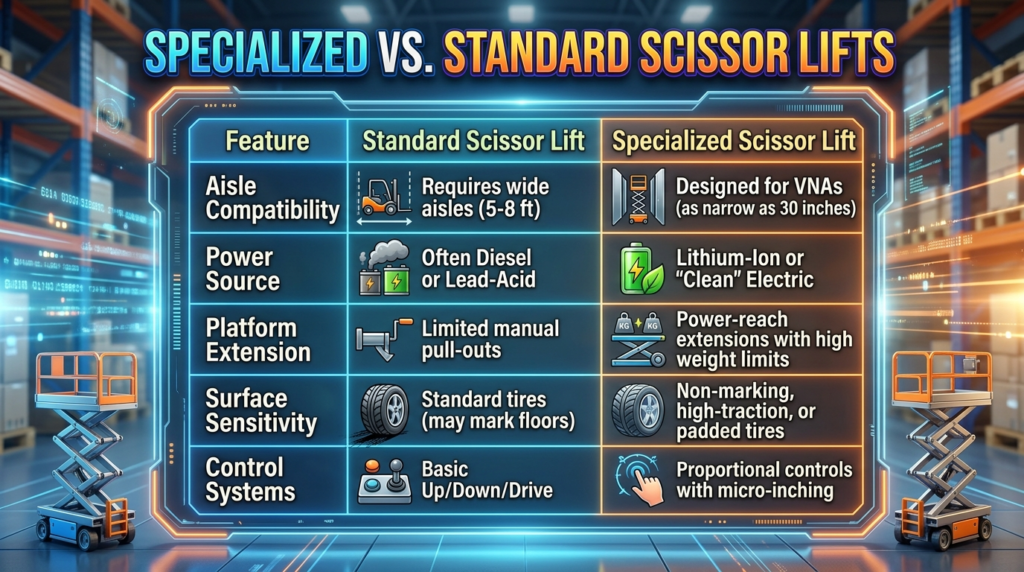
In order to more fully grasp why the industrial sectors are switching to specialized units, it is a good idea to first review the fundamental technical differences between a “one-size-fits-all” lift and a specialized unit.
| Feature | Standard Scissor Lift | Specialized Scissor Lifts |
| Aisle Compatibility | Requires wide aisles (5-8 ft) | Designed for VNAs (as narrow as 30 inches) |
| Power Source | Often Diesel or Lead-Acid | Lithium-Ion or “Clean” Electric |
| Platform Extension | Limited manual pull-outs | Power-reach extensions with high weight limits |
| Surface Sensitivity | Standard tires (may mark floors) | Non-marking, high-traction, or padded tires |
| Control Systems | Basic Up/Down/Drive | Proportional controls with micro-inching |
Economic Impact and Return on Investment (ROI)
The first cost of a specialized scissor lifts may be higher than that of a generic one, but in the long run, the ROI cannot be overlooked. These machines are manufactured for high-cycle environments, which means they are more durable and incur lower maintenance costs. Moreover, productivity increases that come from performing more work in less time with fewer people directly affect the company’s profitability.
- Lower Maintenance Costs: Electric and sophisticated hydraulic mechanisms have fewer components, and hence, they are less susceptible to the leaks and mechanical breakdowns of their cheaper counterparts.
- Reduced Labor Costs: One worker who operates a specialized lift can, in most cases, carry out the work of two or three people using ladders or scaffolding, consequent to which there is a dramatic reduction in labor man-hours per operation.
- Asset Versatility: Many specialized lifts can function as “multi-taskers” capable of performing various facility maintenance activities, conducting inventory audits, and doing heavy-duty material handling all with a single unit of equipment.
Frequently Asked Questions (FAQs) – Specialized Scissor Lifts
What differentiates a specialized scissor lifts from a standard one?
Specialized scissor lifts are designed to overcome particular environmental aspects such as extremely narrow aisles, heavy loads, or clean-room standards. Besides having advanced battery and control systems, they also have safety features that are specially suited to industries like aerospace and logistics, which are absent in standard lifts.
For what reasons is the aerospace industry moving towards using specialized lifts?
The aerospace industry is characterized by the necessity of very fine precision and “no-contact” safety provisions. Specialized lifts provide the possibility of micro-inching and are equipped with protective pads so as to prevent the damage of costly aircraft surfaces, whereas electric drives avert oil leakage in environment-sensitive hangars.
Are electric scissor lifts preferable for indoor warehouses?
Electric scissor lifts are regarded as the industry standard when it comes to indoor use because they release no emission, they work quietly and they are generally more compact. Besides, the recently fabricated lithium-ion types also give longer operating times and quicker charging compared to older battery models.
Can specialized scissor lifts be operated on sensitive floors?
Of course. Most of the specialized lifts have been built with “low floor loading” criteria and non-marking tires mainly to shield the costly epoxy or polished concrete floors which are a feature of modern warehouses and hangars.
What is the maximum height that specialized warehouse scissor lifts can reach?
The working height of a model is usually within a range, and many specialized high-reach scissor lifts can be elevated to a height of 40 to 50 feet, thus enabling operators to reach the highest sections of very dense storage racks safely.
Do specialized scissor lifts necessitate separate operator training?
In general, the basic operation is closely related to that of the normal lifts; however, specialized types which possess some advanced feature (such as outriggers or complex control interfaces) may require operators to go through familiarization training in order for them to safely and efficiently operate all safety and productivity features.
Is it more affordable to rent or buy a specialized scissor lifts?
The answer to this question largely depends on the frequency of your use. For those performing daily activities in a large warehouse or Maintenance, Repair, and Overhaul (MRO) facility, purchasing proves to be a far better long-term investment. However, for short-term jobs or specialized maintenance tasks, renting from a reputable equipment provider like scissorlifts.org would often be the cheaper option.