
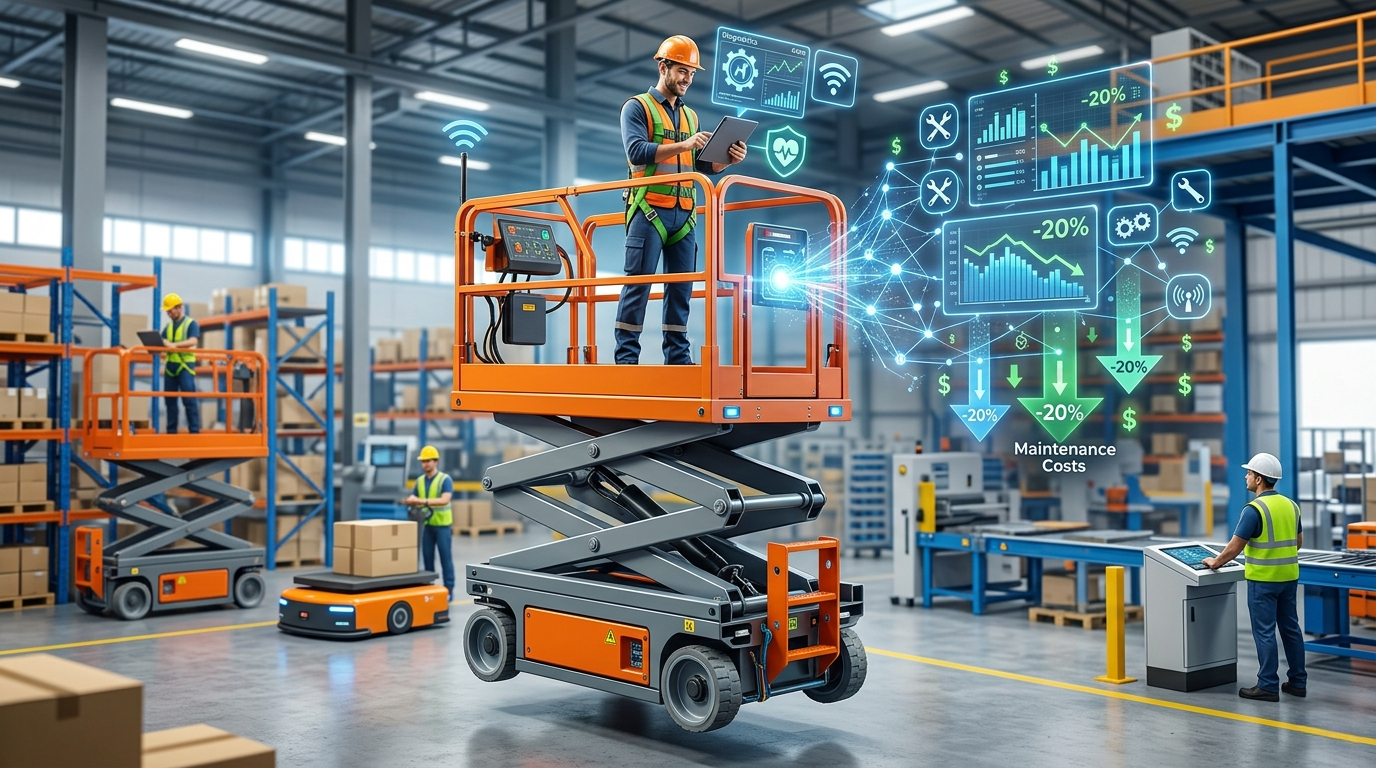
How IoT-Enabled Scissor Lifts Reduce Maintenance Costs by 20%
The integration of Internet of Things (IoT) into industrial machinery is one of the methods used by the industry to improve production and cut costs. Being among the essential equipment in different sectors for both facility managers and construction companies, scissor lifts, nevertheless, can be a big source of expenses in maintenance with the new IoT-Enabled Scissor Lifts.
Maintenance from time to time has been done based on a fixed schedule or, in the worse scenario, repairs are done after the breakdowns possibly causing halts in production. But, the new generation of IoT-enabled scissor lifts is shaking up the industry.
Through utilization of instantaneous data collection, smart sensing devices, and analysis of data on the cloud, companies are able to witness a striking drop in their spending on maintenance.
In particular, it is said that making the change to an IoT-based system can cut down the annual maintenance expenditures by 20% and even more. Not only does this change result in savings, but it also upgrades a scissor lift from being just a piece of equipment into a smart, self-sufficient unit that can communicate its needs well before they become urgent.
The Advantage of Predictive Maintenance Over Reactive Repair
The leading factor for the 20% cost saving is the change to “predictive maintenance”. The maintenance of a scissor lift was perhaps done every half year regardless of whether it was used for the shortest time or the longest within this period.
Maintenance on a regular basis sometimes results in wasted labor cost and premature changing of the parts. On the other hand, if a piece of equipment is heavily used and breaks down before it is due for maintenance, one hour of downtime of a project can be really costly
- Live Component Monitoring: Critical elements of a machine/component can be checked through the use of IoT sensors. These include variables such as temperature, vibrations, and hydraulic pressure etc. The moment a motor vibrates in an abnormal manner, a system sends a warning signal even before the motor completely fails).
- Maintaining with the Help of Data: Rather than sticking to a deadline, maintenance work is done only when records show that it is necessary. This basically means that time spent on a technician or a replacement part is only when absolutely necessary.
- Detection of Anomalies at Their Earliest: Anomalies such as a hydraulic leak or a cable that is fraying will be detected well before they become hazardous. The cost of fixing a leak is much smaller than that of replacing a broken pump or cleaning up an environmental spill on a job site.
Top 3 Benefits of IoT-Enabled Scissor Lifts
1. Extending Battery Life and Decreasing Replacement Intervals
The battery in electric scissor lifts is usually the most costly part as far as maintenance and replacement are concerned. Battery life can be significantly decreased if users neglect water levels and do not follow appropriate charging habits resulting in frequent and costly replacements.
IoT gives an extra intelligence layer dedicated solely for the management of batteries. Through “smart” supervision, an IoT system makes sure that a power source is considered as an investment for a long term rather than a consumable expense.
- Tracking Charging Cycles: IoT solutions monitor the frequency and quality of battery charges. It can also warn managers if a lift is being “short-charged” (plugged in only for 20 minutes between uses), which can cause the battery to develop “memory” problems and decreased capacity.
- Scheduling Watering: This is a major condition for lead-acid batteries. Sensors can alert the maintenance team as soon as the battery needs to be watered, preventing the plates from drying out and sustaining permanent damage.
- Detection of Voltage Irregularities: The IoT system can recognize if a single cell is underperforming in a battery. By spotting and exchanging one faulty cell in time, the entire pack can be preserved and the rest of the batteries can be kept in good condition for several years more.
2. Improving Fleet Usage and Limiting “Ghost” Maintenance
Large scale enterprises are often the most vulnerable to “ghost” maintenance paying for the maintenance of equipment that are not actually used or forgetting where units are located leading to unnecessary rentals. IoT-enabled scissor lifts offer GPS and telematics data that facilitate efficient fleet management.
When you have exact knowledge of every machine’s runtime, you can plan and even out the workload over your past, present, and even future fleets making sure that no single unit is the “workhorse” of the fleet while others are just “sitting ducks”.
- Accurate Hour Metering: IoT ensures 100% accurate hour-meter data. This helps not only in rental billing but also in ensuring that maintenance is done based on actual wear and tear rather than estimated usage.
- Geofencing and Location Tracking: Knowing where every lift is located prevents loss and theft. It also allows maintenance vans to be dispatched to the exact coordinates of a machine, reducing the “search time” for technicians on large, multi-acre construction sites.
- Engine Diagnostics and Load Sensing: For diesel-powered rough terrain lifts, IoT sensors provide deep engine diagnostics. This allows for the monitoring of fuel efficiency and prevents the engine from running in sub-optimal conditions that increase wear.
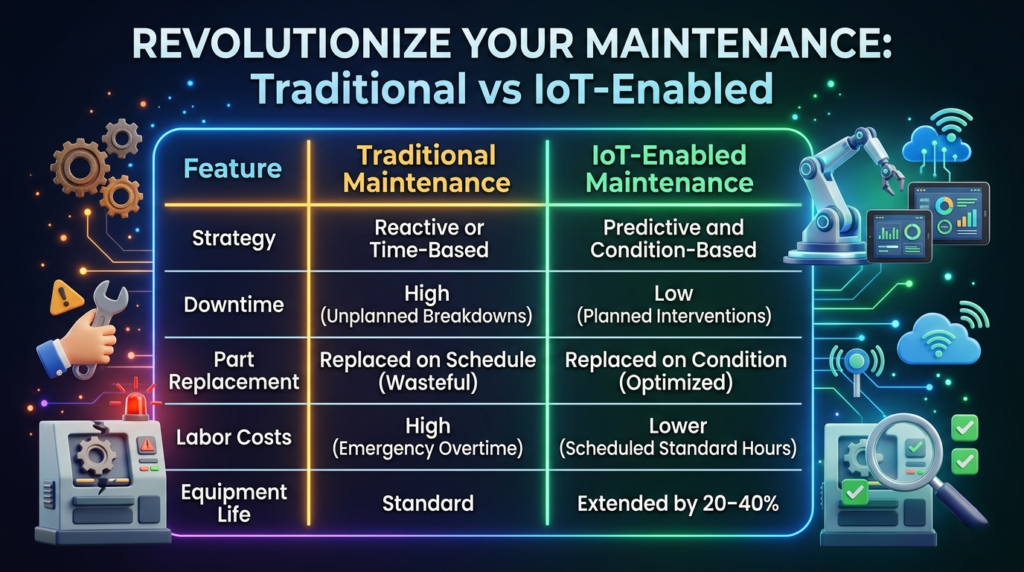
Table: IoT-Enabled Scissor Lifts Features
| Feature | Traditional Maintenance | IoT-Enabled Maintenance |
| Strategy | Reactive or Time-Based | Predictive and Condition-Based |
| Downtime | High (Unplanned Breakdowns) | Low (Planned Interventions) |
| Part Replacement | Replaced on Schedule (Wasteful) | Replaced on Condition (Optimized) |
| Labor Costs | High (Emergency Overtime) | Lower (Scheduled Standard Hours) |
| Equipment Life | Standard | Extended by 20–40% |
3. Reducing Labor Costs Through Remote Diagnostics
It is often underestimated how much a technician spends on diagnosing a problem. There may be a situation where a technician arrives at a site, spends two hours figuring out what’s wrong, and then has to leave to get the necessary parts. IoT-enabled scissor lifts offer “remote diagnostics,” which enables the technician to check the error code and machine health data prior to leaving the workshop.
- Higher First-Time Fix Rate: Since the technician is already informed of the exact fault location before reaching the site, they are able to carry the specific parts needed. As a consequence, “first-time fix” percentages have soared, and multiple visits have been minimized or eliminated altogether.
- Over-the-Air (OTA) Updates: There are times when what is perceived as a “malfunction” is in fact a program error. With IoT, it is possible to perform a remote software reset or update, thus remedying the machine issue without a technician having to go on-site.
- Less Inspection Time: Though daily inspections are still a must (required by law (OSHA/ANSI)), health reports generated by IoT can be used as a digital baseline and make the inspections faster and accurate, thus, operators can get to work faster.
FAQ: Top Trending Search Results for Scissor Lift Maintenance
How does IoT specifically save 20% on maintenance costs?
IoT leads to pay cutting by negating catastrophic failures through early warning signs and the elimination of “unnecessary” scheduled maintenance. Servicing a machine only when the data (vibration, heat, hours) dictates the necessity leads to saving both labor and parts that could have otherwise been wasted on a completely healthy machine.
Can I retrofit my old scissor lift with IoT technology?
Definitely. Nowadays, there exist quite a few third party telematics and IoT sensor kits that sem to be designed specifically for retrofitting onto older models. Although they might not be capable of offering the same deep integration as the “smart-from-the-factory” models, in any case, they can effectively track hours, location, and battery health.
What are the most common sensors used in IoT scissor lifts?
Accelerometers (to measure vibrations), thermal sensors (motors/engines), pressure transducers (hydraulics), and battery management systems (BMS) that monitor voltage and fluid levels are some of the most frequently used sensors.
Does IoT help with OSHA compliance for scissor lifts?
Yes, indeed. Every maintenance action and every hour used are digitally logged by IoT systems, which provides an ease of proving compliance during audit. Not only that, it makes it almost impossible to miss 90-day or 150-hour inspections.
How much does it cost to implement IoT on a fleet of lifts?
Although there will be an initial hardware investment and monthly subscription fee for the data platform, it is widely reported that companies realize the value of “ROI” (Return on Investment) by months 12 to 18 due to reduced repair bills and increased uptime.
Will IoT replace the need for human technicians?
IoT is just a handy tool that helps technicians do their work efficiently. It doesn’t physically perform any maintenance work, but rather provides guidance to the technician where and when to perform their work, thereby minimizing the element of guesswork involved in their job.
Is the data from IoT scissor lifts secure?
Leading manufacturers rely on encrypted cellular and cloud networks to keep machine data secure. This guarantees that proprietary operations and equipment locations are seen only by authorized personnel within one’s own company.