Monsoon-Proof Work at Height: Surviving Scissor Lifts in Rainy Conditions
Let’s be entirely real for a second—when the skies suddenly open up and the seasonal monsoons hit, the construction industry doesn’t just pack up and go home. Your clients still expect the project done on time, and deadlines honestly don’t care what the weather app says. But when you’re working 30 feet in the air, a little bit of rain changes the entire game. Safety is non-negotiable, and throwing heavy elevating equipment into the mix during a downpour introduces a terrifying set of variables with rain the best scissor lifts in rainy conditions.
Here at scissorlifts.org, we talk to site managers and operators all day, and we know the intense pressure you are under to keep things moving. However, operating Scissor Lifts in Rainy Conditions is one of the most hotly debated topics on any job site. The harsh truth? A machine that handles beautifully on dry, compacted dirt on Tuesday can become a literal death trap in the mud on Wednesday.
If you want to keep your crew safe and your machinery intact, you have to know exactly what you are up against. Let’s dive into the gritty, real-world strategies for true monsoon-proof work at height, so your team punches out and goes home safely every single night.
The Ugly Reality of Wet Weather Hazards
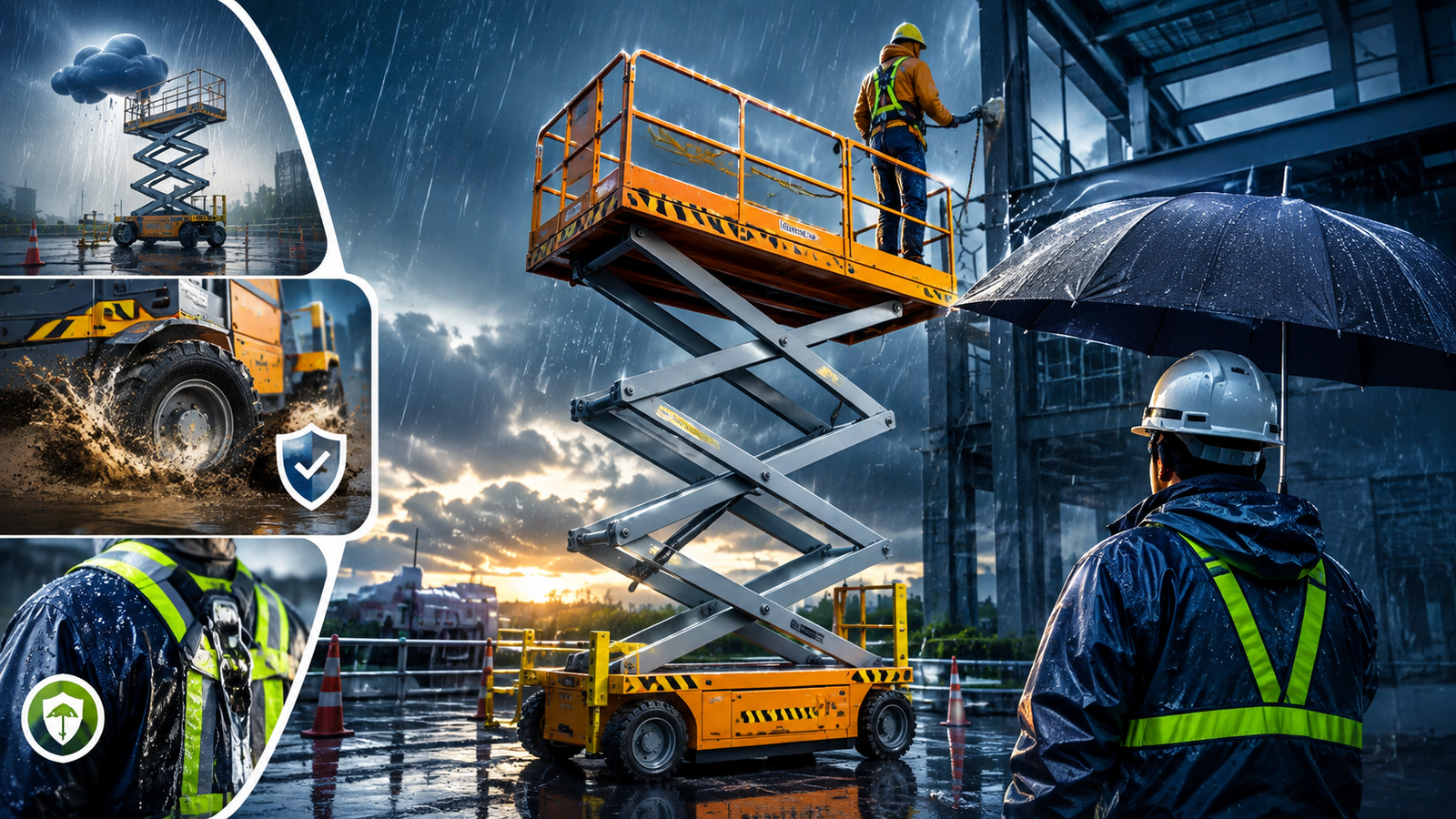
The moment water hits your job site, the physical laws governing your equipment change completely. You aren’t just dealing with the annoyance of soggy boots and fogged-up safety glasses; you are suddenly operating on a rapidly deteriorating foundation. The biggest, most deceiving danger? Ground softening. You might look at a patch of dirt and think it’s solid, but a heavy rainstorm turns compacted earth into a muddy, unstable sponge.
Think about the physics involved. When you extend a machine that weighs several tons straight up into the air, its center of gravity shifts drastically. If just one tire sinks into a soft, hidden pocket of mud, the entire lift can tilt. In the worst-case scenarios, this leads to a catastrophic tip-over. Add in the fact that your visibility is severely compromised by pounding rain and dark skies, and you have a recipe for disaster.
Furthermore, wet steel and mud-caked tires mean you have almost zero traction. Your braking distance doubles, and your steering becomes more of a suggestion than a rule. You have to respect these compounded risks if you want to pull off monsoon-proof work at height without a hitch.
- Traction vanishes instantly: Wet, muddy tires lose their grip on slopes and flat ground alike, meaning it takes way longer to stop and steering becomes incredibly sloppy.
- The ground turns to soup: Rainwater naturally pools and softens the dirt, creating invisible sinkholes that can cause a fully extended lift to violently tilt and collapse.
- Water and electricity don’t mix: If you are using non-weather-rated machines, moisture will eventually find its way into the control panel, causing short-circuits or leaving you stranded mid-air.
The “Life or Death” Pre-Operation Walkaround
If you absolutely have to operate Scissor Lifts in Rainy Conditions, your morning routine has to change. You can’t just turn the key and go. At scissorlifts.org, we always tell operators: do not just eyeball the site from the window of your pickup truck. You have to get out in the rain and physically walk the exact path you plan to drive the lift.
Look for newly formed puddles, fresh washouts, or drainage ditches that literally weren’t there yesterday. Standing water is a notorious liar—it easily hides deep ruts that will swallow a tire whole.
Next, you need to ruthlessly inspect the machine itself. The entry ladder and the platform floor must be completely scrubbed of mud, grease, and standing water. Slipping on the ground is a bruised ego; slipping on a wet steel deck 40 feet in the air is a fatality. Check those guardrails, make sure your harness anchor points are dry and secure, and empty the platform of any loose tools.
Monsoons usually bring heavy winds, and a loose wrench can quickly become a deadly projectile. Taking an extra fifteen minutes to thoroughly inspect the machine and the mud is what separates a professional crew from a reckless one.
- Walk the entire route on foot: Physically step on the ground where the lift will travel to find the soft spots, hidden trenches, and dangerous washouts before your tires do.
- Scrub the platform clean: Demand a perfectly clear deck. Wipe away mud, standing water, and grease from the steps and platform to completely kill the risk of slipping.
- Test the brakes aggressively: Before you even think about raising the basket, test your braking response on the wet terrain to see exactly how the machine is reacting to the mud.
Picking the Right Tool for a Muddy Job
Not every scissor lift belongs outdoors, and choosing the wrong one for a rainy day is the most expensive mistake a site manager can make. When we talk about scissor lifts in rainy conditions, we are really talking about the massive divide between indoor electric slab lifts and rugged, internal combustion rough terrain lifts. Electric slab lifts are amazing machines—if you are inside a dry warehouse on perfectly poured concrete.
But they have zero ground clearance, smooth tires, and electrical systems that freak out at the first sign of moisture. Dragging an electric lift into the mud is just asking for a breakdown.
Rough terrain scissor lifts, on the other hand, are absolute beasts built specifically for this kind of punishment. They rock deep-tread, heavy-duty tires that claw through the mud. They usually come equipped with self-leveling outriggers to stabilize the base on uneven, sloppy ground.
Plus, their engines (usually diesel or dual-fuel) are housed in weather-sealed compartments. A good outdoor lift also has industrial-grade anti-rust coatings. If you are serious about monsoon-proof work at height, you need to match the muscle to the mud.
- Stick to rough terrain beasts: Always demand rough terrain models with aggressive, deep-tread tires and stabilizing outriggers when working on a wet, unpaved job site.
- Keep the electrics indoors: Never force an electric slab lift into the mud or rain; you will ruin the electrical boards and get stuck instantly.
- Demand weatherproofing: Look for machines equipped with heavy electrophoretic anti-rust coatings to keep the structural steel safe from aggressive corrosion.
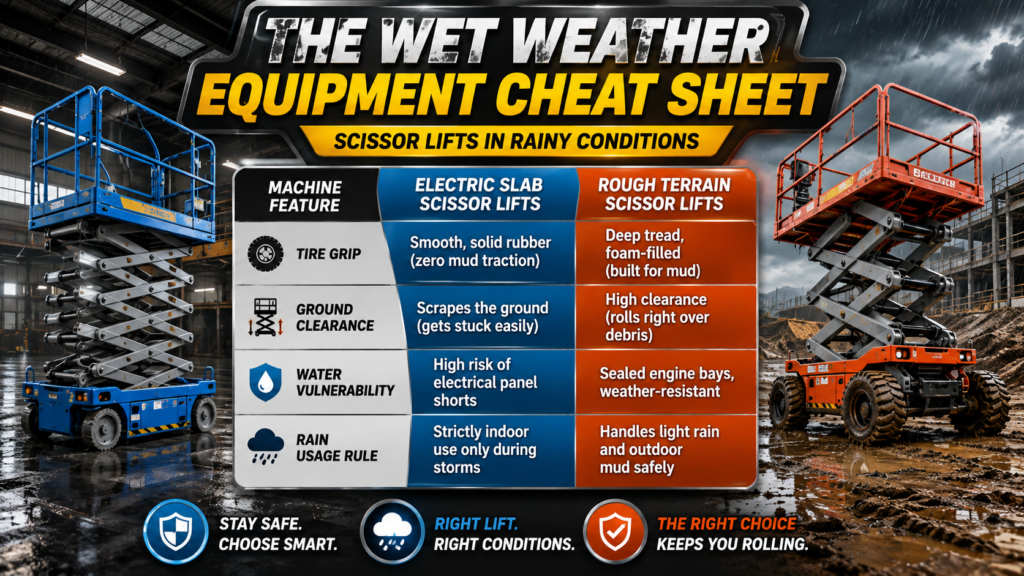
Table: The Wet Weather Equipment Cheat Sheet – Scissor Lifts in Rainy Conditions
| Machine Feature | Electric Slab Scissor Lifts | Rough Terrain Scissor Lifts |
| Tire Grip | Smooth, solid rubber (zero mud traction) | Deep tread, foam-filled (built for mud) |
| Ground Clearance | Scrapes the ground (gets stuck easily) | High clearance (rolls right over debris) |
| Water Vulnerability | High risk of electrical panel shorts | Sealed engine bays, weather-resistant |
| Rain Usage Rule | Strictly indoor use only during storms | Handles light rain and outdoor mud safely |
Staying Alive When the Rain Starts Pouring
Let’s say you have the right rough terrain lift and you’ve checked the ground. The final piece of the puzzle is the operator’s mindset. Managing Scissor Lifts in Rainy Conditions requires you to swallow your pride and slow way, way down. The golden rule for wet weather? Cut your normal operating speed in half.
Whether you are driving across the lot, booming up, or coming back down, every single movement needs to be buttery smooth. Jerking the joystick or slamming on the brakes in the mud will cause the machine to skid out, tilt, or tip right over.
You also need to become obsessed with the wind. Rain almost never shows up alone; it brings gusty, unpredictable winds. Most heavy-duty outdoor lifts have a hard-capped wind rating—usually maxing out around 28 to 30 mph. But let’s be real, you don’t want to be up there testing those limits.
The machine acts like a giant metal sail. If a squall blows in, do not try to “tough it out” just to finish tightening a few bolts. Drop the basket immediately and wait it out.
- Cut your speed in half: Move deliberately. Drive, elevate, and lower the basket at a snail’s pace to keep the center of gravity perfectly stable on the slick ground.
- Bail out when the wind howls: If the wind even gets close to the 28 mph safety threshold, drop the platform to the ground immediately. Don’t risk the sail effect.
- Gear up properly: Make sure anyone stepping into that basket is wearing high-grade, slip-resistant boots and is clipped into their anchor points before the lift moves an inch.
Don’t Let the Mud Destroy Your Investment
The hardest part of the day isn’t over just because you turned the key off. How you treat your machinery after a nasty, rainy shift dictates how long that equipment will survive. Operating scissor lifts in rainy conditions ages the machine fast. Proactive maintenance is your only defense.
Once the lift is parked, you have to get the hose out. Mud packed up inside the wheel wells, around the axles, and in the scissor arms will dry like solid concrete overnight. It will trap moisture against the steel, eat away the paint, and seize up your steering linkages. Wash it off while it’s still wet.
Storage is the next big hurdle for monsoon-proof work at height. Leaving a 50-foot lift sitting out in the pouring rain for weeks on end is a terrible idea. The UV rays ruin the hoses, and the constant water exposure rusts the joints. Whenever humanly possible, park it inside a dry warehouse especially when working with the scissor lifts in rainy conditions.
If you absolutely have to leave it outside, buy a heavy-duty, waterproof canvas tarp to cover the control panels and engine bay. Finally, get generous with the grease gun. Hitting the joints and moving metal parts with water-displacing lubricants keeps the rust at bay.
- Wash the mud off immediately: Blast away all the packed dirt and mud from the undercarriage and scissor joints before it dries into rock-hard cement.
- Cover it up or bring it inside: Always try to park the lift under a roof at night. If it stays outside, use a high-quality weatherproof tarp over the controls.
- Grease it like crazy: Aggressively apply water-displacing lubricants and grease to all the hinges, pins, and moving parts to physically block water from causing rust.
FAQs: Operating Scissor Lifts in Rainy Conditions
Can you actually use a Scissor Lifts in Rainy Conditions?
Yes, but with massive strings attached. If you have a rough terrain lift and the ground is firm and level, you can work through a light drizzle. But if the rain is heavy, lightning is flashing, or the ground is turning into soft mud, shut it down immediately.
Are electric scissor lifts waterproof?
Absolutely not. Electric lifts are meant for dry, indoor environments. Even though the paint prevents rust, the exposed control panels and sensitive electrical boards will short out easily if they get soaked. Keep them inside.
Is it okay to leave a scissor lift outside after the shift?
You can, but it’s a bad habit. Leaving them entirely exposed to heavy rain day after day rusts the metal, corrodes the electrical connections, and ruins hydraulic hoses. If it has to stay outside, throw a heavy-duty tarp over it.
What is the absolute maximum wind speed for a scissor lift?
Check your specific manual, but the industry standard maxes out at 28 mph (12.5 m/s). Honestly, if the wind is howling anywhere near 25 mph and it’s raining, you need to bring the basket down.
How does rain affect the ground underneath the machine?
Rain turns a solid job site into a giant sponge. A 10,000-pound machine sitting on dry dirt is perfectly safe. That same machine sitting on soaked mud will sink on one side, shift its weight, and easily tip over.
Can I drive a raised scissor lift if it’s raining?
No way. Driving a raised lift is already risky, but doing it in the rain on wet, muddy ground is begging for an accident. The slick mud and hidden puddles will cause the lift to skid and tip. Lower it all the way down before moving an inch.
Can we keep working on the lift if there is a thunderstorm?
Not a chance. You are standing in a giant metal box raised high into the sky. A scissor lift is basically a massive lightning rod. If you hear thunder or see lightning, drop the basket and get inside a building immediately.