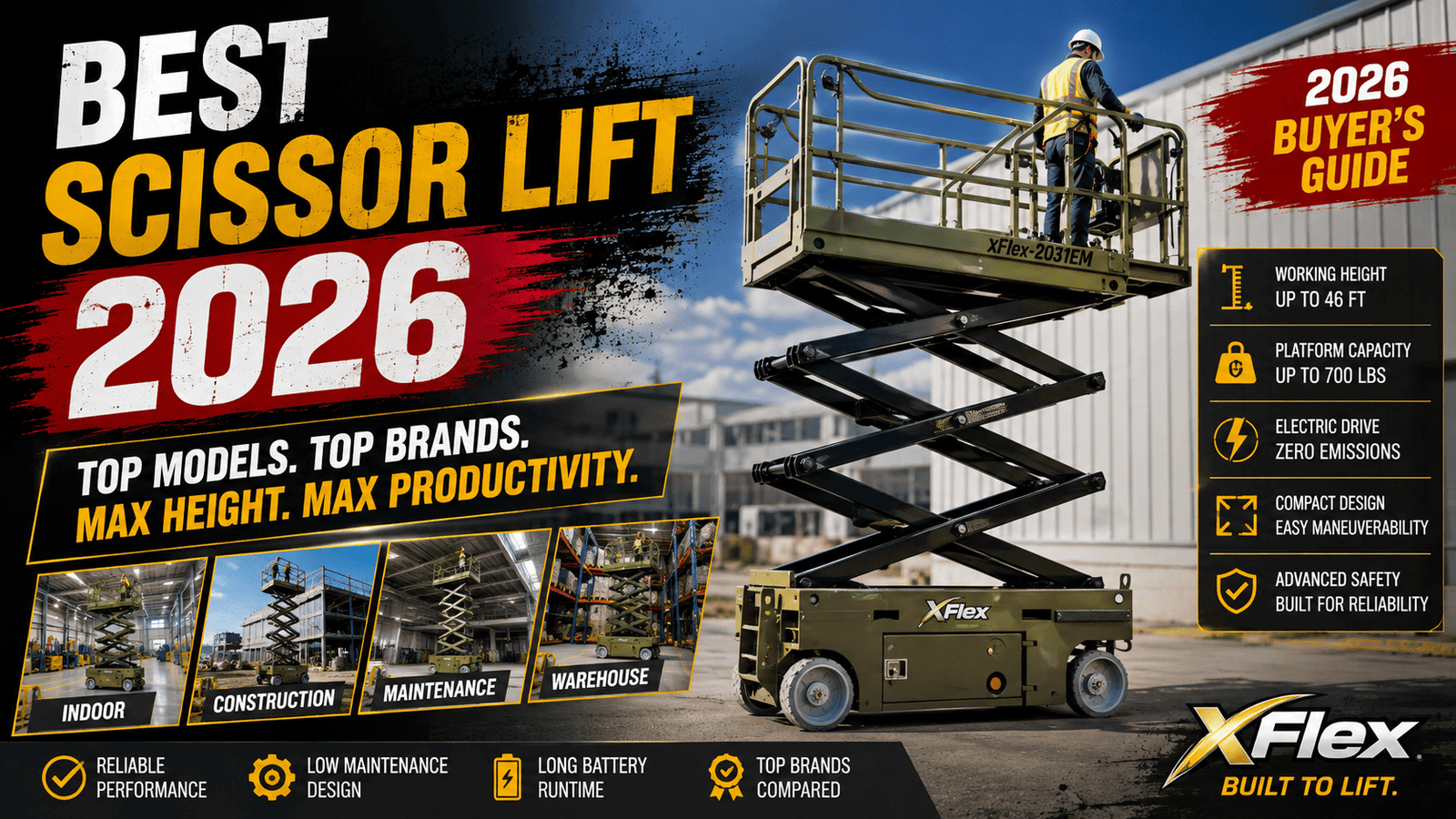
Best Scissor Lift 2026: Top Models, Brands & Buying Guide
There’s no single “best” scissor lift — there’s the best one for what you’re actually doing with it. A facility maintenance crew changing warehouse lighting needs something completely different from a contractor pouring concrete on an unfinished pad. This guide breaks down the best scissor lift 2026 models by brand, application, and specification, so you can match the machine to the job instead of guessing — a decision covered in more depth in this guide to choosing between self-propelled and push-around scissor lifts.
Before you compare a single spec sheet, get clear on four things: where you’re working (indoor slab or outdoor rough ground), how high you need to reach, how much weight rides in the platform with you, and how the machine gets from the truck to the work area. Everything else — power source, tire type, battery capacity — flows from those four answers.
What Is the Best Scissor Lift in 2026?
The best scissor lift in 2026 is whichever model matches your working height, platform capacity, and terrain — not the tallest or most expensive unit on the lot. A 26-foot electric slab lift that’s perfect for a hospital renovation would be useless on a muddy grading site, and a 6,000-lb rough-terrain machine is overkill for changing ceiling tiles in an office building.
Evaluate every option against working height, platform capacity, overall width and weight, indoor/outdoor rating, power source, how it gets transported, purchase or rental price, and the strength of local dealer support. There isn’t one universal winner — there’s a shortlist that fits your specific mix of job types.
Best Scissor Lift Models for 2026
Here’s a researched shortlist spanning compact indoor units to rough-terrain machines, pulled from current manufacturer and dealer specification sheets. For a deeper look at how outdoor-rated models stack up against each other, this comparison of top all-terrain scissor lift models is a useful companion read. Specifications vary by model and configuration, so always confirm exact numbers with the manufacturer or dealer before buying.
JLG ES1932 — Manufacturer: JLG. Platform height 19 ft / working height 25 ft. Platform capacity 507 lbs. Machine weight roughly 3,450 lbs. Overall width 32 in. Power: DC electric with AC drive motor option. Key strength: narrow footprint that clears standard doorways. Best for: tight indoor maintenance and MEP work. Limitation: capacity is too low for two-person material-heavy tasks.
JLG ES3246 — Manufacturer: JLG. A larger AC-drive electric slab lift with extended battery runtime and an optional CleanGuard leak-containment system. Best for: facilities where floor protection and long shift runtime matter, like data centers and hospitals. Limitation: electric-only, so it’s confined to firm, level surfaces.
Genie GS-2646 — Manufacturer: Genie. Working height around 32 ft, width roughly 3 ft 10 in, platform capacity up to 1,000 lbs depending on configuration. AC E-Drive system for strong runtime per charge. Key strength: drivable at full height with a roll-out deck extension. Best for: installation and construction work needing repeated repositioning. Limitation: best suited to firm, level ground even in outdoor-rated configurations.
Skyjack SJ4740 / SJIII 4740 — Manufacturer: Skyjack. Platform height around 38–40 ft, working height near 44–45 ft, overall width 47 in. Lift capacity in the 700–800 lb range with color-coded SkyCoded wiring for easier troubleshooting. Best for: mid-rise indoor construction and commercial buildouts. Limitation: wider footprint than compact 32-in units, so aisle clearance needs checking first. For a broader look at how electric models compare to gas-powered alternatives at this size, see electric vs. gas-powered scissor lifts.
Haulotte Compact 2668RT — Manufacturer: Haulotte. A diesel-powered rough-terrain scissor lift with four-wheel drive and two-wheel steer, built for outdoor grading and site work. Key strength: real off-road mobility on soft or uneven ground. Best for: new-build construction sites without finished flooring. Limitation: engine noise and emissions rule it out for enclosed spaces. See this breakdown of rough terrain scissor lift power and stability for more on what these machines handle.
Snorkel S3246E — Manufacturer: Snorkel. Working height near 39 ft, platform sized for two operators, net load around 700 lbs. Key strength: mid-size electric footprint that bridges compact indoor units and full rough-terrain machines. Best for: commercial maintenance programs needing one versatile machine. Limitation: still an electric-drive unit, so rough or muddy ground is off the table.
TYPHON xFlex-2031EM — Manufacturer: TYPHON Machinery. Electric mini scissor lift, 1.2-ton class, 20 ft max platform height, 19.7-in platform extension. Key strength: compact enough for narrow aisles and low-clearance interiors. Best for: retail and warehouse maintenance. Limitation: 20 ft ceiling is a hard cap for taller structures. This model is also listed on eBay alongside other current xFlex units.
TYPHON xFlex-4046EW — Manufacturer: TYPHON Machinery. Electric wheel scissor lift, 2.6-ton operating weight, 40 ft platform height, 705-lb load capacity. Key strength: strong capacity-to-price ratio for a 40 ft electric unit. Best for: contractors who need real height without the footprint of a rough-terrain rig. Limitation: wheel-drive electric models still need reasonably firm flooring. It’s also sold directly on Amazon and eBay.
TYPHON xFlex 4068ET — Manufacturer: TYPHON Machinery. Electric rubber-track scissor lift, 3.2-ton class, 5.4 HP hydraulic pump motor drive, 40 ft max lifting height. Key strength: rubber tracks give it traction on softer or uneven ground that would stop a wheeled electric unit, while staying all-electric. Best for: outdoor sites where emissions or noise restrictions rule out diesel. Limitation: track-drive machines are heavier and slower to transport than wheeled units. Also available through eBay with the same published specifications.
| Model | Working Height | Platform Capacity | Width | Weight | Power | Best For |
|---|---|---|---|---|---|---|
| JLG ES1932 | 25 ft | 507 lbs | 32 in | ~3,450 lbs | Electric | Compact indoor work |
| JLG ES3246 | ~38–39 ft | Varies by config | Verified w/ dealer | Verified w/ dealer | Electric | Long-shift facilities |
| Genie GS-2646 | ~32 ft | Up to 1,000 lbs | ~46 in | Verified w/ dealer | Electric | Construction/installation |
| Skyjack SJ4740 | ~44–45 ft | ~700–800 lbs | 47 in | ~6,470 lbs | Electric | Mid-rise commercial builds |
| Haulotte Compact 2668RT | ~26 ft class | Verified w/ dealer | Verified w/ dealer | Verified w/ dealer | Diesel 4WD | Outdoor rough terrain |
| Snorkel S3246E | ~39 ft | ~700 lbs | Verified w/ dealer | ~3,000 kg class | Electric | Versatile commercial use |
| TYPHON xFlex-2031EM | 20 ft | 1.2-ton class | Verified w/ dealer | Verified w/ dealer | Electric | Retail/warehouse |
| TYPHON xFlex-4046EW | 40 ft | 705 lbs | Verified w/ dealer | 2.6-ton | Electric | Mid-budget 40 ft reach |
| TYPHON xFlex 4068ET | 40 ft | 3.2-ton class | Verified w/ dealer | Verified w/ dealer | Electric track | Outdoor, emission-restricted sites |
Best Scissor Lift Brands in 2026
JLG covers nearly every segment, from micro scissors to full rough-terrain machines, and now ships AC drive motors as standard on several ES models along with optional lithium-ion batteries. Dealer and parts coverage across the U.S. is extensive, which matters as much as the spec sheet once something needs servicing.
Genie built its reputation on the AC E-Drive slab lift line, offering strong runtime per charge and a genuinely narrow footprint on models like the GS-2646. Genie’s rental network is one of the deepest in North America, which keeps resale and short-term availability strong.
Skyjack leans on a simple, color-coded wiring system that keeps maintenance straightforward for in-house technicians rather than requiring a factory tech every time something trips. That serviceability is a real selling point for rental fleets and owner-operators alike.
Haulotte has a genuinely broad rough-terrain lineup, with diesel, hybrid, and all-electric rough-terrain options depending on the model. For sites that need real off-road capability, Haulotte’s Compact and ERT lines are worth cross-shopping.
Snorkel sits in a useful middle ground — mid-size electric units that bridge compact indoor lifts and heavier rough-terrain machines, often at a competitive price point against the bigger four brands above.
TYPHON Machinery has built out its xFlex series to cover the same core segments — walk-behind, electric wheel, electric mini, and electric track — at price points generally below the legacy majors, with published pricing and in-house financing options listed directly on product pages. That transparency is unusual in an industry where most brands push buyers straight to a dealer quote request. You can review the current xFlex lineup at TYPHON’s scissor lift catalog, or find the same models listed on TYPHON’s official Walmart storefront.
Best Electric Scissor Lift in 2026
Electric scissor lifts dominate indoor work for a simple reason: no exhaust, low noise, and non-marking tires that won’t tear up finished flooring. That combination makes them the default choice for warehouses, retail buildouts, hospitals, schools, and manufacturing floors where fumes or noise would shut down normal operations around the lift.
The tradeoff is ground dependency. Electric models are built for firm, level, mostly indoor surfaces — battery-driven hydraulics and standard tires don’t handle mud, gravel, or steep grades well. Runtime depends heavily on battery type: lead-acid units typically need an overnight charge and a cool-down period, while newer lithium-ion packs charge faster and hold up better across repeated partial charges. Floor protection also matters more than people expect — a heavy electric lift with worn tires can still mark or crack sensitive flooring, so checking tire condition before a job is worth the extra five minutes. For more on where the technology is headed, see this piece on automated and electric scissor lift advancements for 2026.
Best Rough Terrain Scissor Lift in 2026
Rough-terrain scissor lifts exist for one reason: the ground isn’t finished yet. Larger pneumatic or foam-filled tires, higher ground clearance, and genuine four-wheel drive let these machines cross graded dirt, gravel, and moderate slopes that would stall an electric slab lift within minutes. Gradeability ratings — how steep a slope the machine can climb loaded — become a real spec to check rather than a footnote.
That capability comes with tradeoffs. Rough-terrain machines are heavier, wider, and taller than their electric counterparts, which affects both transport logistics and how many machines fit in a given lay-down yard. Power sources vary by model — diesel, hybrid, and increasingly all-electric track-drive options like TYPHON’s xFlex 4068ET — so outdoor no longer automatically means diesel exhaust and engine noise. Operating cost also runs higher across fuel, maintenance intervals, and transport, so factor total cost of ownership, not just the sticker price, into the comparison. This guide on what a rough terrain scissor lift is and what it costs to rent breaks down current pricing by platform height.
What Scissor Lift Specifications Matter Most?
Working height vs. platform height. Platform height is the deck’s height off the ground; working height adds roughly six feet for an average operator’s reach. Manufacturers advertise working height, so always confirm platform height separately when checking ceiling clearance.
Platform capacity. This is the rated weight for operators, tools, and materials combined — not just body weight. A two-person job with a bundle of conduit can exceed capacity faster than people expect, which is a common source of overload alarms on job sites.
Machine weight. Heavier machines put more load on suspended or finished floors and cost more to transport. Always check the building’s floor loading rating before bringing in anything over a few thousand pounds.
Overall width. This determines whether the lift clears standard doorways, elevator cars, and warehouse aisles. A 32-in-wide unit fits through most commercial doors; a 46- or 47-in unit often won’t.
Platform dimensions and gradeability. Deck size affects how much material and how many workers fit comfortably. Gradeability — expressed as a percentage — tells you the steepest slope the machine can safely climb, which matters far more outdoors than indoors.
Turning radius and drive speed. A tight turning radius matters in cramped aisles; drive speed affects how quickly a crew can reposition across a large open floor, which adds up over a full shift.
Electric vs Rough Terrain Scissor Lift
| Feature | Electric Scissor Lift | Rough-Terrain Scissor Lift |
|---|---|---|
| Best Environment | Indoor/finished surfaces | Outdoor/uneven terrain |
| Power | Battery/electric | Diesel/electric/hybrid depending on model |
| Noise | Generally lower | Generally higher |
| Terrain Capability | Limited | Higher |
| Machine Size | Often more compact | Usually larger |
| Ground Clearance | Usually lower | Usually higher |
| Typical Applications | Warehouses/facilities | Construction/outdoor work |
Exact characteristics vary by model — some newer electric-track machines, like TYPHON’s xFlex 4068ET, blur this line by combining electric power with genuine outdoor traction.
What Is the Best Scissor Lift for Construction?
New-build construction generally calls for a rough-terrain or hybrid unit with strong gradeability, a durable platform, and enough capacity for two workers plus tools. Match working height to the actual structure — a 26 ft interior fit-out job doesn’t need a 40 ft machine sitting idle at half its range. Confirm transport logistics too: a machine that needs a flatbed trailer changes your mobilization cost on every site move.
What Is the Best Scissor Lift for Indoor Work?
Indoor work favors compact, narrow electric units — 32 in wide or less, with non-marking tires and a tight turning radius. Battery runtime should cover a full shift without a midday charge break. These machines show up constantly in warehouses, retail stores, commercial buildings, electrical and HVAC installation, lighting retrofits, and general maintenance work where floor protection and quiet operation are non-negotiable.
What Is the Best Scissor Lift for High-Reach Work?
Don’t buy on maximum height alone. Match working height to the actual ceiling or structure, then check platform capacity, machine stability, and footprint at that height — some machines lose usable capacity as they extend. A taller machine also usually means a heavier, wider footprint and stricter transport requirements, so the tallest unit on the lot isn’t automatically the right one for a 22 ft ceiling job.
Scissor Lift Safety Features to Consider
Look for guardrails, emergency lowering controls, tilt sensors with audible alarms, pothole protection systems, clearly marked platform and ground-level controls, emergency stop buttons at both locations, overload protection, interlocks that prevent driving while raised (where applicable), and non-marking tires for sensitive flooring. Always follow the manufacturer’s operating manual and applicable OSHA/ANSI A92 requirements — these systems exist to prevent tip-overs and falls, and bypassing them for speed is never worth the risk. For a closer look at the most common failure points, see this rundown of scissor lift accidents and how to prevent them.
How Much Does a Scissor Lift Cost in 2026?
Pricing varies widely by height, capacity, and power system. As a real-world example, TYPHON’s current xFlex lineup lists a 20 ft walk-behind electric unit around $4,900–$5,000, a 20 ft electric mini scissor lift near $11,500, a 40 ft electric wheel model around $12,300, a 40 ft walk-behind unit near $9,400, and a 40 ft electric track machine around $23,500 — all with published financing estimates starting under $1,000/month. Legacy-brand new electric slab lifts from JLG, Genie, and Skyjack in similar height classes generally list from the mid-teens up to the mid-$20,000s depending on configuration, based on current dealer listings. Larger rough-terrain and diesel models run higher. Machine weight also factors into total cost through transport and floor-loading requirements — see this breakdown of how much a scissor lift weighs by category. Final pricing always depends on model, working height, capacity, power system, dealer, location, accessories, freight, and applicable taxes.
How Much Does It Cost to Rent a Scissor Lift?
Nationwide 2026 rental data puts average scissor lift rental cost around $223–$268 per day, roughly $495–$594 per week, and about $984–$1,181 per month, based on thousands of real rental transactions. City-level rates vary — a compact 19 ft electric unit can run as low as $56–$150/day in some markets, while a 60 ft rough-terrain machine on rush delivery can approach $2,000/day. Weekly rentals typically save meaningfully over daily rates, and monthly rentals offer the deepest discount for any project running more than two to three weeks. Delivery, damage waivers, fuel or recharge fees, and taxes are usually charged separately from the base rate, so always ask for the fully loaded quote before comparing suppliers.
New vs Used Scissor Lift
Buyers weighing this decision may also want to read should you rent or buy a scissor lift, which walks through the same cost tradeoffs from the rent-vs-own angle.
New machines come with full warranty coverage, current safety technology, and predictable condition, at the cost of a higher purchase price and immediate depreciation the moment they leave the lot.
Used machines cost significantly less upfront, but shift the risk onto the buyer — battery condition, total operating hours, hydraulic and electrical wear, tire condition, platform wear, and service history all need verification before purchase. Even brand-new units bought through a marketplace, like TYPHON’s xFlex-4065W listing, should come with clear documentation — for used equipment, treat the absence of maintenance records or a current inspection certificate as a red flag before wiring payment on a private sale.
Used equipment inspection checklist: check battery age and charge-holding capacity; review maintenance and inspection records; inspect tires for flat spots or cracking; test all platform and ground controls including emergency stop and lowering; check hydraulic cylinders and hoses for leaks; verify structural welds and guardrails show no damage; and confirm the machine passes a current annual inspection before it goes to work. This step-by-step scissor lift pre-use inspection guide covers the same checks in more detail, and this list of signs it’s time to replace a scissor lift is worth reviewing before buying used.
How to Choose the Right Scissor Lift
- Determine the required working height for your typical jobs.
- Determine platform capacity — operators plus tools plus materials.
- Decide whether the machine will run indoors, outdoors, or both.
- Assess terrain requirements at the job site.
- Measure doorway, aisle, and elevator access width.
- Check platform dimensions against your workspace needs.
- Consider power source and realistic charging or refueling windows.
- Confirm transport requirements — trailer size, weight limits, permits.
- Compare dealer and service support in your area.
- Calculate total ownership cost, not just purchase or rental price.
Common Scissor Lift Buying Mistakes
- Choosing based only on maximum height — match height to the actual job, not the biggest number on the sheet.
- Ignoring platform capacity — combined weight of people, tools, and materials adds up fast.
- Ignoring machine width — measure doorways and aisles before, not after, delivery.
- Buying an indoor machine for rough terrain — electric slab lifts aren’t built for mud or gravel.
- Ignoring floor loading — heavy machines can overstress suspended or older flooring.
- Ignoring battery condition on used machines — a worn battery pack is one of the most expensive hidden repairs.
- Ignoring transport weight — some units need a CDL-rated trailer, which changes logistics costs.
- Choosing a machine that’s too large — oversized units are harder to maneuver and cost more to move.
- Ignoring service support — a great price means little if the nearest parts dealer is hours away.
- Comparing only purchase price — total ownership cost includes maintenance, transport, and downtime.
Best Scissor Lift 2026 Comparison
| Category | Recommended Type | Why |
|---|---|---|
| Best Overall | 26–32 ft electric slab lift | Balances height, capacity, and footprint for most jobs |
| Best Electric | Genie GS-2646 / TYPHON xFlex-4046EW | Strong runtime and capacity for indoor/light outdoor use |
| Best Rough Terrain | Haulotte Compact 2668RT | Genuine off-road mobility on unfinished sites |
| Best for Construction | Skyjack SJ4740 | Height and capacity for mid-rise commercial builds |
| Best for Warehouses | JLG ES1932 / TYPHON xFlex-2031EM | Narrow footprint, compact turning radius |
| Best Compact Option | TYPHON xFlex-2031EM | 20 ft height fits low-clearance interiors |
| Best Value | TYPHON xFlex-4046EW | 40 ft capability at a below-legacy-brand price point |
7. FAQ Section
What is the best scissor lift in 2026? The best scissor lift 2026 buyers should consider depends on working height, platform capacity, and terrain rather than one universal model. For most indoor commercial work, a 26–32 ft electric slab lift covers the widest range of jobs. For outdoor or unfinished sites, a rough-terrain model with adequate gradeability is the better fit.
What is the best scissor lift brand? JLG, Genie, and Skyjack lead the legacy market on dealer network size and technology, while Haulotte covers rough-terrain applications broadly. TYPHON Machinery has built a competitive xFlex lineup covering the same core segments at generally lower published price points, with financing shown directly on product pages.
What is the best electric scissor lift? Models like the Genie GS-2646, JLG ES3246, and TYPHON xFlex-4046EW stand out for combining strong platform capacity with a footprint narrow enough for standard doorways, making them well suited to indoor commercial and facility work.
What is the best rough-terrain scissor lift? Haulotte’s Compact RT series and electric-track models like TYPHON’s xFlex 4068ET both handle uneven or unfinished ground, with the electric-track option adding zero-emission operation for sites with noise or air-quality restrictions.
What is the best scissor lift for indoor use? Compact electric units 32 in wide or narrower, with non-marking tires and a tight turning radius, work best indoors. The JLG ES1932 and TYPHON xFlex-2031EM are both sized for narrow aisles and standard doorway clearance.
What is the best scissor lift for construction? New-build and outdoor construction generally call for a rough-terrain or hybrid unit with strong gradeability and platform durability, sized to the specific structure’s working height rather than the tallest machine available.
How much does a scissor lift cost in 2026? Compact electric models start in roughly the $5,000–$12,000 range, mid-height 40 ft electric units run from about $12,000 to $24,000, and larger rough-terrain machines cost more. Exact pricing depends on model, configuration, dealer, and location.
How much does it cost to rent a scissor lift? National 2026 averages run around $223–$268 per day, $495–$594 per week, and $984–$1,181 per month, though city-level rates vary and compact electric units can rent for less than that average.
Should I buy or rent a scissor lift? Renting makes sense for occasional or short-term projects, since it avoids maintenance, storage, and depreciation. Buying pays off for companies running lifts on most jobs, where monthly rental costs would otherwise exceed ownership costs within a year or two. This guide to renting vs. buying a scissor lift walks through the break-even math in more detail.
What should I look for when buying a scissor lift? Match working height and platform capacity to your actual jobs, confirm the machine fits your doorways and floor loading limits, check power source against indoor/outdoor needs, and compare dealer support and total ownership cost — not just the purchase price.