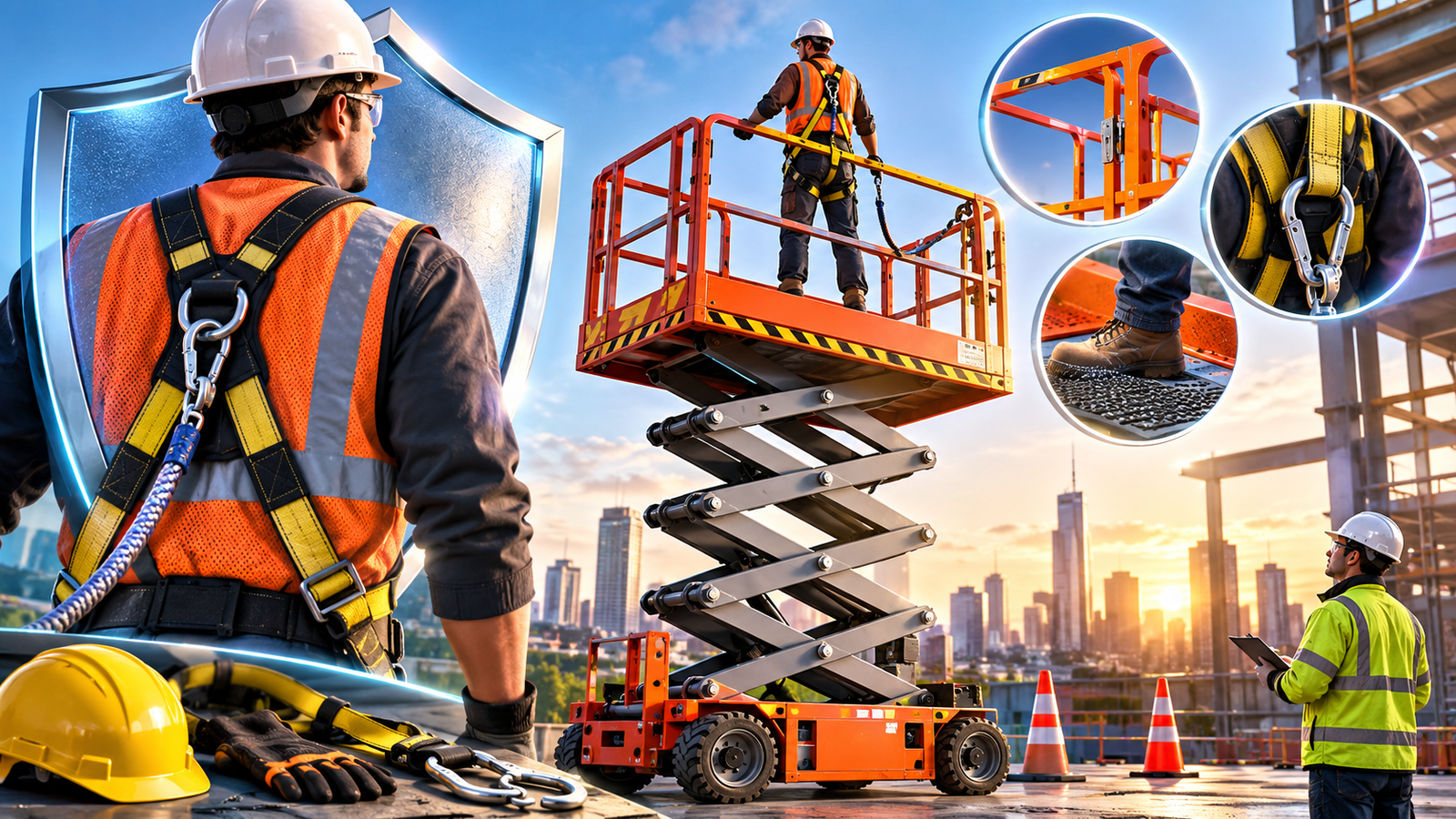
Scissor Lift Fall Protection: Guardrails, Harnesses, and Best Practices
Let’s be completely honest for a second: when you’re standing several stories up in the air on a metal grate, swaying slightly in the breeze, the absolute last thing you want to worry about is whether your safety gear is actually going to hold up. Thus, it is very important to scissor lift fall protection system for safety and security of both operator and machine.
Because they offer a wide, flat platform enclosed by steel rails, scissor lifts tend to give operators a massive sense of security. But sometimes, that exact feeling of safety is what leads to complacency—and on a busy job site, complacency is exactly what gets people hurt.
True scissor lift fall protection goes way beyond just ticking off a box on a daily compliance sheet. It’s about building a genuine culture of safety where everyone understands the tools keeping them alive. From knowing the physical limits of your platform’s guardrails to understanding the ongoing debate over when to strap into a safety harness, these details literally save lives.
By taking the time to really master these practices, you’re doing more than just keeping the safety inspectors happy; you’re making sure that every single person on your crew gets to clock out and head home to their families at the end of the day.
Understanding Scissor Lift Fall Protection Systems
If you want to get the most out of your scissor lift fall protection, you first have to understand how these machines are built. A lot of folks lump all aerial lifts together, but a scissor lift is actually classified as a mobile scaffold, not a boom lift. That distinction completely changes how we approach safety.
The main defense you have up there is what we call a “passive” system. Think of passive protection as the safety features that do their job without you having to think about them—mainly, the guardrails. When everything is locked in and solid, you can focus entirely on the work. But the real world is messy.
Sometimes a gate gets damaged, or a rail pin goes missing, or you have to lean out just a bit too far to reach a tricky spot. That’s exactly when “active” systems, like your personal harness, need to step in and pick up the slack. Knowing how these two systems work together is what separates the seasoned pros from the rookies on site.
- Trusting the Passive Systems: Your heavy-duty guardrails are designed to take a hit. They act as an invisible shield that works continuously, so long as you keep all the gates shut and locked while working.
- Knowing When to Get Active: Personal Fall Arrest Systems (PFAS) aren’t just for show. If the rails are compromised, or if your site boss mandates it, getting tied off with the right gear is your non-negotiable backup plan.
- Handling the Physics: It’s not just about keeping you inside; the whole lift is engineered to resist dynamic forces. If someone trips and falls hard against the side, the rails have to absorb that shock without buckling.
The Role of Scissor Lift Guardrails in Fall Prevention
Ask any veteran operator, and they’ll tell you that the guardrails are the absolute backbone of scissor lift fall protection. With a boom lift, the basket can bounce around like a theme park ride, which is why tying off is mandatory. But a scissor lift just goes straight up and down. That means a solid, well-maintained set of rails is normally enough to keep you safely on board.
However, this only works if the rails are actually in good shape. We’ve all seen lifts on older sites with rusted hinges, missing mid-rails, or access gates that someone tied open with a piece of wire to save time. That’s a disaster waiting to happen.
The team over at scissorlifts.org always points out that a failing lock pin basically turns a safety cage into an open door at 30 feet in the air. You also have to remember what these rails are actually for. They are boundaries, not ladders. The minute you step up on the mid-rail to try and reach a ceiling fixture, you’ve completely voided your protection.
- Checking the Hardware: Don’t just glance at the lift. Actually rattle the gates, check the drop-pins, and make sure the folding joints aren’t bent or structurally compromised before you ever hit the elevate switch.
- Fighting Off the Elements: Scissor lifts take a beating from the weather. Make sure the powder coating or galvanization on the rails isn’t heavily rusted, which can quietly eat away at the metal’s strength.
- Keeping Your Feet Flat: This is the golden rule: never, ever use the top or mid-rails as a step stool to get extra reach. If you can’t reach the job from the floor of the platform, you need a taller lift.
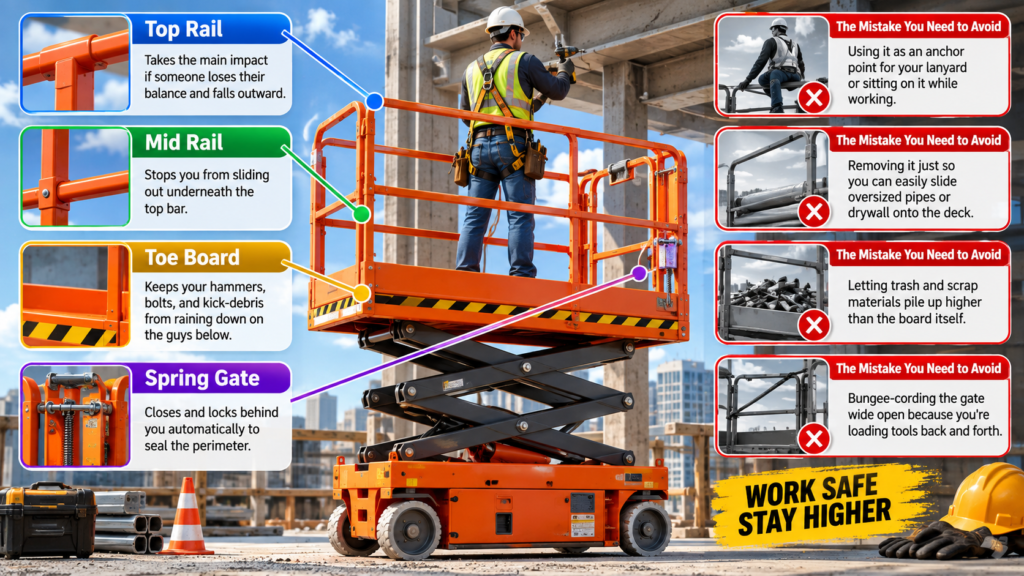
Table: Scissor Lift Fall Protection
| Guardrail Part | What It Actually Does | The Mistake You Need to Avoid |
| Top Rail | Takes the main impact if someone loses their balance and falls outward. | Using it as an anchor point for your lanyard or sitting on it while working. |
| Mid Rail | Stops you from sliding out underneath the top bar. | Removing it just so you can easily slide oversized pipes or drywall onto the deck. |
| Toe Board | Keeps your hammers, bolts, and kick-debris from raining down on the guys below. | Letting trash and scrap materials pile up higher than the board itself. |
| Spring Gate | Closes and locks behind you automatically to seal the perimeter. | Bungee-cording the gate wide open because you’re loading tools back and forth. |
Safety Harnesses and PPE for Elevated Heights
Alright, let’s talk about the elephant in the room: safety harnesses. On almost every job site, you’ll hear arguments about whether or not you actually need a harness for scissor lift fall protection. Here’s the deal—while federal rules might say the guardrails are enough, a huge chunk of general contractors have a strict “100% tie-off” rule.
Why? Because human error happens, and they don’t want to take any chances. If you are going to wear a harness, you need to use it right. You want a fall restraint lanyard, not a fall arrest lanyard. A restraint lanyard acts like a short leash; it physically stops you from ever reaching the edge of the basket.
An arrest lanyard lets you fall over the edge and then violently catches you, which on a tipping scissor lift, could easily pull the whole machine down with you. And it goes without saying, tie off to the actual anchor points welded to the floor, never to the rails. Add in a good hard hat, some sturdy steel-toe boots, and you’re actually ready to work.
- Keep It Short and Safe: Always opt for a short restraint lanyard. The goal is to keep you confined entirely within the basket, stopping the fall before gravity even gets a chance to take over.
- Find the Right Anchor: Look down at the floor of the platform to find the heavy-duty, manufacturer-welded anchor rings. Tying off to the aluminum guardrail is essentially useless if things go sideways.
- Dress for the Drop: Fall protection is full-body. Wear boots with a serious grip so you don’t slip on a wet metal deck, and keep your hard hat strapped on to deal with overhead hazards.
OSHA Fall Protection Guidelines for Mobile Scaffolds
Nobody really reads OSHA manuals for fun, but understanding the legal side of scissor lift fall protection is part of the job. OSHA lumps these machines into the “mobile scaffold” category. What this essentially means in plain English is that as long as your guardrails meet their height and strength requirements, you technically don’t need a harness. But there’s a catch. If you have to take the rails down to load material, or if a section is broken, OSHA immediately requires you to wear a Personal Fall Arrest System.
The rules also get incredibly strict about how you position yourself. The second your boot leaves the floor of that platform—say, you step on the toe board just to get another two inches of reach—you are in direct violation of OSHA rules. It’s always better to treat OSHA guidelines as the bare minimum. Smart crews usually put stronger site-specific rules in place to cover the weird, unpredictable hazards that pop up in real life.
- The Guardrail Mandate: By law, a fully compliant, undamaged rail system has to be locked into place while you work. That is your primary legal defense against a fall.
- Stay Grounded in the Basket: The rules are crystal clear: both feet stay on the structural floor of the lift. Climbing the sides is an instant, heavily fined violation.
- When the Backup Becomes Mandatory: The minute your guardrails are deemed unsafe or have to be lowered for a specific, approved task, OSHA legally requires you to harness up.
| The OSHA Rulebook | What It Covers | What It Means for You |
| 29 CFR 1926.451(g)(1) | Basic Scaffolding Rules | If you are working 10 feet or higher off the ground, fall protection is non-negotiable. |
| 29 CFR 1926.451(g)(4) | Guardrail Specs | The top rail has to sit somewhere between 38 and 45 inches above where you’re standing. |
| 29 CFR 1926.453(b)(2)(iv) | Where You Stand | You must stand firmly on the floor. No ladders, boxes, or buckets allowed inside the lift. |
Best Practices for Working Safely on Scissor Lifts
Knowing the gear and the rules is great, but everyday habits are what actually make scissor lift fall protection work. Before you even think about turning the key, you need to do a pre-check. It only takes a few minutes to check the hydraulic lines, test the emergency lowering valve, and make sure the safety alarms are beeping like they should.
If you ever have to move the lift while it’s up in the air, you need to be incredibly careful. Lifts get super top-heavy when fully extended, and driving them while elevated is a recipe for a tip-over if you hit a tiny bump. If the manufacturer says it’s okay to drive elevated, do it at a snail’s pace, and only on flat concrete. Honestly, having a guy on the ground acting as a spotter is one of the smartest things you can do. A spotter can see the pothole you’re about to back into, or the low-hanging pipe you’re about to hit with your head.
- Do the Morning Walkaround: Check everything from tire pressure and hydraulic leaks to the emergency shut-off switches before you get to work. Don’t skip it just because you’re in a hurry.
- Creep, Don’t Drive: If you absolutely must move the lift while the platform is raised, keep it in the slowest possible gear and only do it on perfectly smooth, flat surfaces.
- Get a Second Set of Eyes: Use a ground spotter. They can see the blind spots you can’t, helping you avoid nasty collisions with overhead beams or ground-level hazards.
Site Assessment and Preventing Tip-Overs
Here’s a scary truth: the best harness and guardrails in the world aren’t going to help you if the entire machine falls over. Tip-overs are the absolute worst-case scenario, and preventing them is a massive part of scissor lift fall protection. Because these lifts go straight up, their center of gravity gets incredibly high. All it takes is one wheel dipping into a hidden pothole, and gravity takes over.
You have to physically walk your work area before you bring the lift in. Look for soft dirt, drop-offs, construction debris, or even slick spots where oil spilled. If you’re working outside on grass or gravel, you better be using a rough-terrain lift with outriggers. Modern lifts have built-in tilt sensors that will lock up the machine if you aren’t level. If that alarm goes off, do not try to override it. Lower the lift, move to safer ground, and start again.
- Walk the Route First: Physically walk around the exact area you’ll be driving the lift. Look for hidden trenches, unmarked floor covers, and messy debris piles.
- Respect the Wind: Check the weather. Scissor lifts act like giant sails in the wind. If it’s blowing past the manufacturer’s safe speed rating, keep the lift on the ground.
- Widen Your Stance: If your machine comes with leveling jacks or outriggers, deploy them fully. Getting that wide, stable footprint is crucial before you start rising up.
FAQs – Scissor Lift Fall Protection
Is fall protection required on a scissor lift?
Yes, but it’s usually built into the machine. Under federal rules, the guardrails act as your primary fall protection. As long as they are fully intact and you keep your feet on the floor, that satisfies the basic requirement. However, your site safety manager might require more.
Do you have to wear a harness on a scissor lift?
OSHA doesn’t legally mandate a harness on a scissor lift if your guardrails are perfect. But let’s be real—most major construction companies enforce a 100% tie-off rule anyway to protect themselves and you. If your boss says wear it, you wear it.
Can you use a scissor lift guardrail as an anchor point?
Never. The aluminum or thin steel rails are meant to stop a leaning body, not catch a falling one. You must always clip your lanyard into the heavy-duty anchor rings that the manufacturer welded to the floor of the platform.
What is the OSHA height requirement for fall protection on scissor lifts?
Because scissor lifts are classified as scaffolds, OSHA requires fall protection to be in place anytime you are working 10 feet or more above a lower level.
Are body belts allowed for scissor lift fall protection?
OSHA banned body belts for catching falls back in the 90s because they can cause horrific internal injuries if you drop. You can technically use them just to keep you tethered away from the edge (fall restraint), but full-body harnesses are much safer and pretty much the industry standard now.
Can you stand on the guardrails of a scissor lift to reach higher?
Absolutely not. This is a massive safety violation. You must keep both of your boots completely flat on the metal deck at all times. If you can’t reach what you’re working on, you need to come down and get a bigger lift.
Do I need to be tied off when moving a scissor lift?
If the lift is meant to be driven while elevated, tying off depends heavily on your company’s policy. But if you are required to wear a harness up there, keep it clipped in while you’re moving so a sudden bump doesn’t bounce you out of the basket.
Conclusion – Scissor Lift Fall Protection
At the end of the day, solid scissor lift fall protection isn’t about perfectly reciting the rulebook—it’s about staying sharp, respecting the equipment, and looking out for the guy next to you.
Trusting the machine’s guardrails is a great place to start, but tying that together with proper harness use, daily safety checks, and a healthy respect for gravity is how you really stay safe. Don’t let the sturdy feel of the platform trick you into getting sloppy. Treat your fall protection routine as the most important part of your job, follow your site’s specific rules, and you’ll keep things running smoothly and safely every single time.