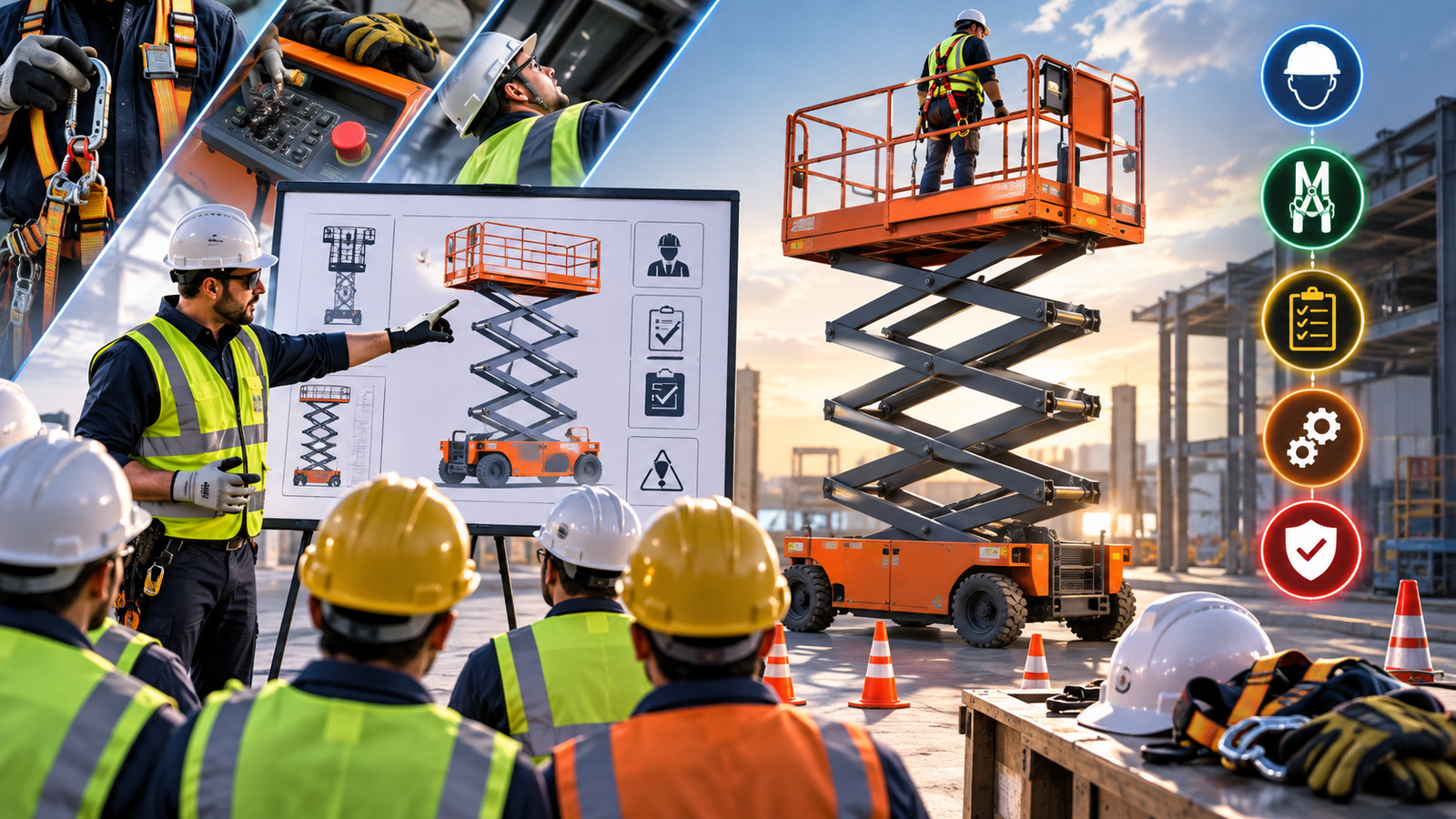
Master scissor lift safety training with our step-by-step guide! Equip your team with essential skills
Walk onto almost any commercial job site, warehouse floor, or staging bay, and you’ll spot a scissor lift within two minutes. They’re indispensable workhorses. Because they feel as simple to drive as an oversized golf cart, crews tend to treat them like motorized stepladders rather than heavy machinery with high centers of gravity. That casual attitude is exactly how people get hurt. Hence, it is very important to be proficient in scissor lift safety training.
A worker leans over a top rail to grab a conduit, someone rolls over a small floor drain while fully elevated, or a gust of wind catches an unanchored outdoor platform—and an ordinary Tuesday turns into a disaster.
Real, effective scissor lift safety training isn’t about handing an employee a flimsy clipboard, having them watch a grainy VHS-era video, and rubber-stamping their card. It takes a deliberate, structured approach that connects raw mechanical physics to what your crew actually encounters when their boots leave the concrete.
Here at ScissorLifts.org, we see the fallout from poor operational habits every single week. Whether you manage a small maintenance crew servicing lighting fixtures or run multi-trade general contracting on high-rises, building a reliable internal training program is the single best investment you can make for your team’s physical safety and your company’s bottom line.
Why Scissor Lift Safety Training Can’t Just Be a Check-the-Box Exercise
Most site supervisors treat aerial equipment training as an administrative chore meant to satisfy an insurance underwriter. That mentality is dangerous. When operators don’t understand how hydraulic pressure, load distribution, or dynamic forces work, they make bad calls under tight deadlines.
A thorough scissor lift safety training program transforms passive equipment drivers into proactive safety managers who can spot an unstable floor plate, a worn seal, or an overhead power line before the machine even leaves the ground. It also eliminates the dangerous assumption that experienced hires know what they are doing; bad habits transfer between job sites just as easily as good ones.
Investing the time into structured training pays off across every corner of your daily operations:
- Fewer close calls and lost-time injuries: Trained operators don’t take reckless shortcuts like climbing mid-rails, bypassing interlocks, or overloading extensions with heavy tool chests.
- Zero panic during regulatory audits: Having verified, documented training records on file keeps OSHA compliance officers satisfied and spares your company catastrophic penalty fees.
- Lower repair and maintenance costs: Operators who understand hydraulic limits and gentle joystick modulation stop burning through drive motors, blowing cylinder seals, and crushing control boxes against structural steel.
Step‑by‑Step Plan – How to Train Your Team on Scissor Lift Safety
Step 1: Untangle OSHA Rules and ANSI A92 Standards
Before you gather your team in a breakroom, you need to be crystal clear on the legal guardrails governing these machines. Many crews don’t realize that OSHA and ANSI look at scissor lifts through different lenses. Under OSHA standards (specifically 29 CFR 1926.453 and 1926.451), scissor lifts are technically classified and regulated as mobile scaffolding—not aerial booms.
Meanwhile, the updated ANSI A92 standards group them into Mobile Elevating Work Platforms (MEWPs), specifically Class 3A. The ANSI rules place heavy legal responsibility on the employer to conduct documented safe-use planning, site risk assessments, and supervisor-level oversight alongside operator instruction. Your training program has to bridge both frameworks so your crew understands the letter of the law alongside real-world mechanics.
When breaking down regulatory requirements for your crew, drill down into these three fundamentals:
- The regulatory divide: Explain why OSHA treats the lift as a scaffold while ANSI expects MEWP compliance, ensuring workers understand why guardrail integrity and weight limits are legal mandates.
- The 10-foot overhead rule: Drill the Absolute Minimum Approach Distance into memory; uninsulated power lines require at least 10 feet of clear space at all times, with distances scaling upward for high-voltage transmission lines.
- Manual availability: Show workers where the manufacturer’s operating manual lives inside the weather-sealed platform canister, and make reading it mandatory before touching unfamiliar model variants.
Step 2: Build a Ground-Floor Theory Curriculum
You wouldn’t hand someone car keys if they didn’t know which pedal was the brake, yet companies regularly send green hands up thirty feet without explaining basic load dynamics. Your classroom or toolbox phase needs to tackle the conceptual mechanics of aerial work before anyone touches a joystick.
Focus heavily on center of gravity. Workers need to realize that a platform rated for 800 pounds doesn’t hold 800 pounds anywhere you toss it; placing three workers and several tool cases at the extreme edge of an extended rollout deck dramatically changes the lift’s tip point.
Use this session to also walk through different machinery types, comparing the rigid indoor limitations of standard slab units against the heavy outriggers and oscillating axles found on rough terrain scissor lifts.
Make sure your classroom syllabus spends dedicated time working through these essential topics:
- Deciphering capacity plates: Teach your team how to calculate the combined weight of their bodies, PPE, materials, and hand tools against the machine’s maximum rated capacity.
- Emergency ground descent controls: Ensure every trainee—as well as designated ground spotters—knows the exact location and mechanical operation of the manual bleed-down valves at the base of the chassis.
- Machine characteristics and limitations: Highlight how electric slab lifts behave differently than wide-stance rough terrain models, particularly regarding ground clearance, wheel compound, and gradeability.
Step 3: Run Supervised, Hands-On Field Evaluations
A written test only proves someone can memorize multiple-choice answers; it doesn’t prove they can parallel-park a multi-ton machine between two sensitive drywall partitions. Hands-on evaluation is the true centerpiece of competent scissor lift safety training. Take your trainees out to an open, flat staging area free from foot traffic and material clutter. Walk them through the control box layouts, demonstrating the distinct difference between drive mode and lift mode, and show them how touchy modern proportional controls can be.
Have each operator run through full elevation cycles, slow-speed maneuvers, steering around cones, and practicing soft stops. Jerky braking while thirty feet in the air creates massive sway at the platform, and trainees need to feel that motion in a controlled environment to respect it.
Every hands-on field evaluation should require trainees to prove mastery over these specific tasks:
- Proportional control feathering: Practicing gradual joystick acceleration and braking to prevent the violent platform whipping caused by abrupt start-stop inputs.
- Navigating blind corners and pinch points: Teaching operators to keep their hands, heads, and shoulders fully inside the guardrail boundaries while traveling through doorways and between overhead rafters.
- Elevated travel protocol: Forcing operators to come down to transport height before driving whenever possible, and practicing slow-speed crawl movements only when ground surfaces are certified completely level.
Step 4: Turn Daily Pre-Shift Inspections into Second Nature
Most mechanical catastrophes on job sites don’t happen out of the blue; the machine was quietly telegraphing the failure for three days prior. Pinhole hydraulic leaks, sluggish limit switches, frayed control cords, and cracked welds get overlooked when crews treat morning walkarounds as an annoying formality.
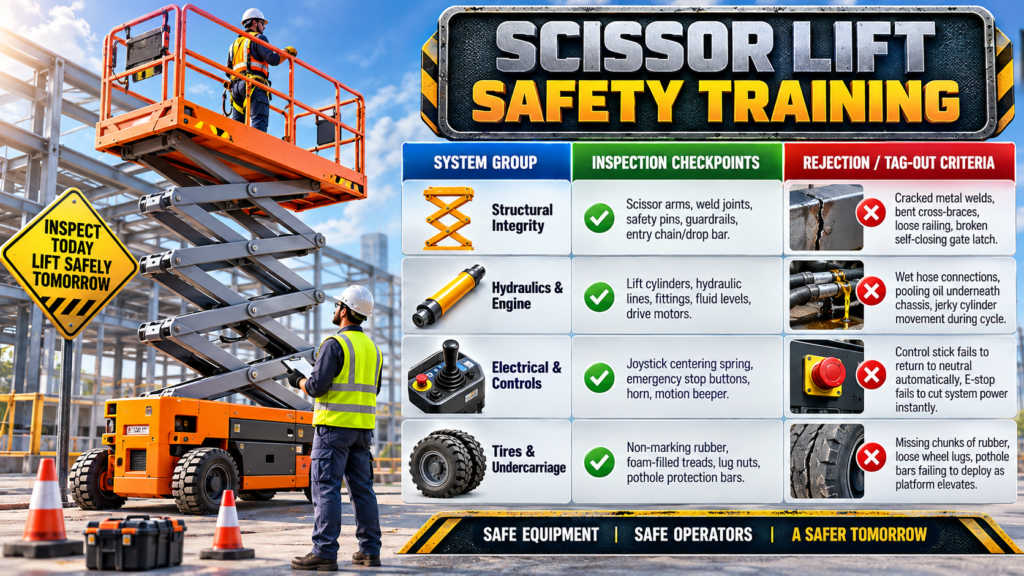
Your scissor lift safety training must establish a strict zero-compromise policy regarding pre-operation checks: if a component looks bent, feels loose, or leaks oil, the lift gets tagged out instantly. No exceptions, no “we’ll just finish this one run.” To keep inspections organized, provide your operators with a tangible checklist so they methodically check the chassis, scissor stack, and basket every single morning.
Table: Scissor Lift Safety Training
| System Group | Inspection Checkpoints | Rejection / Tag-Out Criteria |
| Structural Integrity | Scissor arms, weld joints, safety pins, guardrails, entry chain/drop bar. | Cracked metal welds, bent cross-braces, loose railing, broken self-closing gate latch. |
| Hydraulics & Engine | Lift cylinders, hydraulic lines, fittings, fluid levels, drive motors. | Wet hose connections, pooling oil underneath chassis, jerky cylinder movement during cycle. |
| Electrical & Controls | Joystick centering spring, emergency stop buttons, horn, motion beeper. | Control stick fails to return to neutral automatically, E-stop fails to cut system power instantly. |
| Tires & Undercarriage | Non-marking rubber, foam-filled treads, lug nuts, pothole protection bars. | Missing chunks of rubber, loose wheel lugs, pothole bars failing to deploy as platform elevates. |
Make sure your daily pre-shift inspection training reinforces these three practical steps:
- The mechanical walkaround: Checking fluid levels, inspecting structural scissor arm welds, and making sure the battery disconnect switch is intact.
- The ground-to-basket functional test: Cycling the lift up and down completely from the ground panel first to verify emergency stops before stepping into the basket.
- Pothole protection bar deployment: Verifying that the fold-down safety skirts drop down and lock mechanically when the basket rises above transport height.
Step 5: Address Site Hazards, Bad Weather, and Fall Protection Realities
One of the biggest areas of confusion on any job site revolves around harnesses. Under federal OSHA guidelines, if the scissor lift’s guardrail system is fully intact, closed, and approved by the manufacturer, operators are not strictly required to wear a personal fall arrest system (PFAS). However, many general contractors and commercial sites write company policies that require full body harnesses and short restraint lanyards regardless of the machine type. Your training needs to address this distinction honestly. Teach workers that a lanyard inside a scissor lift is meant to act as a fall restraint—preventing them from climbing or being catapulted over the rails—not a fall arrest system with an extended deceleration pack that could drag the lift over with them.
Beyond harnesses, operators must be trained to constantly read their environment. Wind is an invisible killer. A standard outdoor-rated scissor lift typically has a maximum operating wind speed of 28 mph (12.5 m/s), while many compact indoor units carry a wind rating of zero. If a storm kicks up, that large sheet of drywall your crew is hoisting transforms the platform into an uncontrollable sail.
Keep your hazard mitigation segment focused on these core behaviors:
- Tie-off anchoring rules: Showing workers the specific manufacturer-stamped anchorage points located near the platform floor and forbidding tie-offs to guardrails, pipes, or ceiling trusses.
- Wind and weather cut-offs: Providing operators with handheld anemometers or clear site protocols to cease outdoor aerial work immediately when gusts exceed machine ratings.
- Floor load and trench awareness: Inspecting ground conditions for hidden utility vaults, backfilled trenches, manhole covers, or muddy slopes that can buckle under a 6,000-pound machine.
Step 6: Maintain Equipment Records, Logs, and Recertification Cycles
A safety program is only as strong as its administrative backbone. Simply training an operator once doesn’t cover your company forever. OSHA requires retraining whenever an employee demonstrates improper handling, when new hazards appear on the job site, or when you bring in a brand-new model of lift that handles differently than your older fleet.
On top of personnel training, ANSI standards require periodic machine inspections conducted by certified mechanics at three-month (or 150-hour) intervals, along with an extensive annual inspection. Your safety program must align operator certification tracking with these regular maintenance schedules to ensure human skills and mechanical health move forward in tandem.
To build a paper trail that holds up under scrutiny, establish these recordkeeping habits:
- Triennial evaluation schedules: Setting an automated calendar alert to recertify all active equipment operators every three years, pairing a quick knowledge check with a driving evaluation.
- Documented retraining triggers: Automatically pulling an operator off the controls for refresher training after any near-miss, mechanical collision, or unsafe driving observation.
- Comprehensive maintenance logs: Keeping all daily inspection slips, quarterly mechanic write-ups, and annual certification documents filed directly with the machine’s unit number.
FAQs: Scissor Lift Safety Training
What is the single most common cause of scissor lift fatalities?
Tip-overs and falls represent the vast majority of fatal scissor lift accidents on commercial sites. Tip-overs usually happen when crews drive the machine on an unlevel surface while elevated, hit an unspotted pothole, overload the platform, or push the lift past its rated wind limits. Falls almost always stem from operators overriding safety systems—such as standing on the mid-rails, propping open entry gates, or climbing on buckets to reach a few extra inches overhead.
Do I legally need a certified license to operate a scissor lift?
Yes. OSHA requires every employer to train and evaluate any worker who will be operating a scissor lift before they use the equipment on the job. While there is no single universal “federal driving license,” operators must receive formal classroom education, practical hands-on training, and a site evaluation by a qualified instructor, resulting in a verifiable operator certification card.
Does OSHA mandate wearing a safety harness on a scissor lift?
Under OSHA standard 1926.451, operators are not federally required to wear a harness or lanyard if the scissor lift’s guardrails are properly designed, installed, and closed. The guardrails serve as the primary fall protection system. However, individual site managers, general contractors, and plant owners frequently enforce stricter internal policies requiring a full-body harness and restraint lanyard tied off to designated platform anchors.
How often do operators need to renew their scissor lift certification?
Under standard guidelines, an operator’s certification must be reviewed and renewed at least every three years. That said, retraining is required immediately if an operator is involved in an accident or near-miss, if they are seen operating the lift unsafely, if site conditions introduce new hazards, or if they switch to a significantly different type of lift.
What should an operator check first during a daily pre-shift inspection?
Start with the overall environment and the chassis foundation before climbing aboard. Operators should check ground firmness, look for fluid puddles indicating hydraulic leaks, inspect tires for gouges or missing lugs, verify battery water and terminal connections, and confirm that the emergency lowering pull-handle at the base is completely functional.
What are the maximum wind limits for working on an outdoor scissor lift?
Most outdoor-rated scissor lifts have an engineered wind speed limit of 28 mph (approximately 45 km/h or 12.5 m/s). It is vital to note that many small slab lifts are rated strictly for 0 mph—meaning they can never be operated outdoors exposed to wind. Always read the capacity data plate mounted directly to the machine’s chassis to confirm the specific manufacturer rating.
How far must a scissor lift stay away from overhead power lines?
The universal rule under OSHA is to maintain a minimum safe clearance distance of at least 10 feet (3 meters) from any uninsulated electrical line carrying up to 50 kV. For lines carrying higher voltages, that clearance distance expands significantly. If work must happen closer than 10 feet, the local utility company must formally de-energize and ground the line or erect insulating barriers before work begins.
Scissor lift safety training