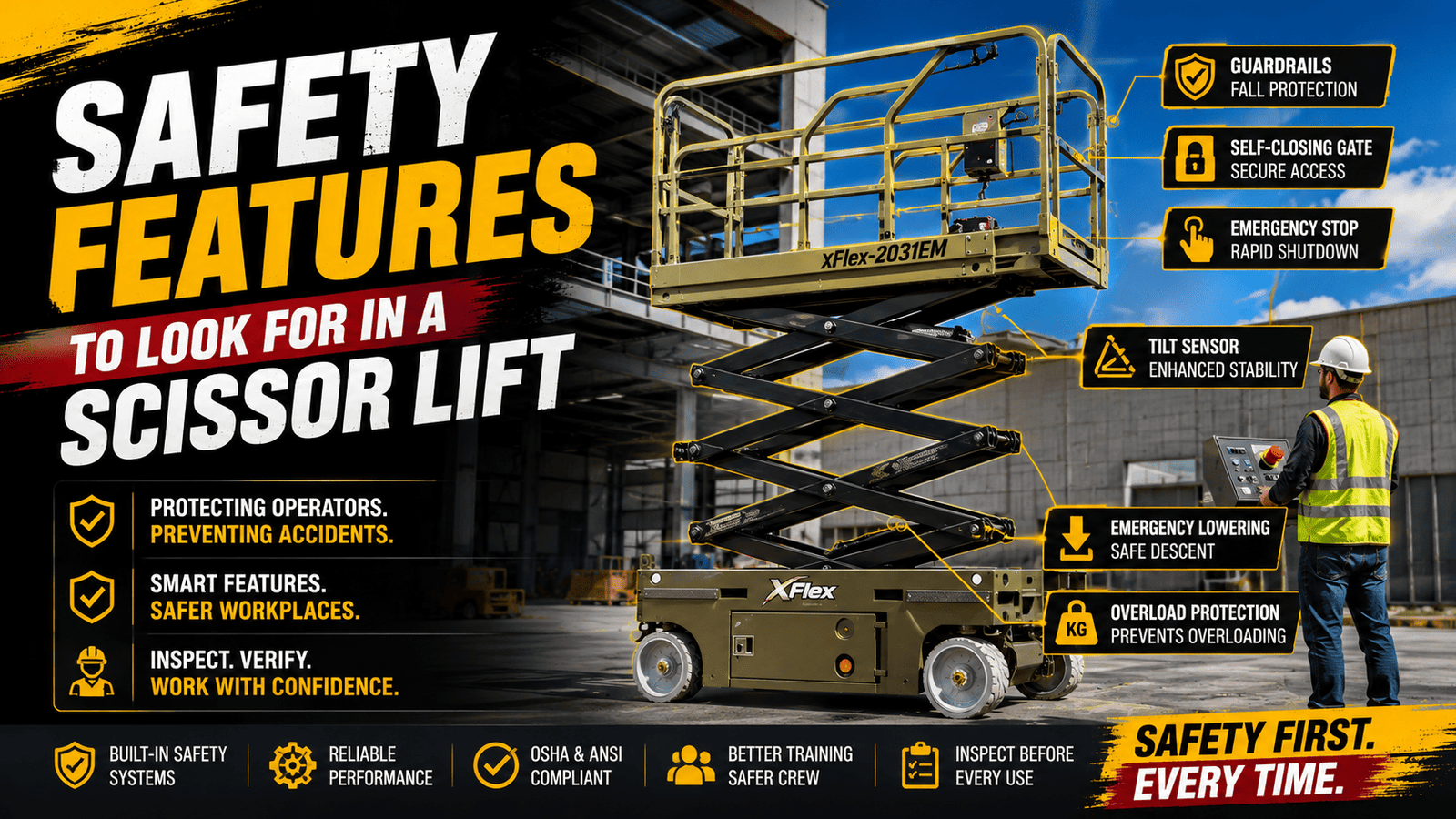
Safety Features to Look for in a Scissor Lift
A scissor lift isn’t safe because of any single part. It’s safe because a set of systems — guardrails, emergency controls, sensors, brakes, and interlocks — all work together and get checked before every shift. Knowing what those systems are and what each one actually does is the difference between buying or renting a machine you trust and one you’re just hoping holds up.
This matters whether you’re buying a lift for your fleet, renting one for a two-day job, training a new operator, or running a pre-start inspection you’ve done a hundred times. The exact mix of features varies by manufacturer and machine type — a compact electric slab lift and a rough-terrain unit don’t carry identical equipment — so treat this as a framework for what to look for, not a universal spec sheet. Always verify specifics against the manufacturer’s documentation for the machine in front of you.
What Safety Features Should You Look for in a Scissor Lift?
The core systems worth checking on any scissor lift are guardrails and secure platform access, emergency stop controls, an emergency lowering system, tilt or level sensing, pothole protection, overload protection, safety interlocks, audible and visual alarms, braking and parking systems, ground controls, controlled descent, non-slip platform surfaces, clear safety signage, and a documented inspection and service history. Not every machine has every feature in the same form, and newer machines increasingly bundle several of these into digital monitoring systems — see this rundown of current ANSI scissor lift standards for how “load sense” and tilt-sensing requirements have evolved. Below, each system gets a closer look at what it does and why it’s worth checking.
Guardrails and Safe Platform Access
Guardrails are the most basic line of defense against falls, and they’re also the feature people are most tempted to treat casually. A proper system includes top rails, mid rails, and toe boards where applicable, plus a gate or chain that closes securely at the entry point. Check that the platform floor itself is solid and free of damage — a guardrail doesn’t help much if the deck underneath it is compromised.
Operators should never remove, modify, or prop open a guardrail system to make a job easier, and buyers should treat any machine with damaged or missing rail sections as unsafe to operate until repaired. This guide to essential scissor lift safety rules covers guardrail inspection points in more depth.
Emergency Stop System
Every scissor lift should have an emergency stop that’s clearly marked and immediately reachable — typically one at the platform controls and one at the ground controls. Hitting it should cut power to the drive and lift functions right away. TYPHON’s xFlex-4046EW, for example, lists emergency stop, a safety support rod, and automatic safety cutouts among its standard safety controls — a fairly typical baseline for a modern electric scissor lift.
Before operating any machine, confirm the emergency stop actually works and that both the operator and anyone assisting on the ground know exactly where it is. Training on emergency procedures is as much a part of this system as the button itself — see the OSHA scissor lift certification overview for what that training typically covers.
Emergency Lowering System
If the primary controls fail or the machine loses power mid-shift, an emergency or auxiliary lowering system is what gets the platform back down safely. Some machines have a ground-level manual lowering valve; others use an auxiliary power pack. The exact procedure differs by manufacturer, and it’s not something to figure out for the first time during an actual malfunction.
Anyone operating the lift — not just the site supervisor — should know the specific emergency-lowering steps for that machine before starting work. This overview of what happens when a scissor lift needs to move or recover while elevated touches on how emergency lowering fits into broader elevated-operation safety.
Tilt and Level Sensors
A tilt or level sensor detects when the chassis is beyond an acceptable angle and typically responds by sounding an alarm and restricting certain lift or drive functions. What it does not do is make it safe to operate on a slope the manufacturer hasn’t rated the machine for. The sensor is a warning system, not a stability guarantee.
Operators need to know their specific machine’s slope limits and treat a tilt alarm as an immediate stop-and-reassess signal, not something to work around. This detailed look at scissor lift use on sloped floors explains how quickly the tipping line shortens once a machine is elevated on an incline.
Pothole Protection
Pothole protection systems — usually deployable guards or sensors near the wheels — help the machine detect a depression, curb, or drop-off before it destabilizes the lift, particularly at height. They’re common on electric scissor lifts that may occasionally cross uneven pavement or transition zones between indoor and outdoor surfaces.
This system supplements safe surface selection; it doesn’t replace it. A machine with working pothole protection can still tip if it’s operated on ground the manufacturer never intended it for. This piece on moving a scissor lift while elevated covers how pothole protection and tilt sensors work together during elevated movement.
Platform Overload Protection
Rated platform capacity covers everyone and everything on the deck — operators, tools, and materials combined, not just body weight. Many current machines include a load-sensing system that warns the operator or restricts lift functions once the platform approaches its rated limit, though the exact behavior varies by model and manufacturer.
Never treat an overload warning as something to push past. If a job genuinely needs more capacity than the platform is rated for, the answer is a different machine, not a workaround. Weight-related tip-over causes — including uneven load distribution — are covered in this piece on why scissor lifts move or tip while elevated.
Safety Interlocks
Interlocks are the systems that prevent certain functions from operating unless specific conditions are met — for example, preventing drive functions unless the platform gate is closed, or preventing elevation unless outriggers (where equipped) are properly deployed. They exist to stop a machine from being used in a configuration it wasn’t designed for.
If an interlock seems to be malfunctioning, that’s a repair issue, not something to bypass. A machine with a defeated interlock has effectively lost one of its built-in safeguards. This overview of common scissor lift accidents walks through several incidents traceable to safety systems being ignored or disabled.
Audible and Visual Warning Systems
Backup alarms, motion alarms, tilt alarms, overload warnings, flashing beacons, and fault-code displays all serve the same basic purpose: giving the operator and anyone nearby a clear signal about the machine’s current condition. A flashing amber beacon during elevation, for instance, tells ground crew the platform is active before they walk underneath it.
These systems help — they don’t substitute for basic situational awareness or clear communication between the operator and anyone working near the lift. Treat an alarm as information to act on immediately, not background noise.
Braking and Parking Systems
Service brakes bring the machine to a controlled stop while driving; parking brakes, often automatic on electric models, hold the machine in place once it’s stationary. Braking performance depends heavily on surface conditions — wet concrete, gravel, and a slight grade all change stopping distance in ways that firm indoor flooring doesn’t.
Check brake function as part of every pre-start inspection, and never assume a braking system rated for firm, level ground will perform the same way on a compromised surface. This rough terrain scissor lift breakdown covers how tire condition, hydraulic fluid, and brake maintenance interact on outdoor-rated machines specifically.
Ground Controls and Emergency Controls
Ground-level controls exist for machine recovery, emergency lowering, and situations where the operator on the platform needs backup from someone below. They’re not just a backup convenience — they’re part of the emergency response plan for the machine.
Anyone who might need to operate ground controls during an emergency should know where they are and how to use them before the machine goes into service, not after something has already gone wrong.
Platform Floor and Access Safety
A non-slip, clean platform floor is part of the safety picture as much as any mechanical system. Loose tools, debris, spilled fluid, or a damaged deck surface all create trip hazards at height where a stumble carries more consequence than it would on the ground.
Basic housekeeping — clearing the platform between tasks, securing loose materials, checking for damaged flooring — belongs in every pre-use routine. This pre-use inspection walkthrough includes platform and guardrail checks as a distinct inspection step.
Safety Features for Electric Scissor Lifts
Electric scissor lifts carry their own set of things worth checking: battery condition and charge level, the condition of the charging system and cables, electrical fault indicators, and the physical condition of the battery compartment. Most current electric models also include automatic safety cutouts and fault-code displays that flag electrical issues before they become operational ones.
Non-marking tires matter for floor protection but aren’t a safety system on their own. Always follow the manufacturer’s specific charging and battery-maintenance procedures — improvised battery repairs or charging shortcuts are a real source of preventable incidents. This overview of slab scissor lift features covers what’s typically standard on compact electric models.
Safety Features for Rough Terrain Scissor Lifts
Rough-terrain machines add four-wheel drive on many models, larger tires, greater ground clearance, and — on some units — oscillating axles or auxiliary leveling systems to help maintain stability on uneven ground. Gradeability ratings tell you the steepest slope the machine is rated to climb, which is a hard limit, not a suggestion.
None of this makes a rough-terrain lift suitable for any terrain. Ground conditions still need to fall within the manufacturer’s stated limits, and site-specific hazards — soft ground, hidden drop-offs, standing water — still need a human assessment before the machine goes out. This guide to what defines a rough terrain scissor lift breaks down which features are standard versus optional across current models.
What to Check During a Scissor Lift Pre-Start Inspection
Platform: guardrails, gate, floor condition, toe boards where applicable, platform controls, emergency stop.
Machine: tires and wheels, visible hydraulic or electrical components, structural condition, fluid leaks, battery condition, warning lights, alarm function.
Safety systems: emergency lowering, interlocks, tilt warning, overload system where equipped, braking, steering, drive functions.
Inspection procedures vary by machine, and the manufacturer’s operator manual is the authoritative source — not a generic checklist. Site-specific requirements from an employer’s safety program apply on top of that.
Scissor Lift Safety Features Buyers Should Prioritize
| Safety Feature | Why It Matters | What Buyers Should Check |
|---|---|---|
| Guardrails | Fall prevention | Condition and secure closure |
| Emergency Stop | Rapid shutdown | Functions at both platform and ground |
| Emergency Lowering | Recovery after power loss or malfunction | Manufacturer-specific procedure |
| Tilt Sensor | Alerts to unsafe inclination | Function and fault indicators |
| Pothole Protection | Helps manage elevated operation on uneven ground | Condition and function |
| Overload Protection | Helps monitor rated capacity | Warning system status |
| Interlocks | Prevents certain unsafe function combinations | Confirms proper operation |
| Alarms | Warns operator and nearby personnel | Audible and visual function |
| Brakes | Controlled stopping and parking | Condition and performance |
No single feature on this list guarantees safe operation on its own — they work as a system, alongside trained operators and proper site assessment.
How to Choose a Safe Scissor Lift
- Identify the work environment — indoor, outdoor, or both.
- Determine the required working height for typical jobs.
- Determine required platform capacity.
- Decide between electric and rough-terrain based on terrain and emissions needs.
- Check machine dimensions against doorways, aisles, and access points.
- Review the safety systems standard on the specific model.
- Check inspection and maintenance history if buying used.
- Review manufacturer documentation for emergency procedures and limits.
- Confirm service and parts support in your area.
- Make sure operators will receive appropriate training before the machine is used.
New vs Used Scissor Lift Safety
New equipment comes with the latest safety systems as designed, full manufacturer documentation, warranty coverage, and predictable condition from day one.
Used equipment requires more legwork: review inspection history, total operating hours, structural condition, battery health, tire condition, and whether all controls, alarms, and emergency systems function as designed. Watch specifically for unauthorized modifications — anything that looks like a guardrail section was altered, an interlock was bypassed, or a warning system was disconnected is a hard stop, not a negotiating point. This list of signs it may be time to replace a scissor lift is a useful reference when evaluating a used machine, and this rent-or-buy guide can help weigh the safety and cost tradeoffs of each option.
Used equipment safety checklist: verify current inspection certification, request maintenance records, test emergency stop and lowering systems, check for structural cracks or corrosion, confirm alarms and warning lights function, and inspect for any sign of a modified or disabled safety system.
Common Scissor Lift Safety Mistakes
- Skipping pre-start inspections — a five-minute walk-around catches problems before they become incidents.
- Exceeding platform capacity — combined weight of people, tools, and materials adds up faster than expected.
- Operating outside manufacturer limits — slope, wind, and surface ratings exist for a reason.
- Ignoring warning alarms — treat every alarm as an immediate stop-and-check signal.
- Modifying safety systems — a bypassed interlock or disabled alarm removes a built-in safeguard permanently, not just for that shift.
- Removing guardrails — even temporarily, for convenience.
- Using visibly damaged equipment — cracked welds, leaking hydraulics, or worn tires are grounds to take a machine out of service.
- Ignoring unsuitable surfaces — matching the machine to the ground, not the other way around.
- Neglecting battery and tire maintenance — small issues compound into stability and reliability problems.
- Allowing untrained personnel to operate the lift — training is not optional, regardless of how simple the machine looks.
Why Training Matters as Much as Equipment Features
The best safety systems on the market can’t compensate for an untrained operator, a skipped site assessment, or a supervisor who doesn’t enforce basic procedures. Equipment features reduce risk; they don’t eliminate the need for a trained person making good decisions in real time. Buyers evaluating a machine should weigh training and documentation support alongside the hardware itself — this OSHA scissor lift certification overview explains what a typical training program covers and why OSHA treats training as a distinct requirement from the machine’s built-in features.
7. FAQ Section
What are the most important safety features to look for in a scissor lift? The most important safety features to look for in a scissor lift are guardrails with a secure gate, working emergency stop and emergency lowering systems, tilt sensing, overload protection, safety interlocks, audible/visual alarms, and reliable braking. Exact features vary by model, so verify against the specific machine’s documentation.
What safety devices are on a scissor lift? Common safety devices include guardrails, platform and ground emergency stops, an emergency lowering system, tilt or level sensors, pothole protection, overload warning systems, interlocks, motion or backup alarms, and parking brakes. Not every device is standard on every model.
Do scissor lifts have emergency lowering systems? Most scissor lifts include some form of emergency or auxiliary lowering system for use if power is lost or primary controls fail. The exact method — a manual valve, auxiliary power pack, or ground-level control — varies by manufacturer, so operators should learn the specific procedure for their machine.
What does a tilt sensor do on a scissor lift? A tilt sensor detects when the machine’s chassis exceeds a safe angle and typically triggers an alarm while restricting certain lift or drive functions. It’s a warning system, not a guarantee of stability, and doesn’t make it safe to operate beyond the manufacturer’s rated slope limits.
What is pothole protection on a scissor lift? Pothole protection is a deployable guard or sensor system, usually near the wheels, that helps detect depressions, curbs, or drop-offs that could destabilize the machine, especially while elevated. It supplements — but doesn’t replace — operating on approved, level surfaces.
Do scissor lifts have overload protection? Many current scissor lifts include a load-sensing system that warns the operator or restricts certain functions as the platform approaches its rated capacity. Not all models have this feature in the same form, so rated capacity should always be confirmed and respected regardless of what warning systems are present.
What should I check before operating a scissor lift? Before operating a scissor lift, check guardrails and the platform gate, test the emergency stop and alarms, inspect tires and visible hydraulic or electrical components, confirm braking and interlocks function properly, and verify the platform floor is clear of debris and damage.
Are guardrails required on scissor lifts? Guardrails are a standard safety feature on virtually all scissor lifts and are treated as fall protection under applicable workplace scaffold standards in the U.S. Requirements can vary by jurisdiction and worksite, so employers should confirm specifics against current OSHA and site safety requirements.
Are electric scissor lifts safer indoors? Electric scissor lifts are generally well suited to indoor use because of their low noise, zero direct emissions, and non-marking tires, which reduce certain workplace hazards. “Safer” still depends on proper operation, inspection, and matching the machine to the surface and task — not the power source alone.
What should I inspect when buying a used scissor lift? When buying a used scissor lift, inspect battery and tire condition, structural welds for cracks or corrosion, hydraulic components for leaks, and confirm that guardrails, emergency stop, emergency lowering, alarms, and interlocks all function correctly. Request maintenance records and a current inspection certificate before purchase.