

High-Capacity Scissor Lifts: When Do You Need More Load Rating?
Let’s be real for a second—running a busy job site or managing a massive warehouse isn’t just about hitting deadlines. It’s about making sure your crew can do their jobs efficiently and, most importantly, get home safely at the end of the day. A huge part of that comes down to the equipment you rent or buy a high-capacity scissor lifts.
Sure, standard lifts are great for quick, lightweight jobs like changing out warehouse lighting or doing a bit of touch-up painting. But what happens when the job suddenly demands heavier materials, bigger tools, and more guys in the air? Pushing standard equipment beyond its limits isn’t just a bad idea; it’s a massive safety hazard waiting to happen.
That’s exactly when high-capacity scissor lifts become the real MVPs of your operation. Figuring out your required load rating shouldn’t be an afterthought. If you miscalculate how much weight your lift can handle, you’re risking equipment breakdowns, blown budgets, and worst of all, serious injuries.
So, knowing exactly when it’s time to upgrade to a machine with a much higher load rating is a call every project manager needs to get right. By taking a hard look at what your daily operations actually look like, you can swap out struggling equipment for heavy-duty machinery that lets your team work confidently and securely.
Top Features of High-Capacity Scissor Lifts
1. Understanding High-Capacity Scissor Lifts and What Makes Them Different
If you think high-capacity scissor lifts are just regular lifts with a fresh coat of paint, think again. These machines are engineered from the ground up to tackle jobs that would literally crush standard equipment.
We aren’t talking about sending one guy up with a toolbelt here. We’re talking about hoisting multiple workers, bulky steel pipes, and heavy diagnostic gear dozens of feet into the air without so much as a wobble.
Here at scissorlifts.org, we’ve seen firsthand how a job site transforms when contractors finally bring in the right equipment. These heavy-duty beasts feature thick, reinforced steel cross-braces and commercial-grade hydraulic systems that keep the platform dead-steady, even when loaded to the absolute max.
They are built for the grit of real-world environments, shrugging off uneven dirt lots, gravel, and massive indoor manufacturing floors. The sheer structural integrity means your crew isn’t constantly fighting the sway of the platform, letting them focus entirely on the complicated task at hand.
- Beefed-Up Structural Framing: Unlike standard models, these feature high-strength steel arms and reinforced chassis designs that completely kill platform sway, even when loaded down with heavy materials at maximum height.
- Massive Deck Space: You get a whole lot more room to breathe. The larger platform sizes mean your crew isn’t tripping over each other or their gear, which directly cuts down on job site accidents.
- Industrial Hydraulic Power: Forget about stalling out halfway up. The oversized hydraulic cylinders on these units deliver smooth, consistent lifting power that effortlessly handles payloads standard aerial platforms simply can’t touch.
2. Signs It’s Time to Step Up Your Load Rating
How do you know when you’ve outgrown your current lift? It’s usually pretty obvious if you spend enough time watching your crew work. The biggest red flag is constantly needing more than one person in the air to get a job done.
If you have two or three guys struggling to muscle a heavy commercial glass pane or an HVAC duct into place, a standard lift is going to bottom out fast. Another huge giveaway is watching your operators play elevator all day.
If they have to make five trips up and down just to swap out tools and materials because the lift can’t hold everything safely at once, you are burning money on wasted time. Upgrading to high-capacity scissor lifts completely wipes out this problem.
You can load up the entire crew, their toolboxes, and the installation materials for a single, safe ride to the top. As a project manager, you have to run the numbers: if the combined weight of your guys, their heavy winter gear, their tools, and the building materials is even creeping close to your standard lift’s limit, it’s time to stop risking it and upgrade your load rating.
- You Need a Bigger Crew in the Air: When your daily tasks require complex teamwork at height, you absolutely need a platform rated for the weight of multiple grown adults working simultaneously.
- You’re Lifting Seriously Heavy Stuff: If your projects involve structural steel, heavy commercial piping, or massive electrical spools, standard limits just won’t cut it.
- Your Cycle Times Are Too Slow: If you are losing hours every week because workers have to keep lowering the lift to grab more materials, a higher capacity machine will instantly boost your daily productivity.
3. Don’t Forget How Scissor Lift Attachments Change the Game
One thing that trips up even experienced contractors is forgetting how attachments mess with your math. Over at scissorlifts.org, we love a good attachment—things like pipe cradles, tool trays, and heavy-duty panel carriers can completely change how fast you get a job done.
They keep the workspace clean and stop tools from getting kicked off the edge. But here is the catch: those attachments aren’t weightless. Every single thing you bolt or clamp onto that platform eats into your total scissor lift load capacity.
Not only that, but hanging heavy materials off the side of the lift shifts its center of gravity. If you aren’t using manufacturer-approved gear, or if you forget to deduct the weight of the attachment (the tare weight) from your total capacity, you are asking for a tip-over accident.
You always have to do the math before anyone steps foot on the deck. Taking the time to understand how your specific setup changes your usable capacity is what separates the pros from the amateurs.
- Watch the Center of Gravity: Every pipe rack or panel carrier you add changes how the lift balances. You have to account for this shift to prevent terrifying tipping hazards on the job.
- Stick to the Manufacturer Specs: Never try to weld on your own makeshift racks. Only use OEM-approved attachments to make sure you aren’t voiding safety certifications or compromising the frame.
- Always Deduct Tare Weight: You have to subtract the physical weight of the attachments themselves from your total load rating to figure out how much weight you actually have left for your crew and materials.
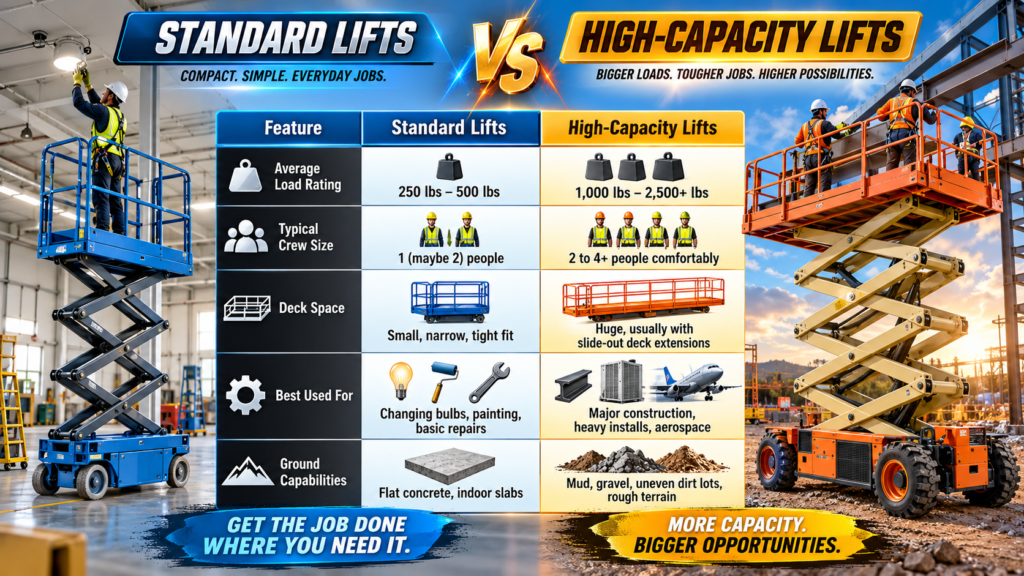
4. Breaking It Down: Standard vs. High-Capacity Lifts
Sometimes you just need to see the numbers side-by-side to understand why an upgrade makes sense. The difference between a standard lift and a heavy-duty model really boils down to raw muscle and workspace. Standard lifts are fantastic for simple, contained jobs on flat, concrete floors.
But when you move into the territory of heavy commercial builds, those standard lifts start to look like toys. High-capacity models are basically mobile, elevated workshops. They are built wider, stronger, and tougher to handle whatever you throw at them. To make it crystal clear, let’s look at a quick comparison.
This breakdown should help you and your procurement team see exactly why paying a little more for a higher load rating is the smartest investment for serious industrial applications.
Table: High-Capacity Scissor Lifts
| Feature | Standard Lifts | High-Capacity Lifts |
| Average Load Rating | 250 lbs – 500 lbs | 1,000 lbs – 2,500+ lbs |
| Typical Crew Size | 1 (maybe 2) people | 2 to 4+ people comfortably |
| Deck Space | Small, narrow, tight fit | Huge, usually with slide-out deck extensions |
| Best Used For | Changing bulbs, painting, basic repairs | Major construction, heavy installs, aerospace |
| Ground Capabilities | Flat concrete, indoor slabs | Mud, gravel, uneven dirt lots, rough terrain |
- Massive Weight Differences: You are looking at machines that can safely carry three to five times more weight than a standard lift, easily holding well over 1,500 pounds without breaking a sweat.
- Room to Actually Work: The larger deck size on heavy duty scissor lifts means your guys can set up a proper workflow in the air, rather than constantly stepping over each other.
- Beasts on Bad Terrain: Standard lifts get stuck on a pebble. High-capacity models usually rock 4WD and foam-filled rough terrain tires, letting you power through mud and uneven construction yards.
5. Real-World Jobs Where High-Capacity is Mandatory
You might be wondering who actually needs all this lifting power. The truth is, some industries simply can’t function without it. Take the aerospace industry, for example. When technicians are doing final safety checks or assembling a commercial jet, they need to bring themselves, heavy replacement parts, and delicate testing computers right up to the fuselage.
A standard lift would be incredibly dangerous in that scenario. Commercial construction is another big one. When ironworkers are tying in structural steel, or glaziers are installing massive exterior windows on a high-rise, they need an aerial work platform that stays rock-solid under extreme weight. Even massive distribution warehouses rely on these big rigs to install heavy pallet racking systems close to the ceiling.
In these high-stakes environments, having a lift that taps out at 500 pounds isn’t just inconvenient; it completely stops the job dead in its tracks.
- Aerospace and Aviation: Mechanics rely on these massive platforms to safely elevate multi-person teams and heavy tools right up to the wings and fuselage of commercial planes.
- Major Commercial Construction: Ironworkers and pipefitters need the extreme capacity to haul steel beams, concrete blocks, and massive pipes up to the higher levels of active job sites.
- Industrial Warehouse Outfitting: Facility teams use them indoors to safely install miles of heavy electrical conduit, heavy-duty sprinkler systems, and overhead crane rails.
6. Keeping It Safe When the Weight Goes Up
Operating big machinery means you have to take safety seriously. Having a massive load rating doesn’t give you a free pass to ignore the rules; in fact, the stakes are even higher. Your operators need to be trained—not just a quick five-minute rundown, but actual, hands-on training so they know how to read the capacity charts stamped on the side of the machine.
Those charts tell you exactly what the lift can handle, especially when you push the deck extensions out. The golden rule? Never push the machine to its absolute limit. Leaving a buffer zone is just common sense.
Also, pre-shift inspections aren’t optional. Your crew needs to check the hydraulics, look for fluid leaks, and make sure any attachments are bolted on tight before they ever go up. Finally, teach your guys about weight distribution.
If you pile 1,000 pounds of concrete blocks onto the very edge of the deck extension, the lift can tip over, even if you are technically under the total weight limit. Spread the weight out, keep your head on a swivel, and respect the machine.
- Read the Charts: Every operator needs to know exactly how to calculate the combined weight of their crew, gear, and attachments so they never accidentally exceed the machine’s true capacity.
- Do the Daily Walkarounds: Before the key even turns, someone needs to visually inspect the hydraulic lines, tire pressure, and structural pins to ensure the lift is safe to operate under a heavy load.
- Balance the Deck: You have to teach your crew to keep heavy materials centered on the main platform. Loading all the heavy stuff on the slide-out extensions completely ruins the machine’s balance.
FAQs About High-Capacity Scissor Lifts
What is the maximum load rating of high-capacity scissor lifts?
Usually, these machines start at around a 1,000 lb limit and can go all the way up to 2,500 lbs or more. This makes them perfect for lifting heavy construction materials and multiple workers at the same time.
How many workers can safely fit on a high-capacity platform?
While standard lifts get crowded with just two people, high-capacity models have massive decks that can easily and safely fit 3 to 4 workers, plus all their gear, without feeling cramped.
Do scissor lift attachments actually lower my load rating?
Yes, they do. Anything you add to the lift, like a heavy pipe rack, adds “tare weight.” You have to subtract the weight of that attachment from your scissor lift load capacity to know how much room you have left for people and materials.
What’s the real difference between standard and high-capacity scissor lifts?
It’s all about weight and space. High-capacity lifts hold thousands of pounds more, have much wider decks, and are usually built with rugged tires to handle rough outdoor terrain, whereas standard lifts are for light, indoor work.
How do I know it’s time to rent heavy duty scissor lifts?
If your crew is constantly making multiple trips to swap tools, if you need three guys in the air at once, or if you’re installing incredibly heavy materials like steel beams, it’s time to get a bigger lift.
Can I use a high-capacity scissor lift in the mud or on gravel?
Absolutely. Many of these bigger lifts are built specifically as rough terrain machines. They come with 4-wheel drive, beefy tires, and automatic leveling systems so you can work safely on uneven dirt and gravel lots.
What actually happens if I go over the lift’s weight limit?
Going over the weight limit is incredibly dangerous. It stresses the hydraulic systems, throws off the machine’s balance, and can easily cause the lift to tip over, leading to severe injuries or worse for your crew.
Conclusion – High-Capacity Scissor Lifts
At the end of the day, picking the right aerial work platform can make or break your project. High-capacity scissor lifts bring the muscle, the deck space, and the rock-solid stability you need to get the toughest jobs done right.
Once you truly understand how much weight your daily operations demand, you can stop settling for equipment that holds your team back. Don’t let an underpowered lift ruin your timeline or put your guys at risk.
When the job calls for heavy materials, specialized attachments, and a full crew in the air, upgrading your load rating isn’t just a luxury—it’s a necessity. Head over to scissorlifts.org to figure out exactly which heavy-duty machine is going to take your next project to the top safely and efficiently.
Discussion
0 comments