

- How Scissor Lifts Increase Workplace Productivity
- Going beyond the limits of traditional ladders and scaffolding
- Adjustability for different work settings and inclined floors
- Specialized Scissor Lift Attachments for an Improved Workflow
- Gas vs. Electric: Picking the Right Power Source for Efficiency
- Safety and Preventative Maintenance Protocols are Improving
- Tabular Comparison: Scissor Lifts vs. Traditional Elevation Methods
- FAQs: How Scissor Lifts Improve Workplace Productivity
- The bottom line - How scissor lifts improve workplace productivity
How Scissor Lifts Increase Workplace Productivity
If you run a busy warehouse, a complicated construction site or a huge industrial plant, time is your most precious asset. Every minute spent on inefficient material handling, risky elevation procedures or poorly optimized operations damages your bottom line. Understanding how scissor lifts improve workplace productivity is prominent to enhance efficiency and productivity.
This gets us to the key issue that project managers and facility supervisors continually ask: what is the most efficient method to lift personnel and large goods securely while keeping a fast pace of work?
The solution is current lifting technology and this is why knowing how scissor lifts improve workplace productivity has become a must for today’s company owners. These tough machines are no longer optional luxuries, but essential assets that alter the way high-reach activities are performed and accomplished on a daily basis.
Scissor lifts may provide a solid, large and highly movable platform, without the burdensome set up time of conventional scaffolding and the inherent risks of regular ladders. In this extensive tutorial, we’ll show you the several ways these machines can make life easier, from high-tech deck attachments to unique terrain features, showing that a purchase of a scissor lift is an investment into the total productivity of your team in the long run.
Going beyond the limits of traditional ladders and scaffolding
For many years, building crews and facility maintenance teams have depended on conventional ladders and sophisticated scaffolding systems to reach high work areas. Although these procedures were useful in the past, they are well known to be labor-intensive, time-consuming, and unsafe.
Getting scaffolding up takes a crew, careful levelling and hours of assembly before any real work can even begin. Also, shifting the scaffold to a new part of the structure entails pulling down and rebuilding all over again.
But ladders limit mobility, have very limited weight capabilities and force workers to make constant, tiring journeys up and down to gather equipment and supplies. This constant interruption produces physical exhaustion and greatly affects the process, resulting in delays to project timeframes.
By incorporating advanced elevation technology into your everyday activities, you eliminate those outmoded inefficiencies altogether. One of the first things you will notice when assessing how scissor lifts improve workplace productivity in the workplace is the substantial decrease in setup and relocation time.
The worker just drives the lift to the correct spot, loads all the gear he needs onto the roomy platform and within seconds he’s lifted to the appropriate working height.
The smooth transition from the ground to peak height enables contractors, electricians and warehouse workers to concentrate on the job without of worrying about their balance or where to store their equipment. The short term effect is an ultra-focused staff that can get projects done in a fraction of the time.
- Quick Movement: Scissor lifts are instantaneously drivable and repositionable without the need for considerable deconstruction, enabling continuous operations over broad project sites, unlike scaffolding.
- High Load Capacity: The generous platforms allow several personnel, heavy equipment and bulk products to be securely housed concurrently, avoiding the need for repeated excursions up and down.
- Improved Ergonomics: Workers may set the platform to the precise inch they need for their individual job, thus eliminating uncomfortable bending, overreaching and physical stress.
Adjustability for different work settings and inclined floors
Scissor lifts are so versatile that they are vital instruments in an incredible diversity of job settings. Whether you’re working within a clean, climate-controlled warehouse or on the muddy, uneven terrain of a preliminary building site, you’re designing for a certain set of settings and there’s a specific model built to combat those precise challenges.
Electric scissor lifts are a great option for interior applications because they provide a whisper-quiet, zero-emission solution that keeps the air clean and the noise levels low enough to allow regular business activities to continue undisturbed. In contrast, outdoor work environments frequently need tough durability. Heavy-duty tires, four-wheel drive and strong engines let scissor lifts designed for tough terrain travel through dirt, mud and debris without becoming stuck.
One of the most surprising technical innovations demonstrating how scissor lifts improve workplace productivity efficiency is the creation of specialized equipment for sloping floors and uneven soils. In the past, operating on a slope required a lot of levelling of the land or complicated stabilising devices to make sure elevation was safe. Today, modern bi-leveling systems and active leveling chassis constantly change the base of the machine, as it travels up and down various types of inclines.
Operators no longer have to spend hours prepping the ground, they can just drive up to a hillside, ramp or inclined driveway and begin to work straight away with total stability. This technology leap allows your team the flexibility to continue to operate at top safety standards while driving productivity to new heights, no matter the terrain.
- Adaptive Leveling Technology: Today’s bi-level scissor lifts can automatically adjust the chassis on sloping or uneven floors, so they may be used immediately without having to prepare the ground.
- Indoor & Outdoor Excellence: Non-marking tire electric variants for warehouse operation and four-wheel drive models for outdoor terrain means minimal downtime across several locations.
- Compact Maneuverability: Many versions are built with a compact chassis and zero inside turning radius to maneuver easily through tight warehouse aisles and crowded industrial routes.
Specialized Scissor Lift Attachments for an Improved Workflow
Using specialist attachments is an important must if you want to properly optimize the value on your heavy equipment investment. A simple platform is handy, but with the correct add-ons, a scissor lift may become a highly specialized mobile workstation. Industries are continuously seeking to stay competitive, and adding accessories like as deck extensions, heavy-duty tool trays and material racks directly helps them do just that.
For example, deck extensions enable the platform to extend over barriers like equipment, racking or landscaping to reach hard-to-reach regions without having to continually move the base of the lift. This implies a worker may access a much bigger surface area, for instance while putting drywall or painting a wide ceiling, in one continuous lift cycle.
Micro-efficiencies are achieved by keeping equipment and supplies organized at height, and they are important to understand how scissor lifts improve workplace productivity and enhances efficiency. Custom tool trays and material handling racks make sure everything an electrician, HVAC professional or pipefitter needs is within arm’s reach.
There are no tripping risks on the platform, and screws, drills and brackets are stored in compartments so workers do not have to bend down or hunt for misplaced goods. Hands free. Work area safe. Concentration unbroken.
This productivity-focused strategy results in speedier turnarounds, allowing contractors to get the job done right the first time and eliminate the annoying need to lower the lift for a forgotten item.
- Extended Reach Capabilities: Deck extensions enable operators to extend their working area and reach over ground level obstructions significantly decreasing the number of times the equipment has to be repositioned.
- Organized Tool Trays: Trays with compartments for holding the most important equipment right where you need them make complex procedures like electrical wiring or HVAC installs faster and keep dropped item dangers at bay.
- Dedicated Material Racks: Built-in racks are provided on the platform for transporting pipe, drywall or signs directly on the platform, making installation easier and preventing harmful clutter on the platform.
Gas vs. Electric: Picking the Right Power Source for Efficiency
It’s an important choice too, since the power source you choose for your scissor lift will have a direct impact on the smooth running of your day-to-day operations. Gas-powered scissor lifts, usually diesel or dual-fuel machines, are the heavyweights of the business. They are driven by stout internal combustion engines that provide the raw power and high torque needed for rugged, all-day labor in the toughest circumstances.
They also have far larger weight capabilities. They can raise several construction workers in heavy work gear, plus a pallet of raw supplies, at the same time. On big building sites, where the ground is a mess and the lifting needs are tremendous, a gas-powered lift reduces the back and forth of material moving which immediately speeds up the construction time frame.
In contrast, electric scissor lifts are the undisputed champions of interior facility maintenance, warehouse and commercial applications. The machines are equipped with modern battery systems that allow for silent, emission-free lifting, a strictly regulated necessity in indoor and poorly ventilated spaces.
Considering the potential of how scissor lifts improve workplace productivity, electric scissor lifts are preferred due to their minimal maintenance demands and smooth and accurate controls.
No filthy engine fluids or complicated combustion parts, therefore the maintenance downtime is greatly minimized. Whether you need raw outside power or interior accuracy, choosing between gas or electric power sources for your work site needs keeps your equipment performing at its best.
- Gas for Unmatched Power: Internal combustion engines provide the high torque and enormous lifting capacity necessary for heavy outdoor work and big material handling.
- Electric for Indoor Precision: Battery powered lifts provide low noise, pollution free operations vital to warehouses, retail locations and operating industrial facilities.
- Reduced Maintenance Downtime: Choosing the correct lift may help decrease mechanical wear and tear. Electric lifts need less time checking fluid levels, while gas lifts give constant power without waiting for battery charging.
Safety and Preventative Maintenance Protocols are Improving
No machine can increase production if it is always breaking down or causing accidents at work. That’s why a proactive strategy for preventive maintenance and comprehensive operator training are closely related to operational efficiency. Scissor lifts are strong devices, but for them to work well, they need to be inspected regularly for hydraulic system, battery level, tire conditions and structural integrity.
The pre-operation checks are done on a rigorous regimen and they may catch little flaws, like a slight hydraulic leak or poor tire wear, and have them fixed before they turn into catastrophic mechanical failures. Project delays caused by abrupt equipment downtime are reduced when the equipment operates precisely as designed every time the key is turned.
Moreover, appropriate scissor lift certification and safety training are some of the most potent instruments in workplace risk control. Well qualified operators know the load capabilities, weight distribution and environmental dangers in detail.
They know just how to operate the equipment quickly and securely, avoiding obstructions above and unsteady terrain. That confidence is the foundation of the main idea of how scissor lifts improve workplace productivity; an operator who understands his or her machine head and out works quicker, makes better judgments and steers totally clear of the mishaps that infamously shut job sites down. Safety in operation means constant, steady production.
- Minimize Equipment Downtime: Daily pre-operation inspections and regular preventive maintenance programs keep your equipment constantly job-ready, preventing unforeseen project delays.
- More Operator Confidence: Certified training gives the operator with the hands-on abilities of maneuvering the lift swiftly and accurately, making the jobs more streamlined and projects completed faster.
- Accident Prevention: By adhering to load capacity limitations and environmental safety requirements, workers avoid incidents that may otherwise result in damaged equipment and delayed operations.
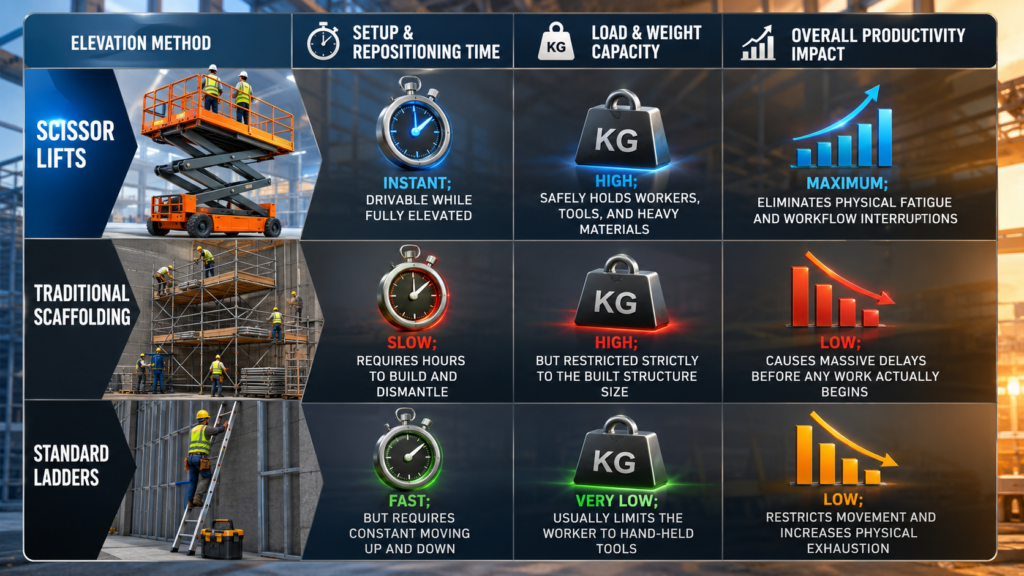
Tabular Comparison: Scissor Lifts vs. Traditional Elevation Methods
| Elevation Method | Setup & Repositioning Time | Load & Weight Capacity | Overall Productivity Impact |
| Scissor Lifts | Instant; drivable while fully elevated | High; safely holds workers, tools, and heavy materials | Maximum; eliminates physical fatigue and workflow interruptions |
| Traditional Scaffolding | Slow; requires hours to build and dismantle | High; but restricted strictly to the built structure size | Low; causes massive delays before any work actually begins |
| Standard Ladders | Fast; but requires constant moving up and down | Very Low; usually limits the worker to hand-held tools | Low; restricts movement and increases physical exhaustion |
FAQs: How Scissor Lifts Improve Workplace Productivity
What is a scissor lift primarily used for in the workplace?
A scissor lift is a multipurpose piece of heavy equipment that can securely carry people, tools and objects vertically. They are mostly utilized in construction, warehouse logistics, building maintenance and electrical installations for work requiring steady, high-reach access without scaffolding.
How exactly can scissor lifts boost efficiency in the workplace?
Scissor lifts provide workers immediate access to elevated regions, removing the need for erecting scaffolding and the physical effort of ascending and descending ladders. Their enormous platforms are able to handle many workers and bulk items at once, minimizing the number of trips up and down and dramatically increasing project deadlines.
What are the benefits of electric scissor lifts for indoor use?
Electric scissor lifts are battery-powered, so they’re silent and emissions-free, helping to keep interior air quality safe. They have non-marking tires to preserve fragile flooring in facilities, and frequently have tiny chassis to handle short passageways in warehouses.
Are scissor lifts safe on steep and uneven floors?
Yeah. Traditional versions need flat floors. Specialized rough terrain and bi-leveling scissor lifts include active leveling chassis. These innovative devices automatically adapt to slopes and uneven terrain, enabling safe, highly productive operation without the time-consuming process of ground leveling.
Why are Scissor Lift Attachments Important for Efficiency?
Trade-specific attachments such as tool trays and material racks and deck extensions help tailor the lift. They protect essential instruments in a segmented fashion, increase the total usable surface space, and remove platform clutter which greatly enhances a worker’s speed and safety when working at height.
How frequently do scissor lifts need maintenance to avoid downtime?
To maintain productivity levels high, operators need to execute fast pre-operation checks before each shift. Perform a full preventive maintenance check, including hydraulic fluids, battery health and structural joints, on a monthly and yearly basis as per manufacturer’s requirements.
Does scissor lift operator training increase productivity?
Indeed. Proper certification ensures operators are completely aware of load restrictions, spatial awareness and sophisticated maneuvering skills. Well-trained operators accomplish complicated jobs more quickly and prevent expensive workplace accidents that may interfere with operational procedures.
The bottom line – How scissor lifts improve workplace productivity
With the fast-paced nature of the industrial ad construction industries today, depending on obsolete ways to do high-reach operations is a definite way to go behind schedule. From massive warehouses to tough outdoor construction sites, current lifting equipment has transformed the way we operate at height.
Looking at the ways how scissor lifts improve workplace productivity, the proof is in the pudding. They substantially reduce set-up times, have large load capacities, are very versatile in difficult and sloping terrains, and can be fitted with highly efficient attachments.
Whether you choose the brute might of a gas-engine lift or the quiet accuracy of an electric model, investing in these equipment – and the right safety training to operate them – ensures a safer, quicker and far more lucrative operational workflow.
Discussion
0 comments