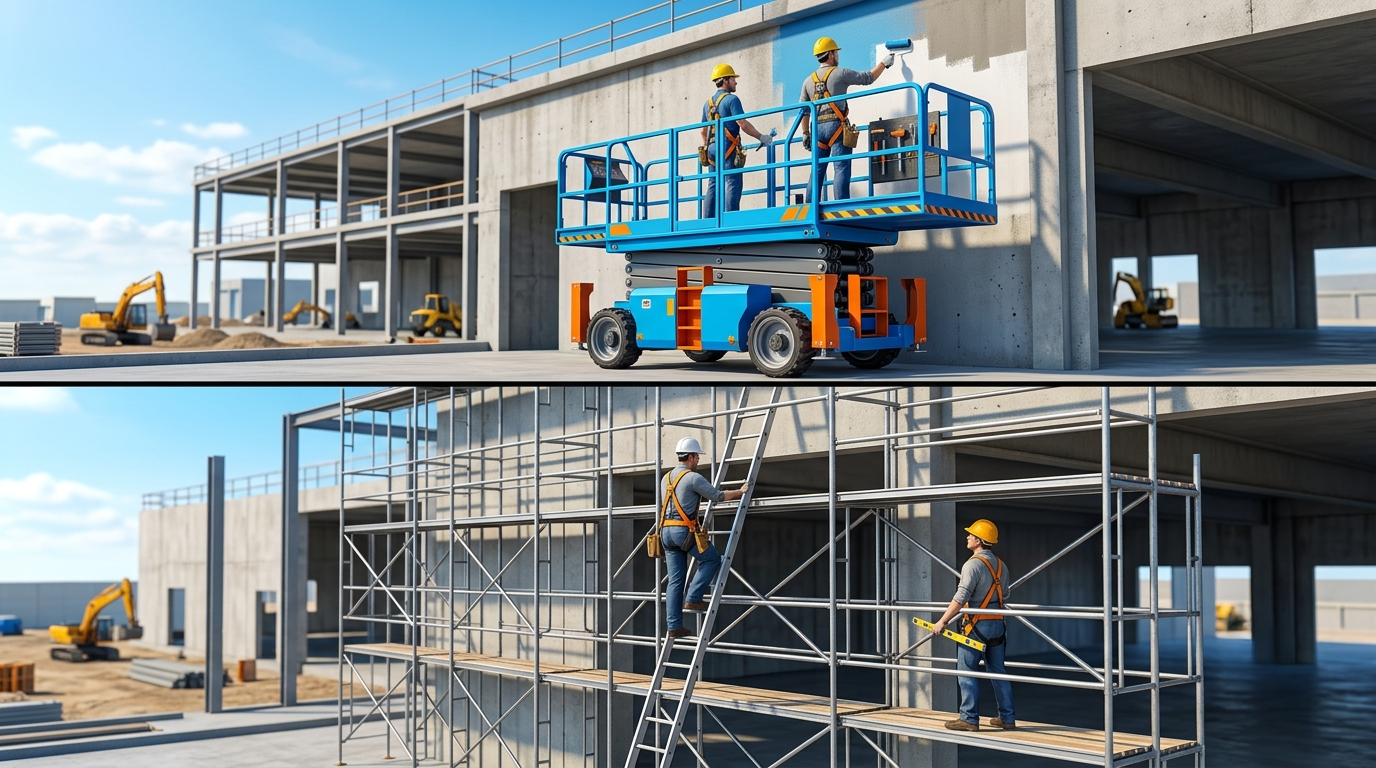
Why Commercial Builders Tend to Choose Scissor Lifts Over Scaffolding?
Choosing the correct work platform at elevation can make a significant impact in the safety, efficiency, and budget aspects of a commercial construction project. For a very long time, scaffolding was a popular choice for the reaching of high elevations in a commercial site. Putting aside the fact that the use of scaffolding was largely the only way for many years, the modern commercial builder tends to be quite different, preferring Scissor Lifts Over Scaffolding.
To this day, most of the commercial contractors choose scissor lifts over scaffolding because of a few unbeatable advantages that that offer – mobility, fast deployment, and site security. Scaffolding is time-consuming and physically demanding to assemble, and it takes up a large amount of space, while a scissor lift can be simply operated and it means a total change of the performance of the work-at-height.
Top Reasons for which the commercial building choose scissor lifts over scaffolding
Top Reasons for which the commercial building sector prefers mechanical platforms over the tubular frame systems which have been traditional for a long time.
1. A Radical Decrease in the Time of Setting Up and Dismantling
The first thing which has an immediate impact on the commercial builders’ decision to use scissor lifts over scaffolding is the optimization of construction schedules. Scaffolding preparation involves such a large amount of manual work that until the actual construction, one cannot really even talk about work starting.
Several hours or even days may pass while the multi-story scaffold frameworks are being erected, which is, of course, not only a very specialized work but also one that needs to be leveled perfectly.
On the other hand, a scissor lift is ready for work the moment it is taken off the trailer. The worker can drive it to the location and raise the platform to the required height. Mechanical, electrical, and plumbing (MEP) contractors can, therefore, begin with their works of overhead infrastructure installation without any delay.
- Immediately Ready for Use: One does not need to align or level pins, braces, or planks in the case of scissor lifts since they are drivable and fully functional right after arriving on-site.
- Fast Working-Height Changes: One has to stop the work and manually reconfigure the wood decks and cross-braces if they want to change the working heights with scaffolding; on the other hand, a scissor lift changes heights in seconds with the push of a joystick.
- Leaner Manpower Requirement: Scaffolding erection and dismantling require a certified crew, but a single operator can deploy, maneuver, and store a scissor lift.
2. Superior Jobsite Mobility and Multi-Positioning
With scaffold, the workers are literally chained to a single, fixed part of a wall or ceiling. If the workers must do the job all along the corridor or have to go around a huge perimeter, they will have to first dismantle the scaffolding piece by piece, then move it, and finally rebuild it. This being literally the nature of it, it inevitably causes bottlenecks in the workflow.
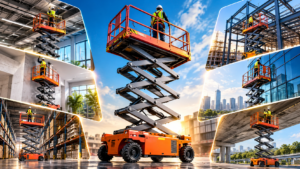
Making a choice scissor lifts over scaffolding gives you thanksgiving moves to use the entire workspace. As opposed to scaffolding, scissor lifts have self-propelled bases with wheels, which means that an operator can be moved while still having them elevated (of course, this depends on the type and the manufacturer’s limits).
Or he can lower them a bit so that the machine can be easily used to move around obstacles and it can travel along the line of the wall. This constant movement iswitch speeds up painting, plastering, insulation, and electrical installations across enormous commercial areas.
- Self-Propelled Control: Operators are able to manually drive the equipment to the concrete surface exactly where they need it, thus completely eliminating the need of ground crews to push or re-assemble equipment.
- Very Small Size for Extremely Narrow Spaces: Compact electric slab models are capable of navigating very narrow hallways and can even fit through standard interior doorways, this is something that is unthinkable for structural scaffolding towers.
- Combination of Indoor and Outdoor Usage: Builders can use the emission-free electric models for wet and delicate indoor floorings and switch to the rough-terrain diesel units when they have to deal with muddy, unpaved outdoor environments.
3. Heavy-Duty Load Handling and Comfortable Working Conditions
It is not uncommon that a commercial project requires work and the moving of heavy materials like bundles of wires, oversized ducts of the HVAC system, heavy stone cladding, or even large sheets of drywall. It is hard physically, and it is very inefficient to have a worker carry a 100-pound drywall sheet up a scaffolding ladder. Also, the team will be exposed to unhealthy ergonomic conditions and fatigue.
Construction teams can rely on scissor lifts over scaffolding and will be operating a heavy-duty mechanized work platform that is designed to accommodate both personnel and weighted materials. Spacious platforms with an ability to safely hold from 500 to more than 2,500 pounds of the workers accompany the majority of the industrial scissor lifts.
This feature alone allows the loads of all tools, fasteners, and heavy materials to be done at the ground level and the lifting of everything at once, which leads to a big reduction in the number of related injuries, physical exhaustion, and muscle strain.
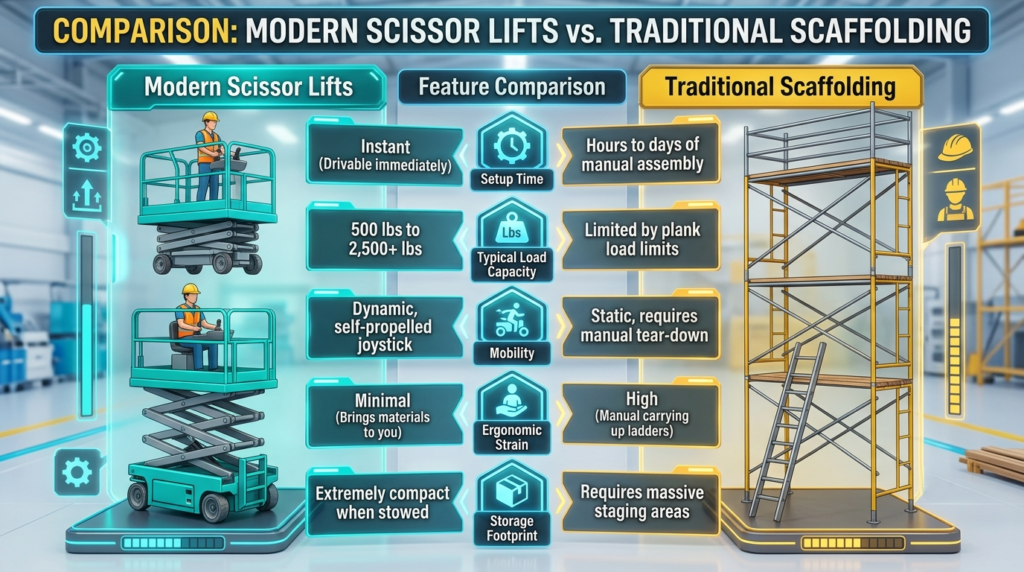
Table: Scissor Lifts Over Scaffolding Comparison
| Feature Comparison | Modern Scissor Lifts | Traditional Scaffolding |
| Setup Time | Instant (Drivable immediately) | Hours to days of manual assembly |
| Typical Load Capacity | 500 lbs to 2,500+ lbs | Limited by plank load limits |
| Mobility | Dynamic, self-propelled joystick | Static, requires manual tear-down |
| Ergonomic Strain | Minimal (Brings materials to you) | High (Manual carrying up ladders) |
| Storage Footprint | Extremely compact when stowed | Requires massive staging areas |
- High Load Capacity: Loading decks that are made for large equipment can easily accommodate multiple workers along with heavy power tools and bulk materials without having to worry about the risk of structural failure.
- Built-in Slide-Out Extensions: Horizontal platform extensions, which are a standard feature of most units, allow workers to bridge horizontal gaps over ground-fixed obstacles, which means they are even safer when avoiding jumps using stairs, etc.
- Reduction in Physical Fatigue: There is also the direct effect that no longer having to, manually, haul heavy supplies up structural ladders results in significantly reduced fatigue and reduced musculoskeletal injury risk.
4. Worker Safety Measures and Accidents Prevention
Working at heights is, unfortunately, one of the primary causes of occupational injuries in the commercial construction sector. Scaffolding can lead to many safety risks in the form of things like planks not properly installed, toe boards missing, a lack of guardrails, or even a tip-over accident due to poor base leveling.
Keeping everything safe across hundreds of linear feet of manual scaffolding can be a nightmare, and it requires daily rigorous inspections and constant oversight.
With a scissor lift, though, the situation is a lot different, due, in large part, to the fact that the design is so thoughtful and that the operation of the piece of machinery is so well regulated.
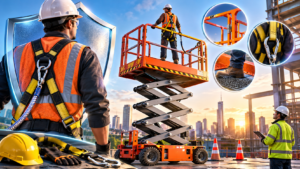
Buying a machine such as a scissor lift means that workers will often have the spot equipped with perimeter guardrails all the time, except for single self-locking entry gates, and there are lanyard anchor points for added safety and security. Automated safety systems such as tilt sensors, pothole protectors, and descent alarms prevent unstable operations.
- Manufactured-Fall Protection System: The steel guardrail systems and self-closing entry gates that have been built-in provide excellent, continuous perimeter protection so the workers have nothing to worry about and the safety is guaranteed all the time.
- State-of-the-art Electronic Sensor Systems: The built-in tilt alarms and slope indicators automatically prevent platform elevation when an unsafe angle of the base is detected to ensure workers’ safety at all times.
- Strong and Precise Lift: Hydraulic force systems move the platform smoothly so that the usual swaying, flexing, and bouncing motion caused by multi-level scaffolding is left completely behind.
5. Financially Sound and Offering Great Return on Investment
There is almost an immediate aspect of price tag when comparing the rental or purchase of scissor lifts with that of buying only basic steel scaffolding pipes and wooden planks. Still, labor almost always is the very largest line-item expense in the commercial construction sector.
Scaffolding accounts for a huge number of unbillable hours, the bailiwick of workmen having to repeatedly assemble, adjust, dismantle, and move it.
Commercial contractors who decide to use scissor lifts over scaffolding are doing so because they are greatly cutting down the number of hours spent on labor-intensive tasks. A job where there was a four-person crew (two assembling scaffolding, two moving it) can now be managed by two people who work from a mobile lift platform.
Time cuts act in the second way by worker wage reduction (fewer workers needed). Also, project delivery time is shortened reducing indirect and overhead costs. The overall outcome is an increase in profitability per project. Besides, some of the indirect cost savings (such as those from first-time quality and reduced safety incidents) are not quantifiable.
- Less Labor-Intensive Tasks: Changing from unproductive setup time to pure production build time increases daily operational efficiency significantly.
- Reduced Presence of On-Site Equipment: Securely locked scissor lifts can be neatly parked away when stowed, while disassembled scaffolding components require ground space and provide opportunities for theft.
- Decreased Number of Workplace Injuries: Softening down the ladder climbs and fall hazards is one of the ways which lead to fewer workers’ compensation claims and helps protect your company’s EMR (Experience Modification Rate); consequently, the insurance premiums are lowered.
Frequently Asked Questions (FAQs) – Scissor Lifts Over Scaffolding
Why is a scissor lift safer than scaffolding?
Because a scissor lift includes steel guardrails, descent valves for emergency use, tilt sensors, and electronic stability sensors among features, it is definitely safer. Scaffolding, on the other hand, depends largely upon the human hand for the last element; which means there is a possibility of human errors such as braces being loosened or toe boards being missing.
What is the use of a scissor lift on the ground which is uneven?
Electric slab models need a flat concrete surface, but Rough Terrain (RT) scissor lifts are specially designed for going around uneven areas outdoors. They have four-wheel drive, the ability to work safely on slopes, and outriggers which are hydraulic and used to level the unit before elevating.
Are the workers required to be specially trained for operating a scissor lift?
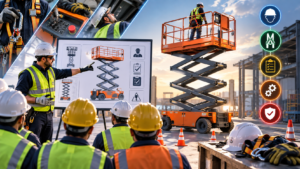
Formally trained and certified operators are the only ones permitted to operate these mobile aerial platforms by the International Safety Regulations and OSHA; these trainings include equipment inspections, load capacities, and fall safety.
What are the differences between the storage spaces?
When a scissor lift is stowed, the footprint it occupies is about the size of a standard shipping pallet. Disassembled scaffoldings, on the other hand, need a large horizontal area for the sorting of frames, planks, and pins. Such spaces become cluttered and increase the risk of theft.
Indoor commercial projects should have more scissor lifts, right?
Electric indoor models use zero emission electric motors and non-marking rubber tires. Their small width allows them to be slid down standard drywall corridors and enter through standard doorways to access ceiling grids cleanly.
To what height can a scissor lift reach?
Typical compact indoor models have working heights of approximately 19 feet, while giant heavy-duty rough terrain models have extents of 50 to over 60 feet.
How is a scissor lift able to lower the costs of a whole project?
It waves goodbye to the unbillable labor hours which are spent i the chores of scaffolding set up and tear down. By turning setup downtime into productive build time and requiring fewer workers to operate safely, it compresses project schedules and significantly cuts labor expenses.