

- Slab Scissor Lifts Explained: Ideal Applications and Benefits
- Getting to Know Slab Scissor Lifts
- What Makes Them Tick: Core Mechanics and Power
- Where They Shine: Ideal Applications
- The Real-World Benefits for Your Business
- Slab vs. Rough Terrain: Making the Right Call
- Safety First: Keeping Your Crew and Equipment Intact
- FAQs About Slab Scissor Lifts
Slab Scissor Lifts Explained: Ideal Applications and Benefits
Let’s be honest: picking the right aerial work platform for your job site can feel a bit overwhelming. If you manage a bustling warehouse, run an indoor construction crew, or handle maintenance for a large commercial building, you know exactly how critical it is to get your team up in the air safely. That’s exactly where Slab Scissor Lifts come into play.
Getting to Know Slab Scissor Lifts
Think of them as the undisputed kings of smooth, flat concrete floors. Unlike those massive, rugged machines meant for muddy outdoor sites, these lifts are built specifically for controlled indoor environments.
They use a crisscrossing, accordion-style mechanism beneath the platform to push the workspace straight up into the air. This gives your crew a super stable, heavily railed platform with enough room for both the workers and their heavy materials.
Choosing this specific piece of equipment is often the smartest move you can make for indoor projects, ensuring your team stays productive without ever risking their safety or damaging your facility.
- These machines are specifically engineered for flat, hard surfaces, meaning they perform best on smooth warehouse concrete, asphalt, or finished commercial flooring.
- The straight-up-and-down lifting motion provides a highly stable, wobble-free workspace that easily accommodates multiple workers and heavy tools.
- Thanks to their incredibly compact footprint, you can easily drive most standard models right through normal doorways and down narrow storage aisles.
What Makes Them Tick: Core Mechanics and Power
If you really want to understand why these machines are so popular, you have to look at what’s going on under the hood. The vast majority of these lifts run entirely on electric battery power. This isn’t just an eco-friendly gimmick; it’s a hard requirement for indoor jobs.
Running a diesel engine inside a closed warehouse is a massive health hazard, so having an electric motor means zero toxic exhaust fumes and a much safer breathing environment for everyone in the building.
Another huge feature is the tires. Instead of aggressive, chunky treads, these machines are fitted with solid, non-marking rubber tires. This means you can drive them over expensive tile, epoxy, or polished concrete without leaving ugly black scuff marks everywhere.
Plus, because they ride so low to the ground to keep their center of gravity stable, they come with built-in pothole protection systems. When you raise the platform, these heavy metal guards drop down automatically, reducing ground clearance to almost zero. So, if a wheel accidentally rolls into a dip or a floor drain, the machine won’t tip over.
- The all-electric battery systems provide a completely zero-emission workspace, making them perfectly safe and compliant for enclosed indoor facilities.
- Solid, non-marking rubber tires come standard, totally eliminating the headache of cleaning up tire scuffs on expensive indoor flooring.
- Automatic pothole protection guards deploy whenever the platform is elevated, adding a critical layer of anti-tip security for your operators.
Where They Shine: Ideal Applications
Putting the right machine in the right environment is the golden rule of heavy equipment. Slab Scissor Lifts are incredibly versatile, but only if you keep them in their natural habitat: flat, solid ground. If you walk into any major retail fulfillment center, you’ll see these machines buzzing around constantly.
They are absolute lifesavers for inventory management, letting workers comfortably reach the top racks without messing around with dangerous, wobbly ladders. In big retail stores, maintenance teams use them after hours to hang heavy promotional signs, swap out lighting, or set up tall displays.
The indoor construction and facility maintenance crowds love Electric Slab Scissor Lifts too. Whether you’re running miles of overhead electrical wire, installing ceiling panels, fixing an HVAC unit, or painting an atrium, the low-profile design lets you get exactly where you need to go.
Just remember to keep them inside. Trying to take one of these machines out onto a muddy lawn or a sloping dirt driveway is a recipe for disaster.
- They are the go-to choice for facility maintenance crews handling ceiling repairs, ductwork, and overhead lighting replacements in commercial buildings.
- High-volume warehouses rely heavily on them for daily inventory stocking, easily squeezing them through narrow aisles to reach high-tier shelving.
- Indoor construction teams utilize them constantly for drywall installation, running overhead conduit, and safely reaching high interior walls for finishing work.
The Real-World Benefits for Your Business
Renting or buying one of these lifts brings a ton of practical perks to your operation that go way beyond just reaching high places. First up is the noise—or rather, the lack of it. Because they run on advanced electric motors, these machines operate at a whisper.
If you need to do overhead maintenance in a busy hospital, an active shopping mall, or a quiet corporate office, you can actually get the work done without driving everyone crazy with engine noise. Then there’s the steering. These lifts are insanely maneuverable.
They have a tight turning radius and super responsive controls, which means an operator can thread the needle through a crowded warehouse floor safely and confidently. Finally, let’s talk about your budget.
The maintenance on these machines is a breeze compared to gas or diesel equipment. You don’t have to deal with buying expensive fuel, doing oil changes, swapping out complex engine filters, or fixing broken drive trains. Keep the batteries charged and watered, do your basic safety checks, and the machine is basically good to go.
- The electric motors are incredibly quiet, letting you knock out critical overhead maintenance without disrupting ongoing business operations below.
- A compact chassis and an ultra-tight turning radius give operators the ability to safely navigate through heavily congested work areas.
- They offer massive savings on routine maintenance since you completely skip the headaches of servicing internal combustion engines and buying diesel fuel.
Slab vs. Rough Terrain: Making the Right Call
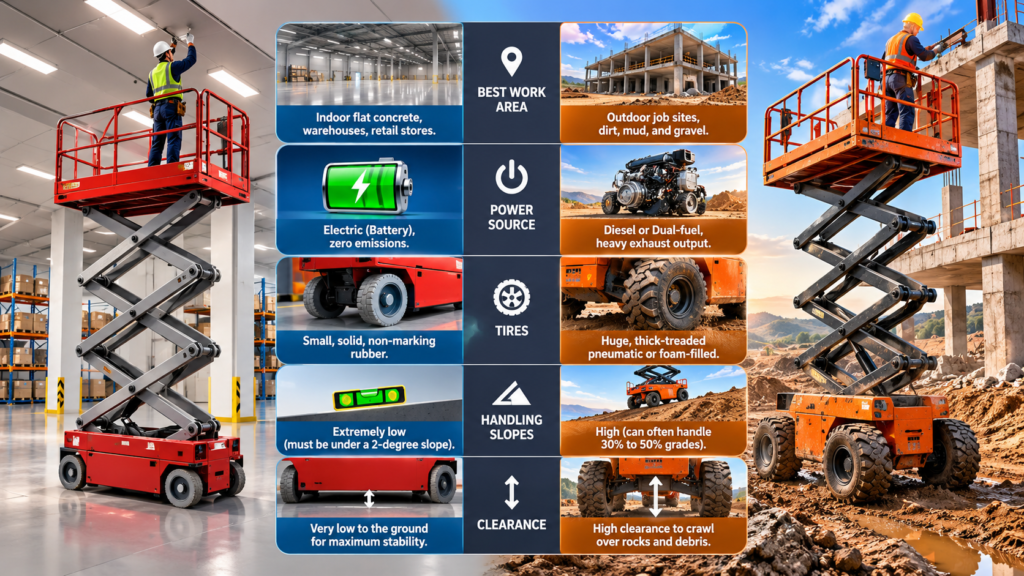
One of the biggest mistakes site managers make is confusing a slab lift with a rough terrain (RT) lift. Getting this wrong isn’t just frustrating; it’s genuinely dangerous. The differences all come down to where the machine is meant to live. Slab Scissor Lifts are your indoor specialists—compact, clean, and meant for flat concrete.
On the flip side, Rough Terrain Scissor Lifts are absolute beasts built for the mud, rocks, and chaos of an outdoor construction site. RT lifts usually pack massive diesel or dual-fuel engines, aggressive four-wheel drive, and huge, thick-treaded tires.
If you take a slab lift onto a dirt lot, its small, smooth tires will instantly get stuck, or worse, the machine will tip over because it sits too low to the ground. Conversely, if you drive a massive diesel RT lift into a warehouse, you’re going to choke everyone with exhaust fumes, deafen them with the noise, and likely crush the floor.
Table: Slab Scissor Lifts
| Feature | Slab Scissor Lifts | Rough Terrain (RT) Scissor Lifts |
| Best Work Area | Indoor flat concrete, warehouses, retail stores. | Outdoor job sites, dirt, mud, and gravel. |
| Power Source | Electric (Battery), zero emissions. | Diesel or Dual-fuel, heavy exhaust output. |
| Tires | Small, solid, non-marking rubber. | Huge, thick-treaded pneumatic or foam-filled. |
| Handling Slopes | Extremely low (must be under a 2-degree slope). | High (can often handle 30% to 50% grades). |
| Clearance | Very low to the ground for maximum stability. | High clearance to crawl over rocks and debris. |
- Slab models are extremely sensitive to slopes and have built-in sensors that will shut the machine down if you try to elevate on an incline over 2 degrees.
- Rough Terrain lifts use heavy-duty 4×4 systems and massive tires to physically push through nasty outdoor environments where a standard lift would sink.
- Always strictly evaluate your ground conditions before renting; bringing the wrong lift to your site will completely halt your project and risk worker safety.
Safety First: Keeping Your Crew and Equipment Intact
Running elevating work platforms is serious business, and you can never cut corners on safety. If you read the expert guidelines over at scissorlifts.org, the number one rule is crystal clear: keep these machines off slopes and soft ground.
If the floor is uneven by even a tiny margin (usually anything over 1.5 to 2 degrees), the lift’s internal tilt sensor is going to scream at you and lock out the lifting controls. Do not try to override this. It’s there to stop the machine from falling over. You also need to be really strict about weight limits.
Piling too many heavy tools onto the platform shifts the center of gravity and makes the whole rig incredibly unstable. Maintenance plays a huge part in safety, too. Your operators need to do a thorough walk-around every single morning before they start working.
Check the battery water so you don’t fry the cells, look for sneaky hydraulic fluid puddles under the machine, and make sure those solid tires don’t have deep cracks or huge chunks of debris stuck in them.
- Never ignore or attempt to bypass the machine’s tilt alarm; it is the ultimate safety net designed to prevent fatal tip-overs on uneven ground.
- Daily pre-shift inspections are mandatory and must include checking hydraulic lines, inspecting tire integrity, and verifying battery water levels.
- Keep the machine strictly off grass, loose gravel, and dirt, as the heavy weight combined with small wheels is a guaranteed recipe for getting stuck.
FAQs About Slab Scissor Lifts
What exactly is a slab scissor lift used for?
These machines are your go-to for indoor work. Think warehouse inventory management, swapping out overhead commercial lighting, running electrical wires, and fixing HVAC systems. Because they run on quiet electric motors and don’t create exhaust, they are the standard for indoor facility maintenance on flat concrete floors.
Can I use Slab Scissor Lifts outdoors?
Technically, yes, but only under perfect conditions. The outdoor surface has to be totally flat, paved, and solid—like a finished concrete parking lot. You should never take them on grass, dirt, or gravel. Their small, smooth tires have zero traction for off-roading, and the low clearance means you’ll get stuck almost instantly.
How high can standard models safely reach?
Depending on the exact model you rent, standard indoor lifts will give you a working height anywhere from 15 feet to over 40 feet. When picking a model, always calculate the height of your ceiling or rack, and leave a little wiggle room so your operators aren’t stretching to reach their workspace.
What does the “gradeability” limit mean for these lifts?
Gradeability is simply how steep of a hill the machine can drive up while it is fully lowered. These slab machines usually have a gradeability of less than 25%. But here is the catch: when you actually want to raise the platform up into the air, the machine must be on practically flat ground (less than a 2-degree slope).
Why is it dangerous to drive them on the grass?
It comes down to weight and tire size. These lifts are incredibly heavy because of their thick steel chassis and massive battery banks. When you roll those small, hard tires onto soft grass or mud, the machine just sinks. Once it sinks unevenly, the risk of tipping over skyrockets.
How much weight can I put on the platform?
This depends heavily on the size of the machine, but standard models typically hold between 500 and 1,500 pounds. Always check the manufacturer’s data plate on the machine before loading it up. Remember that this weight limit includes the heavy tools, materials, and the weight of the operators themselves.
Are they hard to maintain?
Not at all. In fact, they are much easier to maintain than diesel equipment. Your main job is taking care of the electrical system. This means charging the batteries properly, checking the battery water levels, looking for hydraulic leaks, and making sure the tires aren’t damaged. Keep up with those basics, and the machine will run for years.
Discussion
0 comments