7 Scissor Lift Technology Trends that will shape the Construction Industry in 2026
As 2026 approaches, the construction industry is set for a major change. This is because the industry is challenged to become more sustainable, precise and safe. A major part of this change is the development of aerial work platforms with the growing advancements among scissor lift technology trends in 2026.
Scissor lifts, which were simply mechanical tools for vertical access, have become very advanced machines equipped with the latest digital and electric technologies. To keep up, contractors and project managers will have to familiarize themselves with these advancements.
As urbanisation intensifies and safety standards become stricter worldwide, there is an increasing demand for lifting solutions that are intelligent, clean, and flexible. To meet these requirements, manufacturers are incorporating IoT connectivity, new battery chemistries, and semi-autonomous features in their machines scheduled for 2026.
We discuss the seven main scissor lift technology trends that are changing construction sites this year, which is key to keeping your equipment productive and compliant while staying competitive.
Top 7 Scissor Lift Technology Trends in 2026
1. The Dominion of Lithium-Ion Battery Systems
The changeover from the conventional lead-acid batteries to the advanced Lithium-Ion (Li-ion) technology has hit the highest point in 2026. Although lead-acid was the industry’s standard for a very long time, its limitations of maintenance and charging cycles made it unsuitable for today’s swift construction environments.
- Zero Maintenance: In contrast with lead-acid batteries, Li-ion batteries do not require watering or cleaning of terminals. This can reduce the labor costs significantly.
- Opportunity Charging: Workers can connect their machines to the charger during their lunch break. This won’t harm the battery life and, as a result, supports 24-hour multi-shift operations.
- Long Service Life: Contemporary Li-ion batteries of 2026 models could be used the length of the machine’s lifetime (which is up to 10 years), so they provide a better return of investment.
2. The Emergence of AI and Semi-Autonomous Controls
AI is more than just a buzzword nowadays; it’s a working part of the 2026 scissor lift. To help the operators in complicated indoor environments and to get to exact heights with only minimal manual inputs, semi-autonomous features are being used.
- Lift Sequences Stored: Operators can save the heights of their operations for those jobs that are repeated frequently, like HVAC ducts or ceiling panels, etc. This creates uniformity of work throughout the whole job.
- Collision Avoidance: These lifts use 3D laser scanning, lasers or visual sensors, and alarms. They can identify an obstacle on the ceiling or a wall protruding and as a result, they will automatically stop moving to prevent a potential accident.
- Platform Auto-Leveling: The use of cutting-edge sensors guarantees that the working platform stays level. This is of enormous help to the operator, as it eliminates the guesswork and at the same time, it strengthens the stability.
3. IoT-enabled Telematics and Remote Diagnostics
In 2026, a scissor lift is essentially a “connected” item. Fleet managers depend on live data to supervise every machine on site, no matter where it is located. The Internet of Things (IoT) that allows these arrangements to interact with the manufacturer or rental company servers is the source of the connectivity with the immense growth of scissor lift technology.
- Predictive Maintenance: Telematics systems can alert a mechanic in advance if a component is likely to fail. They do so by analyzing the patterns of use. This way, repairs happen before breakdowns, not after them.
- GPS Geo-Fencing: Managers have the ability to establish virtual boundaries. When a machine is moved beyond the assigned zone, its function can be disabled remotely. The risk of theft is therefore drastically reduced.
- Remote Fault Codes: When a machine fails, the error code is immediately sent to a technician’s mobile. This way he can resolve the problem without even coming on-site.
4. The move to 100% Electric Drive (E-drive) Systems
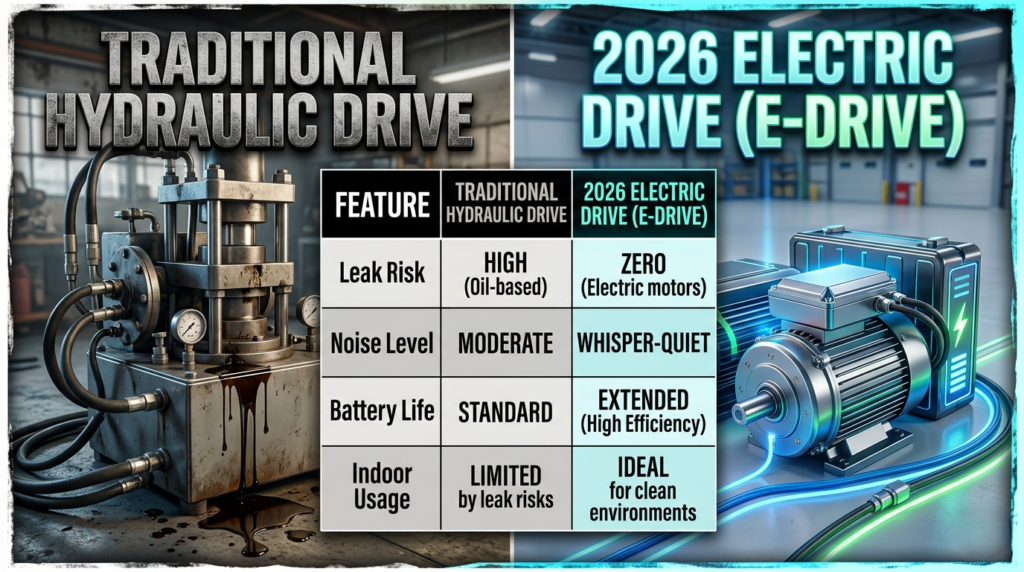
Replacing the hydraulic drive systems with the full electric drive configurations, also known as E-drive is the way forward for the industry. Even though hydraulic systems are very rugged, they are a source of occasional oil leaks and energy losses. E-drive is a cleaner and more productive option which is indispensible for indoor construction nowadays.
- Operation without leakage: Replacing a hydraulic drive motor with an electric one results in almost no risk of getting an oil spill on a sensitive floor (for instance in hospitals or shopping malls).
- Increased energy efficiency: E-Drive systems may use substantially up to 70% less energy than classic hydraulic drives, which gives the machine longer working time on one battery charge.
- Exact maneuverability: Electric motors allow more gentle starting and stopping, which leads to the operator having more control when he has to maneuver in narrow aisles or tight corners.
Table: Scissor Lift Technology 2026 Latest Features
| Feature | Traditional Hydraulic Drive | 2026 Electric Drive (E-Drive) |
| Leak Risk | High (Oil-based) | Zero (Electric motors) |
| Noise Level | Moderate | Whisper-Quiet |
| Battery Life | Standard | Extended (High Efficiency) |
| Indoor Usage | Limited by leak risks | Ideal for clean environments |
5. Intelligent safety compliance and load sensing
Safety regulations such as ANSI A92 and EN280 were made harsher in 2026. Scissor lifts are henceforth equipped with “active” safety systems that remove the decision-making from the operator’s side when a hazard is sensed.
- Digital Load Sensing: When the platform is overloaded, the gear will lock all the functions of the lift. This will prevent tip-overs that are caused by overloading.
- Inclination measurement with cut-outs: Modern inclinometers will stop the lift from rising if the chassis is on an incline that is beyond the safe operating limit.
- Improved Emergency Descent: If there is a power outage, the new models will have an electronic emergency lowering system that can be controlled safely from the ground or the platform.
6. Using Sustainable Materials and Noise Reduction
Since “Green Building” rating systems (such as LEED) are becoming the norm, the machines used for constructing these types of buildings also have to be environmentally friendly. The scissor lift topics for 2026 with the scissor lift technology put foremost low environmental impact through noise reduction and recyclable components.
- Operation with very low noise levels: By producing sound levels less than 65 dB, these lifts are great for “quiet zones” like an occupied office building, school, or hospital.
- Chassis made from recyclable components: The leading manufacturers are now using 95% recyclable steel and aluminum for their products.
- Non-Marking Polyurethane Tires: On most 2026 electric versions, these tires not only protect vulnerable surfaces but they are also made of eco-friendly materials.
7. Compact Designs for Urban “Micro-construction”
Urban’ rejuvenation projects have made workspaces smaller. In 2026, there will be “Micro-Lifts” or even ultra-compact scissor lifts which will be able to fit into regular elevators and through single doorways but they will still be able to provide a substantial reach.
- Foldable Guardrails: There are modern models that have guardrails which are foldable so that they can be made very small and allow the machine to get through very narrow doorways, sometimes as narrow as 30 inches.
- Zero Inside Turning Radius: Most of the 2026 models have been designed to actually turn on the spot, which is very useful in widely crowded warehouse environments.
- Weight Saving Designs: Aviation-grade aluminum and high-strength manganese steel have been used, which is why the machine is lighter and can be run on floors that have a maximum weight limit.
Frequently Asked Questions (FAQ) – Scissor Lift Technology Types
What is the main distinction between conventional and electric scissor lifts in 2026?
Electric scissor lifts are powered by batteries, therefore they produce no emissions and less noise – which makes them very suitable for indoor and green construction sites. On the other hand, traditional models depend on diesel engines that release pollutants and require heavy maintenance.
Are automated scissor lifts safe for the untrained operators?
Definitely. The 2026 automated lifts are equipped with safety interlocks, programmable limits on movements, and intuitive touchscreen controls which all together contribute to a significant reduction in the operator’s mistakes. So that both experienced professionals and newcomers who have received proper training are safe with these lifts.
How long will a lithium-ion scissor lift battery last after being fully charged?
Current lithium-ion batteries support approximately a full day of work (8-10 hours) on a single charge. Additionally, their fast-charging feature allows for a “top-up” charge during breaks without harming the battery’s lifespan.
Can electric scissor lifts be employed on outdoor rough terrains?
Of course. There are quite a few 2026 models that are suited for all sorts of environments. Electric scissor lifts for rough terrain have weatherproof components, four-wheel drive, and heavy-duty tires to cope with uneven outdoor surfaces without producing the noise of a diesel engine.
In what ways does telematics enhance scissor lift management?
Telematics facilitate real-time defect detection, GPS tracking, and predictive maintenance reminders. Thanks to this, fleet deployment is optimized, and machines are serviced before breaking down, thus ensuring maximum uptime.
Do I require a special permit to operate a 2026 scissor lift?
Even though the technology has evolved, OSHA and international safety standards mandates that operators be trained and certified. The 2026 models come with interfaces that are easy to use which assists the trained operators in working more safely.
With these new features, is it cheaper to rent or buy a scissor lift?
While the purchase price of the high-tech electric models is higher, their Total Cost of Ownership (TCO) is much lower because of the reduced fuel and maintenance costs. For short-term projects, renting continues to be a widely used option that gives access to the latest 2026 technologies without the need for a capital investment.