The Comprehensive Guide to Parts of a Scissor Lift: Everything You Need to Know
Scissor lifts have become the main working equipment for construction, warehousing, and maintenance industries. This article is an overview of parts of a scissor lift starting from the base frame and moving up towards the Platform. It also explains the good maintenance of the hydraulic systems which are very effective in this equipment
Everything to know about Parts of a Scissor Lift
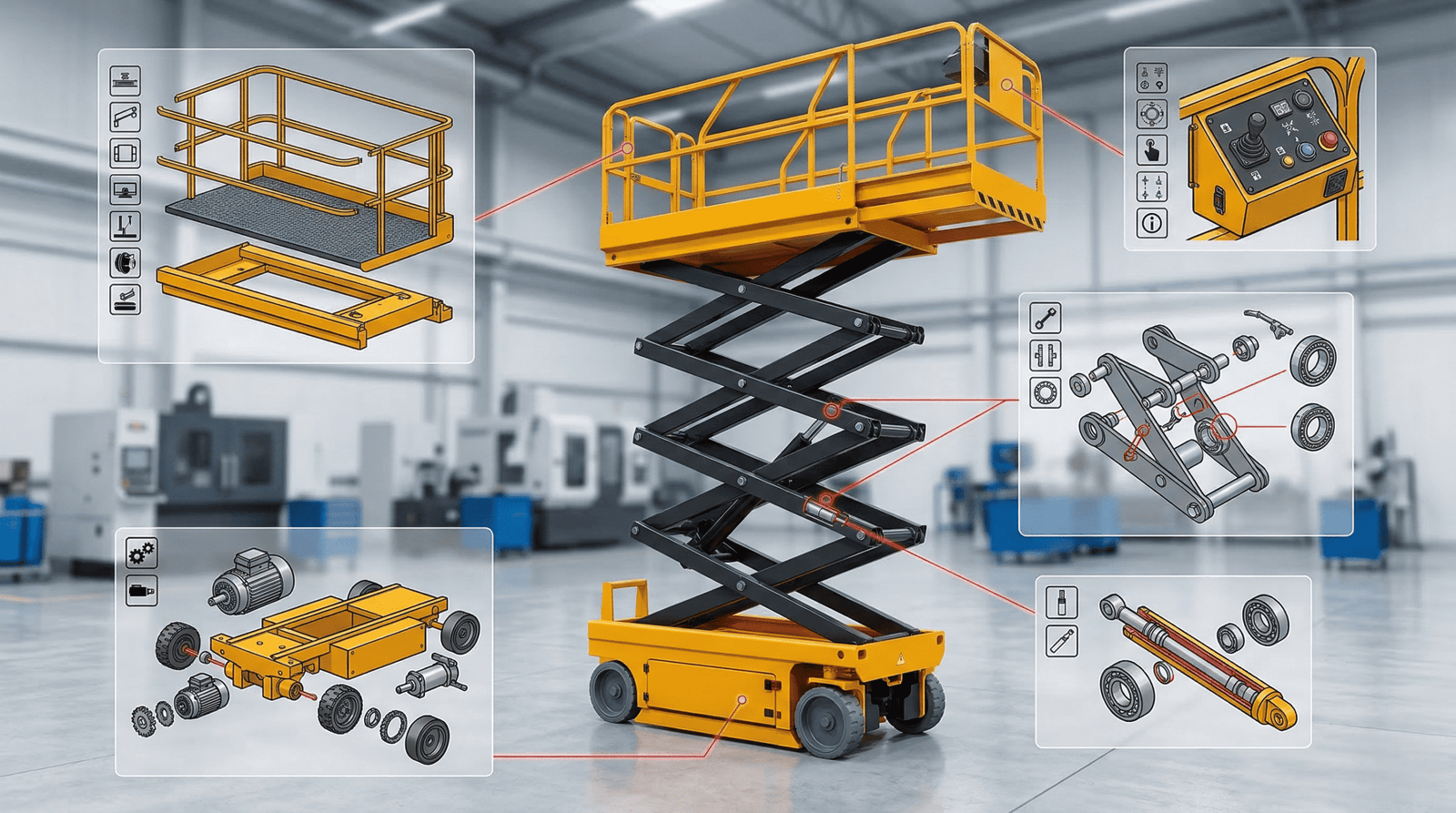
1. The Working Platform: Your Elevated Command Center
Often the platform is the main point of physical contact with the machine by the user. The operator’s safety and well-being depends largely on the platform.
- They are protected from falling down and getting injured by the guardrails and toe boards that are installed around the platform.
- A platform even features a roll-out or a slide-out deck that increases horizontal reach such as when going over a wall or a machine.
- Operators can control the movements of the machine and even operate some functions from a control box.
2. Scissor Legs (Pantograph Mechanism)
What you see on a scissor lift is the main mechanism that leads to the vertical movement of the platform. A series of connected metal struts forming folding patterns are called scissor legs. It is the scissor legs expanding and contracting that elevates the platform.
- In a cross-brace design, each scissor leg is made to bear half the weight through the two members of the leg working against each other.
- Pivot pins and bushings are elements of the joints that allow the legs to move with the minimum amount of friction and wear and tear through lubrication.
- Safety props are parts of the legs that are locked in an upright position by mechanical locks in case the lift has to be serviced.
3. The Hydraulic System: The Muscle of the Machine
Probably the most important component of the machine is leading to the vertical movement of the platform. The following 3 parts make up this system.
- Hydraulic cylinders action fluid under pressure that moves the piston inside the cylinder which then drives the scissors legs outward.
- The hydraulic pump is responsible for supplying the cylinders with the oil under pressure from the reservoir.
- The down valve is a manually operated valve that can stop the flow of oil to the cylinder. Also, the flow control valve throttles the outflow of oil and regulates the speed of descent.
4. Power Sources and Motors
Power sources determine where scissor lifts can be used. They vary from battery, internal combustion engines, and fuel cells.
- Battery-powered electric scissor lifts are mainly used indoors where the operator is exposed to a healthy environment and the lifting heights are limited to the height of the slabs of floors.
- Diesel or dual-fuel (LPG/Gas) engines are mainly used outdoors in areas that require the operator to be mobile and able to change locations easily.
Some new units are equipped with electric drive motors installed on the wheels so that the vehicle is more efficient during movement and batteries last longer.
Table: Parts of a Scissor Lift Benefits
| Power Type | Best For | Key Benefit |
| Electric | Indoor Warehouses | No fumes, quiet operation |
| Diesel | Outdoor Construction | High power, rough terrain capability |
| Pneumatic | Clean Rooms/Explosive Areas | Powered by air, no spark risk |
| Hybrid | Large Indoor/Outdoor Sites | Versatile and fuel-efficient |
5. The Chassis and Base Frame
The chassis and base frame form the basic structure of a scissor lift unit. They support the components of the lifting mechanism as well as the heavy parts such as engine and batteries which need to be placed low for stability.
- Pothole protectors are common safety devices designed to prevent tip-over situations due to uneven surfaces or holes in the ground.
- Tires, given the nature of the job, can be either solid, non-marking rubber or foam-filled, high-traction rubber.
- Stabilizers or outriggers add extra stability by widening the support base and are fitted to the heaviest of the models.
6. Steering and Drive Components
The self-propelled scissor lifts are very advantageous since they are capable of moving around other props and the operator does not have to make use of a separate means of transport.
- Traction is the ultimate purpose of the drive wheels since they bear the full weight of the machine in motion.
- Linked to the drive wheels is the steering system which governs the turning of the machine. For such machines the inside turn radius can be virtually zero.
- The braking system is usually spring-applied and hydraulically released so as to be fail safe and the moment the joystick is released the machine is locked.
7. Essential Safety and Sensor Systems
One of the many benefits of modern scissor lifts is their being equipped with enough sensors so that accidents can be prevented based on accurate information obtained about the environment and properties of the machine.
- Their tilt sensors function as a warning and safety cut-out mechanism such that the platform cannot be lifted if the base is on an unsafe slope.
- Overload sensors measure the weight on the platform and prevent operation if the rated capacity is exceeded.
Emergency stop buttons are big red ones that are placed on both platform and ground controls so that any member can use them in case of emergency and the machine can be immediately shut down.
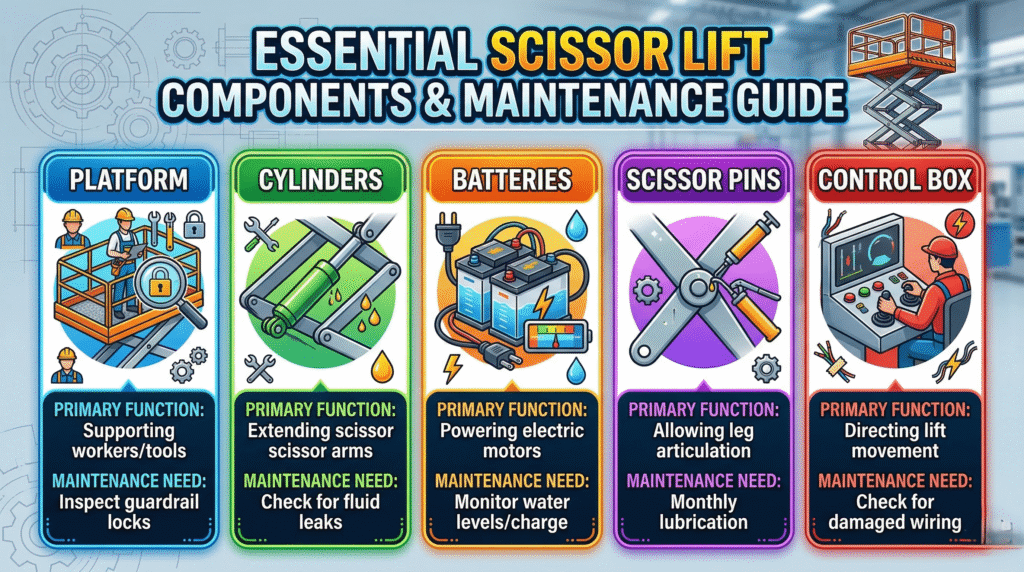
Summary of Key Parts of a Scissor Lift Components
| Component | Primary Function | Maintenance Need |
| Platform | Supporting workers/tools | Inspect guardrail locks |
| Cylinders | Extending scissor arms | Check for fluid leaks |
| Batteries | Powering electric motors | Monitor water levels/charge |
| Scissor Pins | Allowing leg articulation | Monthly lubrication |
| Control Box | Directing lift movement | Check for damaged wiring |
Frequently Asked Questions (FAQs) – Parts of a Scissor Lift
What are the main parts of a scissor lift?
The main parts are platform (work table), scissor legs (pantograph), hydraulic system, base (chassis), power source (battery or engine), and the control system.
How does a hydraulic scissor lift work?
Hydraulic systems operate by a hand or motor-driven pump forcing fluid (usually oil) into a cylinder. The resulting mechanical motion is used to operate the scissor legs vertically and thus raise the platform.
What is the “scissor” mechanism called?
Scientifically it is called a “pantograph.” It is a type of lever mechanism with two arms connected through a joint and each arm has two parallel supports.
Why is the down valve important?
The down valve controls oil flow out of the cylinders. When it is closed, it locks the platform and when it is opened, it regulates the speed so that it lowers slowly and safely.
What are pothole protectors on a scissor lift?
Pothole protectors on a scissor lift are metal bars that extend when the platform is raised. In case a wheel drops into a hole, then the machine hits the bar instead of tipping over.
Can I use an indoor scissor lift outside?
Generally, it is not recommended unless one is sure that the outdoor surface is completely flat and there is no wind at all. Characteristics of indoor lifts such as wind rating and tire types are quite different from those of rough-terrain ers.
How often should scissor lift parts be inspected?
Scissor lifts should be inspected as per the safety regulations of the particular country; before every use a pre-shift inspection should be conducted and once a year a detailed inspection should be conducted by a professional.