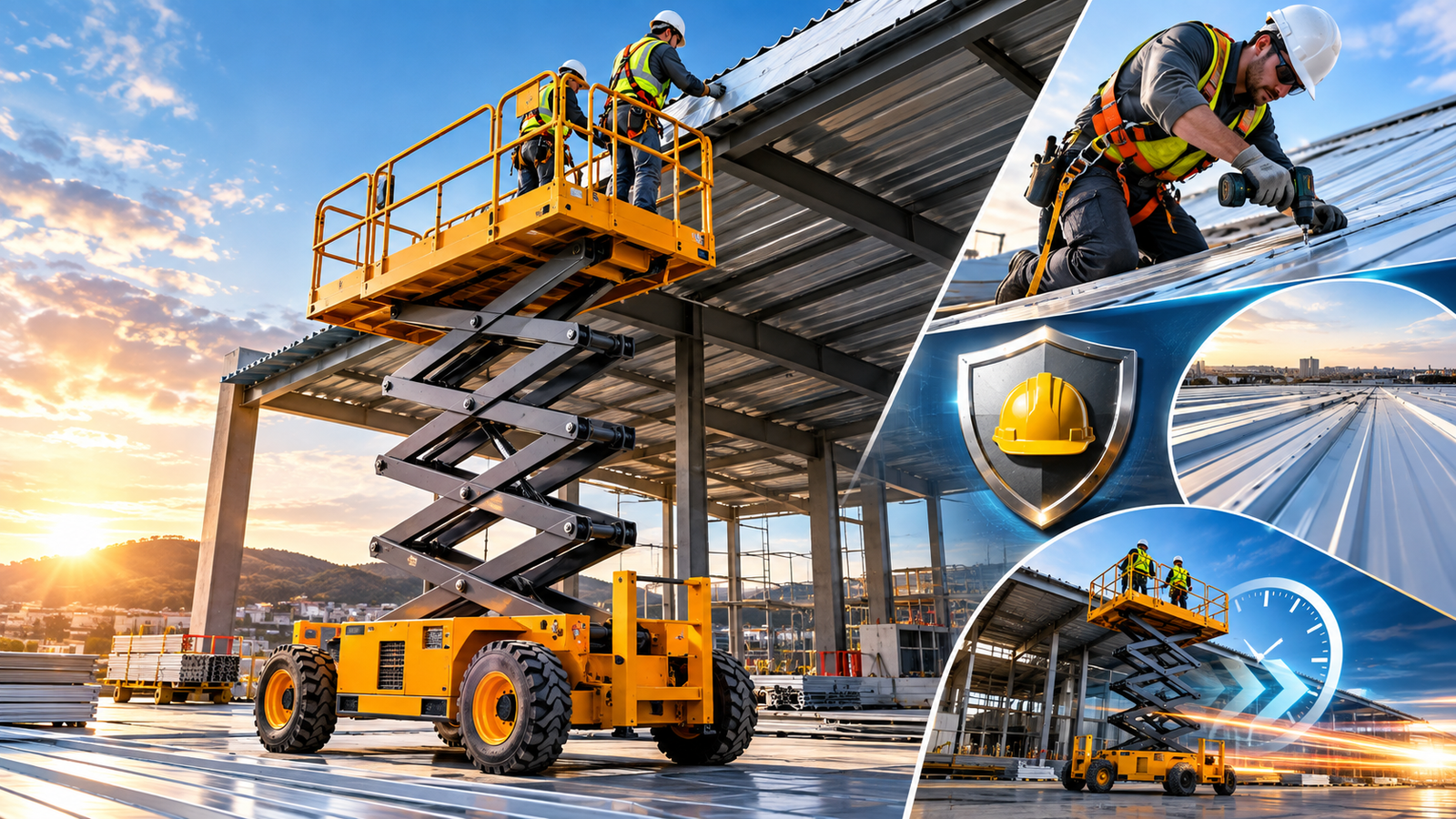
Scissor Lifts for Roofing: How They Speed Up Installation and Boost Safety
Let’s be completely honest for a second—if you work in the roofing industry, you already know that working high off the ground isn’t just a small part of the job; it literally is the job. And along with that reality comes a whole mess of logistical headaches and genuine physical hazards which can be easily handled effectively by scissor lifts for roofing.
For what feels like forever, roofing contractors have been stubbornly relying on the old-school methods. We’re talking about rickety traditional ladders, slow and clunky material hoists, and those massive, complicated scaffolding setups just to get guys and gear up to the roof edge. But let’s face it, the construction world has evolved, and the equipment we use has gotten so much better.
Today, bringing scissor lifts for roofing onto your job sites has completely changed the game, flipping how we tackle both everyday residential homes and massive commercial buildings. Instead of forcing your crew to exhaust themselves climbing up and down ladders with heavy bundles of shingles all day, these machines give you a rock-solid, motorized platform that easily adjusts right to the roofline.
With the industry pushing harder than ever for quick project turnarounds and better worker protection, having top-tier access equipment isn’t just a nice bonus anymore—it’s something you absolutely need to stay competitive.
To really get why this equipment is making such waves, you have to look at how it actually changes the daily grind on a busy, chaotic job site:
- A total game-changer for materials: You can literally lift entire pallets of shingles, rolls of underlayment, and all your heavy flashing straight up to the edge of the roof in one smooth, easy motion.
- Saving your crew’s backs and knees: When your guys don’t have to carry heavy loads up steep ladders hour after hour, they stay fresh longer, and the risk of those nasty, nagging physical injuries drops off a cliff.
- Ditching the nightmare setup times: Forget spending half the day building and tearing down scaffolding. You can drive a modern lift right onto the dirt, turn the key, and have your guys working in minutes.
Understanding the Mechanics Behind Scissor Lifts for Roofing
When we start talking about using scissor lifts for roofing, it really helps to peel back the curtain and look at the nuts and bolts of why these machines are so incredibly perfect for outside construction.
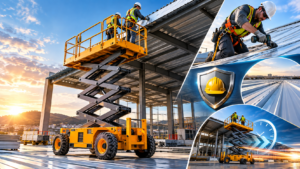
At its core, a scissor lift is a mobile work platform that gets its name from those crisscrossing, “X” shaped steel supports underneath. When the engine pumps hydraulic pressure into the bottom of that stack, the metal beams stretch out, and the whole deck goes straight up. That pure, straight vertical lift is exactly what roofers need.
You can drive the machine right up tight against the side of a house or a commercial building and raise it so the deck sits perfectly flush with the eaves. Now, since roofing almost always happens outside on grass, mud, or unpaved dirt, contractors usually go straight for Rough Terrain (RT) models. These aren’t those little lifts you see inside warehouses.
RT scissor lifts for roofing are absolute beasts, equipped with massive, deep-tread tires, aggressive four-wheel drive, and heavy-duty diesel engines built specifically to chew through the mud and gravel of a messy construction site.
When you bring this kind of mechanical muscle onto your job sites, you immediately start seeing some massive benefits in how your crew gets things done:
- Planting feet firmly with outriggers: A lot of these rough terrain models come with hydraulic legs that shoot down into the dirt, automatically leveling the machine so your guys have a perfectly flat, safe platform even if the yard looks like a rollercoaster.
- Room to actually move around: The platform decks are surprisingly huge. Plus, a lot of them have slide-out extensions that let your crew reach right over flower beds or porches, getting them safely closer to the actual roof deck.
- Handling the heavy stuff effortlessly: Because that crisscross design spreads the weight out perfectly across the base, these lifts can usually handle way more weight than a standard boom lift, which is exactly what you need when you’re hauling dense roofing supplies.
How Scissor Lifts for Roofing Accelerate Project Timelines
In the roofing business, we all know the golden rule: time is money, and you’re always racing against the weather forecast. Integrating scissor lifts for roofing into your workflow puts your project timelines on the fast track by completely changing how stuff moves around the site.
Think about the old way we used to do it. The supply truck drops a mountain of shingles on the driveway, and your guys have to either hump them up a ladder one by one or mess around with a slow ladder elevator. It takes forever, and your crew is wiped out before the actual roofing work even kicks off.
A tough, high-capacity scissor lift turns that brutal morning chore into a ten-minute job. You grab a forklift, drop a whole pallet of materials onto the lift’s deck, and drive it straight to the wall. The guys ride it up, step right off onto the roof, and their materials are sitting right there waiting for them. As they work their way across the roofline, someone just lowers the lift, bumps it down a few feet, and raises it back up. It keeps the workflow completely uninterrupted.
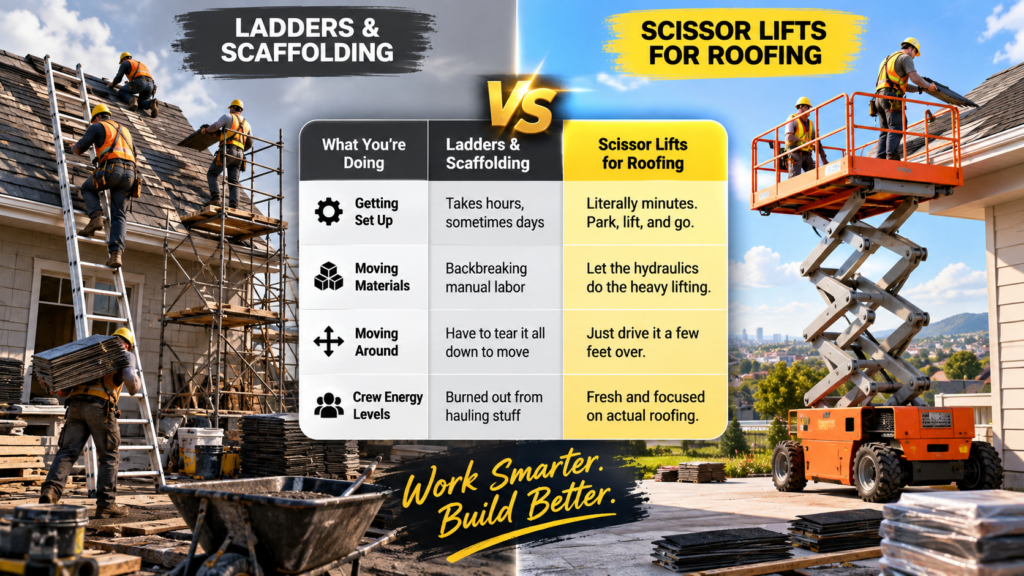
If you want to see just how wild the difference is, take a look at how the old-school methods stack up against modern lifts:
Table: Scissor Lifts for Roofing
| What You’re Doing | Ladders & Scaffolding | Scissor Lifts for Roofing |
| Getting Set Up | Takes hours, sometimes days | Literally minutes. Park, lift, and go. |
| Moving Materials | Backbreaking manual labor | Let the hydraulics do the heavy lifting. |
| Moving Around | Have to tear it all down to move | Just drive it a few feet over. |
| Crew Energy Levels | Burned out from hauling stuff | Fresh and focused on actual roofing. |
This kind of speed isn’t just about looking good; it directly impacts your profit margins by giving you some serious operational advantages:
- Killing the waiting game: The guys up on the roof never have to stand around twiddling their thumbs while they wait for ground support to lug up another bundle of shingles.
- Shifting on the fly: Because you can drive these units around easily (and sometimes even while they are slightly raised, if the safety manual allows), your crew can smoothly shift their main access point as they move across a massive commercial flat roof.
- A high-altitude workbench: That big deck isn’t just for riding. It becomes a perfect spot to keep nail guns, air compressors, and heavy tools out of the way, keeping the actual roof deck clear of tripping hazards.
Elevating Job Site Safety: Why Scissor Lifts for Roofing Are Crucial
Sure, finishing a job faster is great for the bank account, but the absolute main reason smart contractors are leaning heavily into scissor lifts for roofing is to keep their people safe and keep OSHA off their backs.
Falls from high places are still the number one killer in the construction world, and traditional ladders are usually the main villain in those stories. Think about it: when a guy throws an awkward, 80-pound bundle of shingles on his shoulder and starts climbing, his balance is completely thrown off. There is zero chance he can keep three points of contact on that ladder.
A scissor lift basically wipes that specific danger off the map entirely. Instead of a risky climb, your guys get a fully enclosed steel box surrounded by heavy-duty 42-inch guardrails, mid-rails, and toe boards. It creates a completely safe pocket for them to move from the machine to the roof edge.
On top of that, these lifts give your guys heavy-duty steel anchor points to hook up their safety lanyards, meaning they are completely tied off and secure before their boots even touch the slanted roof.
Making this kind of equipment a standard part of how you run your jobs takes a massive bite out of your daily risks:
- Stopping falls before they happen: Those thick, OSHA-approved guardrails wrapping around the deck act like a cage, totally stopping anyone from accidentally stepping backward or slipping off while wrestling with heavy materials.
- Saving the human body: When you let a diesel engine do all the heavy lifting, you’re going to see a massive drop in guys calling in sick with blown-out lower backs, wrecked knees, and severe heat exhaustion.
- A smarter way to handle trash: When you’re tearing off an old roof, nobody likes dodging flying debris. With a lift, you can put a trash bin right on the deck, toss the old shingles directly in, and bring it down safely without dropping debris all over the homeowner’s lawn.
Key Factors When Choosing Scissor Lifts for Roofing Operations
Now, you can’t just pick the first machine you see in a catalog. Picking the right scissor lifts for roofing takes a bit of planning, and you really have to think about the terrain of your job site, how high the roof is, and how heavy your materials are.
If you try to bring a little electric indoor slab lift with smooth tires onto a muddy, torn-up residential lot, it’s going to get stuck in the mud in about five seconds. For almost everything roofing-related, Rough Terrain (RT) models are your best friends.
When you’re browsing around on platforms like scissorlifts.org to rent or buy, you need to do the math on your maximum working height. A good rule of thumb is that the “working height” is usually the platform height plus about six feet (assuming a person is reaching up).
You also have to obsess over the weight limit. Roofing stuff is heavy as lead; a single square of asphalt shingles can easily weigh well over 200 pounds. You need a machine that can handle three of your biggest guys plus a few squares of material without the overload alarms screaming at you.
Before you pull the trigger on a rental for your next big job, keep these real-world factors locked in your mind:
- Checking the ground conditions: Always, always lean toward four-wheel-drive RT models with deep, aggressive tires so you don’t end up paying a tow truck to pull your lift out of a muddy front yard.
- Doing the weight math: Take a second to actually calculate the combined weight of your guys, their tools, and the heaviest load of materials you plan to send up at once. Make sure it gives the machine’s maximum limit plenty of breathing room.
- Getting that extra reach: Specifically look for lifts that feature roll-out deck extensions. When a house has huge overhanging eaves or a delicate porch you can’t park on, that slide-out deck is the only way your guys will be able to reach the roof safely.
FAQs About Scissor Lifts for Roofing
What exactly is a scissor lift used for on a roofing job?
Think of it as your ultimate heavy-duty elevator. Instead of risking your neck carrying awkward shingles, heavy plywood, and slippery underlayment up an unstable extension ladder, you load it all onto the lift. It safely hoists huge batches of materials right to the gutters, gives your guys a rock-solid platform to step onto the roof, and even acts as a high-up workbench to keep your tools out of the way.
How high up can these things actually go?
It totally depends on the size of the rig you rent. Those smaller, compact ones usually max out around 19 to 26 feet, which is honestly perfect for your standard single-story house. But if you’re tackling big multi-story apartment buildings or commercial warehouses, you can rent massive rough terrain models that easily push past 50 or 60 feet in the air.
How much weight can I realistically put on it?
You have to check the spec sheet, because they vary wildly. A narrow electric lift might max out at 500 pounds—barely enough for two guys and some hand tools. But the big, beefy rough terrain scissor lifts for roofing are built for abuse. Many of them can comfortably lift between 1,000 and 2,500 pounds, which is exactly what you need to hoist a whole crew and a couple pallets of shingles at the exact same time.
What’s the damage to my wallet to rent one?
Pricing is all over the map depending on where you live, how high the lift goes, and how long you need it. For a basic daily rental, you’re usually looking at somewhere between $100 and $300. If you keep it for the week, expect to pay around $350 to $800. Those monster, high-reaching RT lifts will cost more—sometimes over $1,500 a month—but contractors almost always make that money back instantly because the job gets done days faster.
Do my guys need a special driver’s license for it?
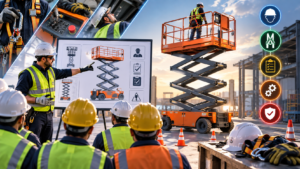
You don’t need a state DMV driver’s license, but yes, OSHA is very strict about this. Anyone touching the controls has to be officially trained and certified to operate an aerial lift. As the boss, it’s on you to make sure they’ve gone through the safety training, understand fall protection, and know how to read the load capacity charts. Letting an untrained guy drive one is a massive liability.
Can I actually use them in a muddy, uneven yard?
Yes, but only if you bring the right tool for the job. If you bring a standard concrete-floor warehouse lift to a muddy yard, you’re going to have a bad time. You absolutely need a Rough Terrain (RT) lift. They have heavy tractor tires and hydraulic outrigger legs that punch down into the dirt, lifting the machine slightly to make sure the platform is dead-level before it ever starts going up into the air.
How do we keep from getting hurt while using it?
Safety is everything with these machines. First, your crew has to do a quick walk-around every single morning to check for leaking hydraulic fluid or flat tires. Second, you can never, ever exceed the weight limit, or the thing will tip over. And finally, tell your guys to keep their boots flat on the steel deck—no standing on buckets or leaning ladders against the guardrails to get an extra few feet of reach.
Pro Tip
If you want to keep your job sites running smoothly and safely, make sure your foremen are constantly hammering these rules home:
- Do the morning walk-around: Make it a hard rule that someone checks the hoses, the tires, and the emergency shut-off valves before the engine even turns on.
- Look up before you go up: Constantly remind the crew to look up for active power lines and thick tree branches before they start raising the deck.
- Plant those outriggers every time: Never let anyone raise the platform on a muddy or sloped yard without shooting those stabilizing legs down into the dirt first.
Final Thoughts on Integrating Scissor Lifts for Roofing
At the end of the day, leaning into better technology is the only real way to grow a construction business without burning out your workforce, and bringing scissor lifts for roofing into your daily routine is the perfect example.
By walking away from the dangers of hauling heavy stuff by hand and fighting with annoying scaffolding, you can shave days off your project timelines while actually protecting the guys who make your business run.
Sure, there’s a cost to renting or buying heavy equipment, but that money comes right back to you in saved labor hours, a crew that isn’t totally exhausted by noon, and a massive drop in terrifying ladder-fall accidents.
When you’re ready to stop doing things the hard way and upgrade how your site runs, just keep these final tips in your back pocket:
- Rough Terrain is the only way: Don’t cheap out—always get the heavy-duty tires and the 4WD so you can actually maneuver around sloppy residential yards.
- Take training seriously: Keep the safety inspectors happy (and your guys alive) by making sure everyone is fully OSHA-certified before they touch the joystick.
- Use your resources: Jump onto sites like scissorlifts.org to dig into the specs and make sure you’re renting the exact right machine to handle the heavy lifting your specific jobs demand.
Scissor lifts for roofing