

When Is It Appropriate to Replace a Scissor Lift Instead of Repairing It?
Making the decision to replace a scissor lift will undoubtedly be one of the major financial decisions in the operations of any construction or warehouse. Despite the fact that these pieces of equipment are really performance machines, there will be times when a vendor you contact will tell you that you are continuing to lose money by scheduling scissor lift repairs on your one and only old unit even more than the cost of a new investment.
For starters, you need to take into account how reliable your machine is before deciding to replace a scissor lift. You might get an old unit still functioning, however, if you keep in mind the fact that the unit will be less safe than the new ones and the efficiency of the fuel consumption has deteriorated as well, then your old lift will be a liability.
In order to be able to meet the working standards these days and at the same time keep your workers safe, recognize the signals that you have to replace a scissor lift before it becomes overly inefficient and unsafe.
Signs from Your Budget That You Should Replace a Scissor Lift
The easiest sign that it’s time for you to replace a scissor lift is the one you will find in your accounting books. If the care and maintenance schedule (and consequently the scissor lift repair costs) is shooting up dangerously, then the “Total Cost of Ownership” may have become atrociously wrong.
If you believe in the idea that the repair estimate for a single transaction is approaching 50% of the current value of the scissor lift, then in all likelihood you should be replacing a scissor lift.
- 50% Rule: If replacing the motor or hydraulic system costs more than half of the lift’s resale value, it is better to replace a scissor lift.
- Diminishing ROI: Regularly measure how much you spend on maintenance annually; if it goes up by more than 20% from one year to the next, then it is undoubtedly time to replace a scissor lift.
- Rental Expenses: If you are forced to get rental scissor lifts while your units are undergoing repairs, then those additional – and in most cases unplanned – expenses should be part of your budget for the very substitution.
Recognizing Major Signs of Physical Damage
If you’re wondering how to replace a scissor lift, it will probably be impossible for you to get the answer unless you examine the metal itself. In fact, if the “scissors” or the frame are exhibiting clear and unmistakable signs of warping and/or deep corrosion, then you must replace a scissor lift to provide a stable platform at the full extension of your working height.
- Pivot Point Play: An excessive “wobble” was found in the scissor arms that even a standard scissor lift repair could not eliminate, so you should replace a scissor lift.
- Weld Integrity: Hairline cracks in the major welds represent a severe safety failure and this is usually a driving factor in deciding to replace a scissor lift.
- Rust and Corrosion: Continuing a scissor lift repair plan is hazardous when there is considerable rust present on load-bearing parts.
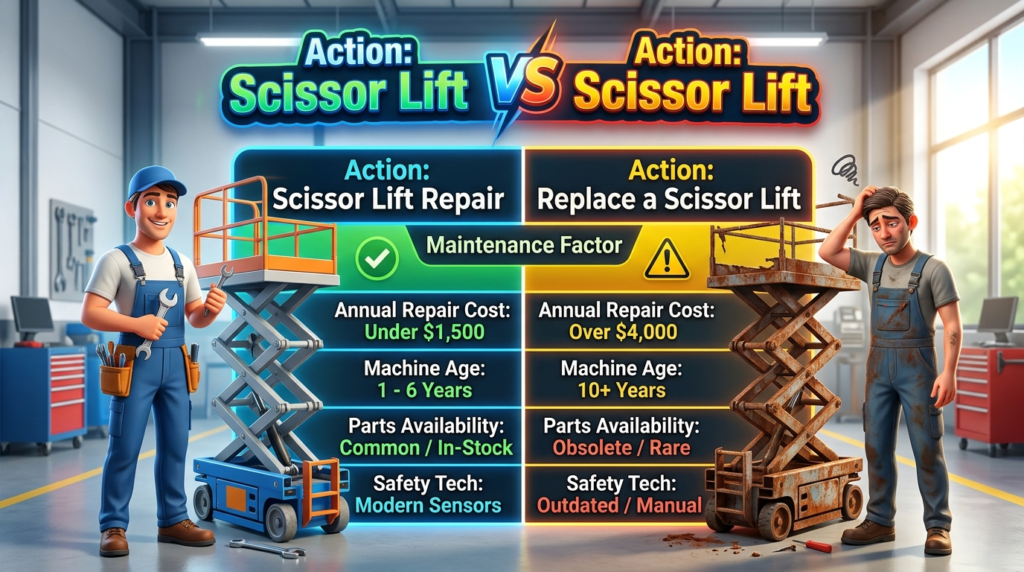
Table: Replace a Scissor lift
| Maintenance Factor | Action: Scissor Lift Repair | Action: Replace a Scissor Lift |
| Annual Repair Cost | Under $1,500 | Over $4,000 |
| Machine Age | 1 – 6 Years | 10+ Years |
| Parts Availability | Common / In-Stock | Obsolete / Rare |
| Safety Tech | Modern Sensors | Outdated / Manual |
Safety Compliance and Modern Standards
Safety rules change from time to time and the fact that older machines are unable to meet the new ANSI or OSHA standards is quite common. If the cost to fit your old machines with new tech is thousands of dollars even before the scissor lift repair is made, then it would be better just to replace a scissor lift with one that has the load-sensing and tilt-alarm system already built-in. Worker safety is the number one reason why we at scissorlifts.org recommend that you replace a scissor lift.
- Load Sensing Systems: It is very common for the latest safety regulations to require the automatic turning off of the scissor lifts in cases of the machines being overloaded which is in fact the primary feature justifying replacing a scissor lift.
- Emergency Controls: You should never depend on manual descent when it is finicky; in fact, you should replace a scissor lift if you want to have peace of mind.
- Guardrail Standards: It often happens that older guardrails do not meet the present height or strength codes and in such instances, it is necessary to replace a scissor lift.
Operational Efficiency and Technological Gains
New generation of lifts offer more than adequate improvements in battery life and control smoothness. You will certainly be required to replace a scissor lift if you have a team that is continually-geared-up to frustrate them with jerky movements and short runtimes.
A scissor lift repair may very well be able to get the little motor of an old unit on its feet, but it won’t give you the extremely efficient brushless AC drive performance that you can have when you replace a scissor lift with a 2026 model.
- Battery longevity: When you replace a scissor lift you get new lithium-ion versions that are way ahead of lead-acid batteries in terms of performance and capacity.
- Digital diagnostics: Newer equipment not only saves the operator quite a bit of time but directly points out the service area, while an older unit needs more and more labor hours for almost the simplest of problems.
- Proportional controls: When doing precision work, you will not find a smooth handling experience as the one you get when you replace a scissor lift in the entire legacy hardware pool.
FAQ’s – Replace a Scissor Lift
Are there any particular indications that suggest the need for a scissor lift repair?
Continuous leaking of fluid; lengthy lift times; grinding noises are some of the indications that a scissor lift repair is necessary. However, if such problems keep on emerging even after being fixed, you should replace a scissor lift.
How long does an electric scissor lift usually last?
You may get 8-12 years out of most electric models. After this period, equipment and components regularly fail and the decision to replace a scissor lift becomes more economically sound.
Can you trade in your machine when doing so?
Absolutely. Platforms like scissorlifts.org offer you such a possibility. This will lessen the amount of cash necessary to replace a scissor lift with a newer and safer one.
When is the right time to replace a scissor lift?
Some signs that you need to replace a scissor lift are, for instance, the costs of the maintenance exceeding 50% of the worth or the machine being 10 years old. A continuous downtimes is an unmistakable signal to replace a scissor lift.
Will I always save a lot of money if I go for a scissor lift repair rather than for the replacement option?
Surprisingly no. Even if one single operation or scissor lift repair is rather cheap, the total cost resulting in the parts, labor and lost productivity may turn out to be much more expensive than the monthly payment to replace a scissor lift.
How to find the break-even point to replace a scissor lift?
You need to do a comparison between the amount of money needed for a brand new machine and your current repair bills together with the “opportunity cost” of the lost work. If the new machine is able to pay for itself in 24 months through saved repairs, then you have to replace a scissor lift.
Will I have to replace my scissor lift because of the new safety laws?
In most cases, you will be able to use your old machinery if it was compliant when it was constructed, however, nowadays the job sites are so far that they require the latest safety equipment, so, replace a scissor lift has become the only option to stay eligible for contracts.
Discussion
0 comments