

Importance of Scissor Lifts in Aerospace
The aerospace sector is one of the most regulated industries in terms of safety and precision standards worldwide. Whether assembling commercial airplanes or maintaining military aircraft, accessing components at different heights is something that happens almost every day. So, the importance of scissor lifts in aerospace
was certainly one of the things that we at scissorlifts.org pondered deeply. A work platform with a stable, wide base that allows two-handed operation without the need to hold on to safety guardrails is exactly what engineers and technicians crave. Also, the vertical positioning accuracy that these machines provide is essential not only for safety but also for efficiency in manufacturing.
Improving Accuracy in Aircraft Manufacturing
In aerospace manufacturing, it is precision that separates a good flight from a bad one. In order to work on large areas of the fuselage or wings that are at a height, you need stable access from different levels.
Besides that, scissor lifts are the ones that have the best “slab” design, i.e., they are perfect for the flat and clean floor of a hangar. Besides that, this lift can be raised or lowered gradually, which ensures that the technician is always at the ergonomic “sweet spot” for drilling, riveting, or installing delicate avionics.
- Stable Vertical Lift: Moving only in the vertical direction, scissor lifts have no sway even at high level, unlike boom lifts which may sway at full extension.
- Large Platform Capacity: Large pieces of aerospace components require several workers to lift and maneuver them; the capacity of scissor lifts cannot be exceed by any other lift type.
- Ergonomic Alignment: Working closely with the curved surface of an aircraft is sometimes quite demanding physically and mentally. With the help of these lifts, workers are able to align themselves perfectly, so that they work with minimal strain and the chance of mistakes is very low.
Facilitating Routine Maintenance and Inspection
Maintenance, Repair, and Overhaul (MRO) facilities run the aviation industry. Sporadic inspections of all sorts are the reason why an airplane needs to be taken to MRO, and every part of the airframe is inspected.
For example: an A-check, a routine check every 400-600 flight hours, or a D-check, an extensive check happening every 6-10 years, require complete disassembly. The importance of scissor lifts in aerospace MRO is so huge that technicians can get up to the tail fin or engine housing with a lift and do the checks, then safely come down.
Save time is very important for minimizing the “Aircraft on Ground” (AOG) – time which is very costly as airlines lose thousands of dollars per hour.
- Rapid Deployment: Electric scissor lifts can be maneuvered into place quickly without the long setup times required for traditional scaffolding.
- Non-Marking Tires: Most indoor scissor lifts used in hangars feature non-marking tires to protect the specialized epoxy coatings on hangar floors.
- Integrated Power Sources: Many modern lifts come equipped with AC power outlets on the platform, allowing technicians to use electronic diagnostic tools without trailing dangerous cables across the floor.
Specialized Safety Features for Aviation Environments
Every aerospace operation focuses on safety. Risks of falling, collisions with costly aircraft wings, etc., are constant worries. Scissor lifts help reduce these problems with better design.
Therefore, the tilt sensors, emergency lowering system, pothole protection are nowadays standard options. What’s more, when you consider the fact that a hangar is a place full of flammable fuel vapors, the use of electric or pneumatic scissor lifts – which produce neither emissions nor sparks – is a must safety measure.
- Zero-Emission Operation: The work environment remains safe and clean with electric outlets because there will be no exhaust fumes. This also removes any chance of a spark or explosion in the fuel vapor laden hangar areas.
- Compact Maneuverability: Narrow-aisle models can navigate between parked aircraft and hangar equipment without the risk of “tail swing” common in other lift types.
- Soft-Touch Sensors: Some high-end lifts used in aerospace are fitted with padded rails or ultrasonic sensors to prevent the platform from making contact with the aircraft’s skin.
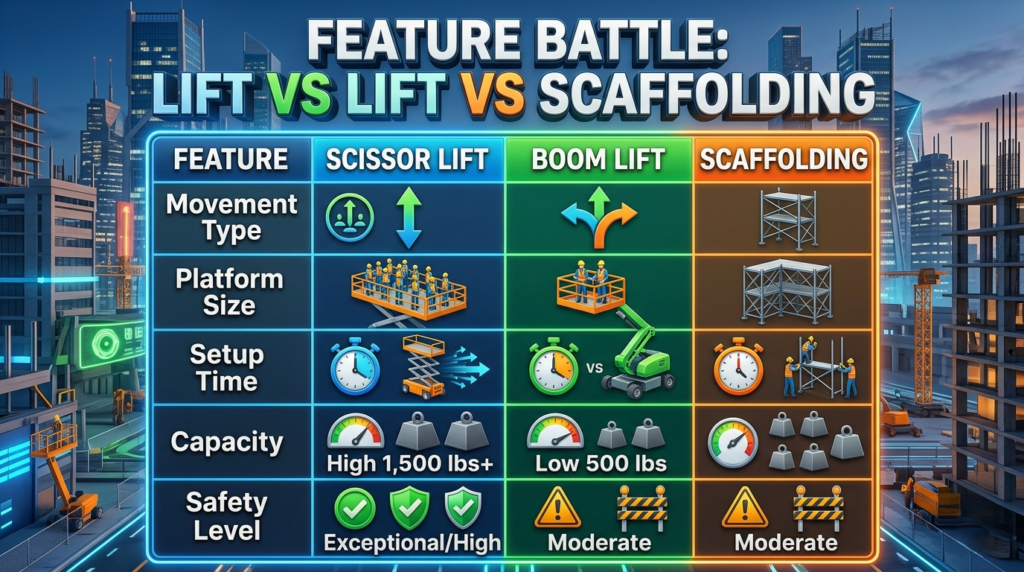
Comparative Utility in Aerospace Operations
For a better grasp of importance of scissor lifts in aerospace, one must learn how they differ from other aerial work platforms (AWPs) usually used in the industry.
| Feature | Scissor Lift | Boom Lift | Scaffolding |
| Movement Type | Vertical Only | Vertical & Horizontal | Static |
| Platform Size | Large (Multiple Workers) | Small (1-2 Workers) | Fixed |
| Setup Time | Instant | Instant | High (Hours/Days) |
| Capacity | High (Up to 1,500 lbs+) | Low (500 lbs) | High |
| Safety Level | Exceptional | High | Moderate |
Versatility Across Different Aerospace Sectors
These lifts are used not only in commercial planes. Aerospace includes the manufacture of satellites, interplanetary vehicles, military hardware, etc. In all these subsectors, scissor lifts serve different purposes.
For example: in cleanrooms where satellites are assembled, pneumatic scissor lifts are chosen as they rely on compressed air and are free of hydraulic fluid leakage and out-gassing, which could cause a contamination of the sensitive optical equipment.
- Cleanroom Compatibility: Specialized lifts meet the “Class 100” cleanroom standards required for satellite and high-tech component assembly.
- Defense Applications: Rugged, gas-powered scissor lifts are used on military airfields for exterior maintenance where the terrain may be less than perfect.
- Cargo Loading: Scissor mechanisms are often integrated into ground support equipment (GSE) to lift heavy cargo containers to the height of an aircraft’s freight door.
Future Trends: Automation and Telematics
Continuing with the future, importance of scissor lifts in aerospace is yet to be on the rise with the advent of smart technology. Internet of Things-enabled lifts is what we are talking about here – they can give you a heads-up on battery status, weigh load capacity and height so that hangar managers are able to use their fleet optimally.
Besides that, predictive maintenance makes sure that a lift does not break down during an engine swap that is very critical. Still, limited access to interior spaces of large cargo planes has led to the development of “micro-lifts” whose dimensions are small enough to be used where regular platforms cannot fit.
- Telematics Integration: Remote monitoring of lift health prevents unexpected downtime in time-sensitive MRO environments.
- Lithium-Ion Technology: Newer battery tech allows for faster charging and longer runtimes, matching the 24/7 pace of modern aerospace hubs.
- Enhanced Precision Controls: Proportional controls allow for “inching” the platform, which is vital when working inches away from a multi-million dollar composite wing.
Summary: Importance of Scissor Lifts in Aerospace
The fact that without these machines, the aerospace industry cannot function properly is perhaps the best demonstration of the significance of scissor lifts in aerospace. Scissor lifts have provided not only a safe and highly stable work platform but also a high-capacity one to enable the workers to do their best work.
It doesn’t matter if it is the initial assembly of a fuselage or the final safety check before a transatlantic flight, the scissor lift is still a very helpful and necessary tool in the hangar.
- Safety First: Reduces fall risks and provides a secure perimeter for high-altitude tasks.
- Efficiency Boost: Decreases the time taken to access difficult areas compared to manual climbing or scaffolding.
- Cost-Effective: Lowers insurance premiums and labor costs by reducing accidents and increasing hourly productivity.
Frequently Asked Questions (FAQs) – Importance of Scissor Lifts in Aerospace
Why are scissor lifts preferred over boom lifts in aircraft hangars?
The main reason scissor lifts are preferred is because they are more stable and their platform size is also larger. Since they only move vertically, their footprint is the smallest possible and they have no “tail swing”, which makes it safer to use them in tight spaces between aircraft.
What is the average weight capacity of a scissor lift used in aerospace?
Generally, electric scissor lifts in aerospace can hold anywhere from 500 to 1,200 lbs, but some heavy-duty versions go all the way up to 2,000 lbs, which is more than enough for two technicians and heavy engine parts.
Are electric scissor lifts safe for indoor hangar use?
Indeed, electric scissor lifts are the preferred tool for indoor use because they do not emit any fumes, and operate silently, which is very important in maintaining a safe and healthy environment inside enclosed hangars.
How high can a typical aerospace scissor lift reach?
Most hangar-based scissor lifts offer a working height range of around 20 to 45 feet. When it comes to reaching higher areas like the tail of a Boeing 747, specialized high-reach models or boom lifts are sometimes used.
Do scissor lift operators in the aerospace industry need special certification?
They indeed are required to do so. Operators must be trained and certified according to OSHA and ANSI standards. Besides that, many aerospace companies require specific “site-induction” training so that operators are skilled at maneuvering in the vicinity of sensitive aircraft parts.
Can scissor lifts be used on uneven surfaces outside the hangar?
While “slab” scissor lifts require flat surfaces, “Rough Terrain” scissor lifts are equipped with four-wheel drive and outriggers to allow them to operate on gravel or uneven asphalt surfaces typically found on airfields.
How do scissor lifts prevent damage to the aircraft?
Most of the lifts used in aerospace have padded guardrails and proximity sensors installed, which prevent the lift from contacting the aircraft’s surface even when the operator accidentally moves the lift too close to the aircraft.
Discussion
0 comments