

The Ultimate Guide to Scissor Lift Movement: Safety, Regulations, and Best Practices
Efficiency is what really drives production in today’s industrial world. For a lot of contractors and facility managers, a scissor lift question on whether it is allowed to move the scissor lift while the platform is raised is a hot topic. Indeed, Scissor lift movement at height can save hours of labor by not constantly lowering and raising the lift, but it also creates a powerful set of forces that may endanger the worker’s safety if not handled properly.
At scissorlifts.org, the safety and awareness of operators are what we are concerned with most. In this detailed guide, we explain the machinery requirements, legal rules, and working procedures needed for safe and efficient scissor lift movement at an elevated level. While keeping the balance among machine power and environmental dangers, multi-person teams can really get the most out of their working time to the highest extent without endangering anyone.
Top 4 Tips: How to move in the work platforms while the platform is elevated with scissor lift
1. Grasping the Mechanics of Moving a Raised Scissor Lift
When the platform of a scissor lift is raised, the situation in the physics of the lift is transformed. Raising the “X” stack lengthens the lift and raises the center of gravity of the whole unit, and hence it becomes even more vulnerable to side forces. In fact, moving a scissor lift at height is not an ordinary feature for all the models since it is a piece of special engineering work requiring specific counterweights and stability systems.
- Center of Gravity Change: Besides raising the platform, what makes the lift susceptible is the slightest ground level change, a 1-inch (2.5 cm) pothole for example, that is magnified at the top and may cause the lift to tip over.
- Drive-at-Height Concept: Lifts made for movement while elevated generally include “Pothole Protectors”. These are metal skirts that lower the ground clearance when the platform is raised to prevent the lift from tipping if a wheel happens to fall into a hole
- Tilt Sensor Alongside Interlocks: To automatically stop the drive function, most higher-end models have sensors that detect if the machine is on a slope greater than the rated one (1.5 to 3 degrees normally) with the platform elevated.
2. Regulatory Compliance: OSHA and ANSI Standards
Bodies enforcing the law physically like the Occupational Safety and Health Administration (OSHA) and the American National Standards Institute (ANSI) set up the legislative basis for moving a scissor lift.
Besides exposing oneself to penalties, even worse, neglecting the enforcement of these standards may lead to accidents that could have been avoided.
- Indisputable Manufacturing: OSHA 1926.453 explicitly states that aerial lifts should not be moved while the boom or platform is elevated in a working position unless the means for safe movement have been provided by the manufacturer.
- Cutting the Area Under Your Feet Rule: Even if a machine is certified for elevated scissor lift movement, such work has to be carried out only on hard and even surfaces. Moving a lift at height on a slope or uneven surfaces is a direct breach of safety protocols.
- Operator Qualification: An operator should under no circumstances drive a lift at height without having received adequate training on that particular make and model. Due to differences in how each machine “drift” and “sway” during movement, etc., performance may vary.
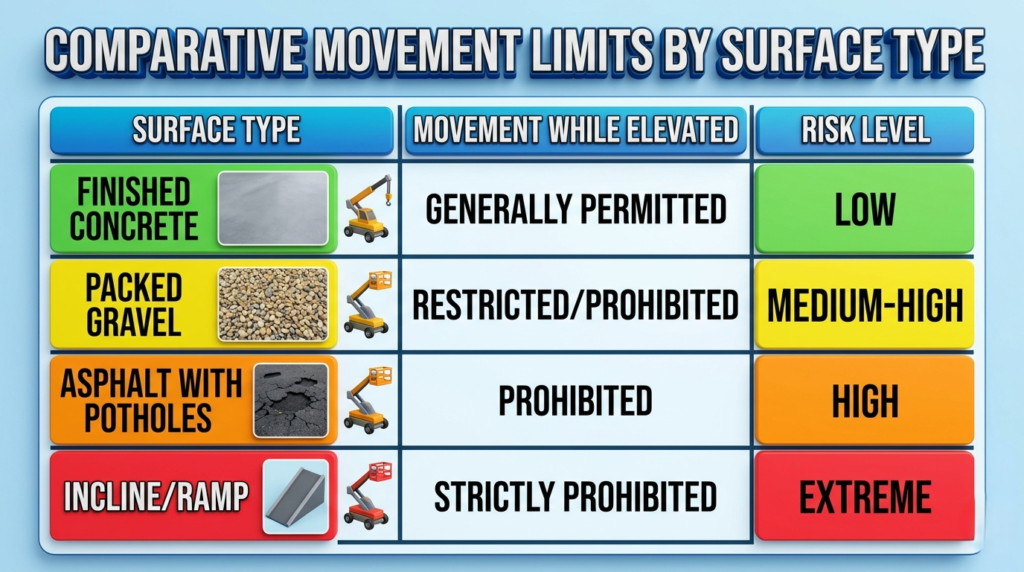
Comparative Movement Limits by Surface Type
| Surface Type | Movement While Elevated | Risk Level |
| Finished Concrete | Generally Permitted | Low |
| Packed Gravel | Restricted/Prohibited | Medium-High |
| Asphalt with Potholes | Prohibited | High |
| Incline/Ramp | Strictly Prohibited | Extreme |
3. Necessary Safety Procedures for Operating at a Raised Height
When regular scissor lift movement while the platform is extended is part of your tasks, the operator must shift to an attitude of “heightened awareness”. From a height, the view is entirely different and what on the ground may seem to be only a small obstacle can at height turn into a danger.
- Pre-Drive Ground Walk: The operator, or the spotter if there is one, should examine the platform’s travel path for the presence of hazards like cracks, debris, or overhead obstructions
- Activate “Creep” Mode: Due to safety reasons, most lifts at elevation will limit their speed automatically. Make sure that this function is operational. Never try to bypass or tamper with speed limiters in order to make the lifts go faster.
- Always Communicate Clearly: Use radios or standardized hand gestures if a ground spotter is involved. Often the person at the ground level sees potential hazards better.
4. Maintenance and Safety of Movement
Machines which are not maintained well represent a great danger especially when used for scissor lift movement. Platform stability is necessarily dependent on the strength of every bolt and hydraulic seal in the scissor assembly.
- Condition of Tires: Since tires are the only elements of the lift touching the ground, flat spots or chunks of rubber missing from the solid tires can cause, during the movement, dangerous vibrations.
- Levels of Hydraulic Fluid: Erratic hydraulic pressure fluctuations will result in the platform “bouncing” during transit which will displace the center of gravity and put the lift’s stability at risk.
- Brake Adjustment: For operating at height, the brakes have to be gentle and smooth. Become the culprit of a pronounced jolt that causes the platform to sway or to be subject to the “pendulum effect”.
Stability-Related Maintenance Checklist
- Examine pothole protection bars for proper functioning.
- Check scissor arm pins for wear and/or play.
- Run daily tests on the tilt alarm and drive-cutout switches.
5. The Identification of Environmental Dangers
External factors determine the safety of scissor lift movement regardless of the capability of the machine. Operators must be well-trained not only to identify but also to analyze the environment and take the issuance of the lowering platform command as a safety measure.
- Wind Speed Thresholds: Like a lateral force, wind affects the lift. The general wind speed limit after which scissor lifts should no longer be moved is 28 mph (45 kph). Indoor lifts, on the other hand, are often not rated at all for any gust of wind.
- Overhead Obstructions: Risks of “pinching” or “crushing” are highly probable while driving when elevated against ceiling beams, sprinklers, or power lines.
- Floor Load Capacity: The floor must be capable of supporting the concentrated weight of the lift. It is important to bear in mind that a scissor lift at height is exerting more localized pressure than a stationary one.
6. Training and Certification Requirements
The best kind of safety gear is knowledge. Moving a scissor lift, in particular, is a piece of work that should be done in a controlled environment before it is taken to a busy construction site. scissorlifts.org follows this philosophy and gives the highest priority to training and certification.
- Getting to Know the Lift: Operators should get to know the control layout intimately of the lift that they are going to use. The difference in joystick sensitivity is a common factor from one manufacturer’s design to another.
- Fall Protection: Guardrails constitute primary protection. Nevertheless, many safety managers go beyond this requirement and insist that the operators wear a body harness and lanyard during elevated movement.
- Emergency Lowering: It is understood that operators as well as the persons on the ground know the use of the emergency manual lowering valve. This is especially critical when the drive/lift system breaks down at height.
FAQ’s – Unlock the secrets of Scissor Lift Movement!
Is it safe to move a scissor lift while the platform is up?
There is no problem with safety if guidance is followed that the machine has been specifically designed for the so-called “drive-at-height” and if the ground is completely level and clear of debris. While most modern electric lifts are “drive-at-height”-ready, many rough-terrain models require the platform to be lowered prior to movement.
What are the OSHA rules for moving elevated work platforms?
According to OSHA, movement of the scissor lift while elevated is allowed only if the machine is designed for such operation. Besides, the operating surface has to be within the machine’s tilt limits according to the manufacturer, and the operator must always have a clear view of the travel path.
Can wind tip over a moving scissor lift?
Definitely. Wind works in the position of a lateral force. When a lift is moving, it is at a disadvantage compared to when it is parked regarding stability. If the wind speeds go beyond the rating of the machine (normally 28 mph), scissor lift movement tip-over risk goes up a lot.
Do I need a spotter when driving a scissor lift at height?
Having a spotter is not always a legal requirement under OSHA but it is strongly advised. In fact, a spotter may see ground-level hazards such as floor openings or debris that the elevated operator does not.
Why does my scissor lift slow down when I raise the platform?
That is a safety mechanism put in place known as “creep speed.” It restricts the machine’s speed to a low level during the time that the center of gravity is high. This way the risk of a tip-over in operation is vastly reduced.
What should I do if the tilt alarm goes off while moving?
You have to stop immediately. Do not go on moving or try to raise the platform further. Gently, lower the platform to the lowest position and then relocate the machine to a level area.
What is the most common cause of scissor lift accidents?
Tip-falls due to uneven ground and falls from the platform are on top of the list of causes leading to fatal accidents. Both scenarios are risk-wise way higher when scissor lift movement is being carried out in haste and without observation of safety time.
Conclusion: Efficiency Without Compromise
Good mastery of scissor lift movement involves reconciling the need for speed with the absolute need for safety. You can ensure that your workplace is both highly productive and free from accidents by choosing suitable machines, thoroughly maintaining them, and following OSHA standards. Be sure of one thing: in case there is any uncertainty as to the stability of the ground or the capability of the machine, then the safest act is to lower the platform prior to making any travel.
Discussion
0 comments