Scissor Lift Inspection Guide: Ensuring Safety & Compliance for 2026
Ensuring safety while working at heights is not only a requirement from authorities but also a key aspect of the workplace environment. For industries that use aerial work platforms, the thorough scissor lift inspection schedule is an integral part keeping the equipment dependable, the operators safe, and the companies aligned with the new OSHA and ANSI requirements. On a construction site or in a warehouse, knowing the health of your equipment can save you from fatal structural failures or tip-over accidents.
Preventive maintenance is far from being just a casual visual check. In fact, it requires a thorough mechanical, hydraulic, and electrical system inspection. Making use of checklists standardized for scissor lift inspection can help in spotting the smallest signs of wear before they turn into costly repairs or hazardous mishaps.
Why You Shouldn’t Skip Scissor Lift Inspection?
Every inspection is primarily a safety measure. Scissor lifts are intricate pieces of equipment that will put their parts under extensive stress and foliage over time. Hence, regular scissor lift inspection is a safety measure that should never be underestimated.
- Risk Mitigation: Your biggest guard against mishaps in the workplace is through prevention. spotting cable frays or hydraulic leakages before the equipment failure leads to the worker’s fall or ejection.
- Regulatory Compliance: It is also part of the regulatory compliance. OSHA mandates that a pre-start inspection be carried out and documented before each work shift to ascertain that the equipment is in a safe working condition.
- Equipment Longevity: Plus, these inspections contribute to the prolonged utilization of the machinery since scissor arms and hydraulic cylinders are kept lubricated and free from any particles due to regular monitoring.
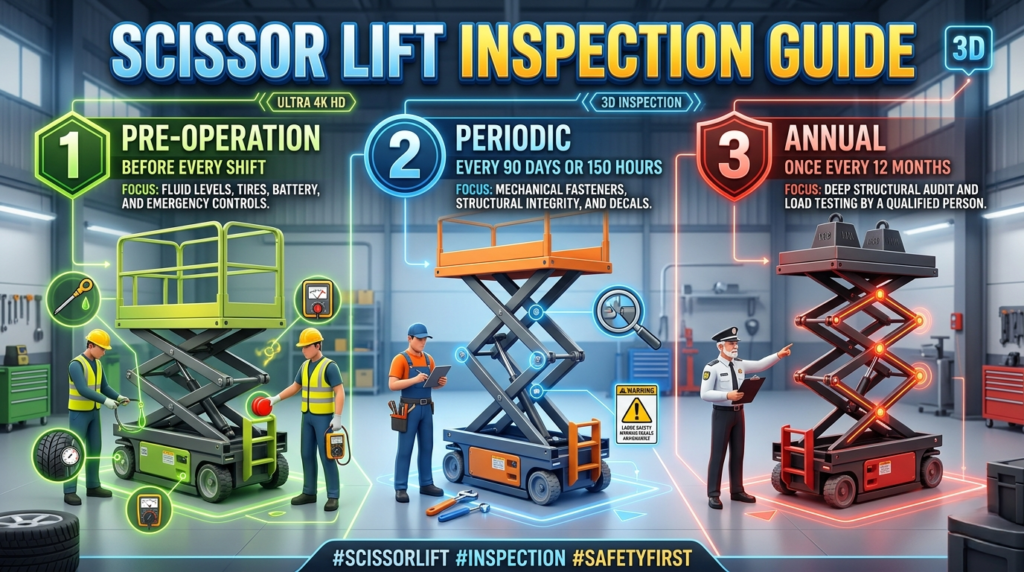
Table: Scissor Lift Inspection Guide
| Inspection Type | Frequency | Primary Focus |
| Pre-Operation | Before every shift | Fluid levels, tires, battery, and emergency controls. |
| Periodic | Every 90 days or 150 hours | Mechanical fasteners, structural integrity, and decals. |
| Annual | Once every 12 months | Deep structural audit and load testing by a qualified person. |
Daily Pre-Start Checklist: The Operator’s Guide to Scissor Lift Inspection
The scissor lift inspection that is going to be the most decisive for the operator is the one done before the beginning of every work shift. This pre-start check is like a “pre-flight check”, ensuring that the vehicle and lift components are working the way the manufacturer designed them.
- Vehicle Components: Check all fluid levels including hydraulic oil, fuel, and coolant to prevent engine or system failure during operation.
- Control Verification: Test both the lower-level and platform controls, ensuring that emergency stop buttons and backup alarms are fully functioning.
- Structural Integrity: Look for missing or unreadable placards, loose guardrails, and any signs of cracked welds in the scissor stack.
Work Zone Inspections: Beyond the Machine
Work Zone Inspections: Complementing the Scissor Lift Inspection with the Surroundings It is of paramount importance to do a scissor lift inspection in the broadest sense: besides checking the lift, also consider the conditions of the work zone. It is the elimination of environmental hazards that may result in tip-overs or electrocution that you want to target.
- Surface Conditions: Look out for holes, drop-offs, floor leveling problems, and unstable surfaces such as loose dirt, which could cause the lift to become unbalanced.
- Overhead Obstructions: Inspect if there are any overhead power lines or communication cables, and if the ceiling height is sufficient.
- Weather and Environment: For work outdoors, check on wind speeds and presence of ice or debris that could affect the lift’s stability or the operator’s footing.
Annual and Periodic Maintenance:
The Basis of a Perfectly Healthy Equipment. Besides daily checks, it is highly recommended that a qualified mechanic carries out a technical scissor lift inspection at longer time intervals. These inspections focus on the inside “health” of the machinery.
- Hydraulic & Pneumatic Systems: A technician will look for any hose leak in the hydraulic system and will also check if the lift is capable of holding its maximum intended load without load drift.
- Electrical Systems: A certified professional’s inspection of wiring harnesses and battery charger averts foul electrical contact and unexpected power loss.
- Tires and Brakes: Make sure that tires are not only free of gouges, but that also the braking mechanism reacts immediately when controls are released.
Most Commonly Found Scissor Lift Inspection Hazards
During a typical scissor lift inspection, suspicious signs that are the red flags come certain times more than others. Being proactive on these issues can help save lives.
- Guardrail Damage: Loose or missing guardrails lead to falls from elevated levels which is among the top causes of fatal injuries at work.
- Fluid Leaks: Apart from being an indication of a failing system, hydraulics leaks also contribute to slip hazards both on the platform and ground.
- Worn Mechanical Fasteners: Locking pins and bolts may loosen due to vibrations. Therefore, ensuring that they are securely fitted is important for structural stability.
Training and Retraining for Inspection Success
Unauthorized and untrained persons should not be allowed to perform a scissor lift inspection. Training guarantees that the operator is capable of distinguishing between the component marked as “safe” and one ready for “tag out”.
- Skill Demonstration: Prior to being allowed to carry out job tasks at the workplace, operators must first prove that they have the ability to do a pre-start inspection correctly.
- Mandatory Retraining: Whenever an accident occurs or if the type of lift is changed, workers must be given retraining to meet the updates in their respective hazard knowledge.
- Manufacturer Requirements: Always refer to the specific manufacturer’s manual during an inspection, as different models have unique maintenance specifications.
FAQ’s for Scissor Lift Inspection
How often does a scissor lift need to be inspected?
The pre-start inspection of a scissor lift should be carried out every day before starting a work shift. Yet, along with this daily method, a more thorough periodic inspection is to be carried out every 90 days, while a comprehensive annual one must be done by a qualified technician.
Does OSHA require a written scissor lift inspection checklist?
Even though OSHA obliges that inspection should be done, the presence of a written or digital checklist is the normal industry practice for proving that one is up to date with the compliance. It also guarantees that no steps are left out and is a record that can be shown in the case of a safety audit.
Who is qualified to perform a scissor lift annual inspection?
Annual scissor lift inspection has to be carried out only by a “qualified person”—meaning someone who is professionally knowledgeable, trained, and experienced to recognize and solve problems with the equipment.
Can I use a scissor lift if the backup alarm isn’t working?
No. According to OSHA guidelines, if any safety component—including horns, lights, or backup alarms—is defective, the lift must be taken out of service and “tagged out” until it is repaired.
What are the most common causes of scissor lift accidents?
The major contributing factors to scissor lift accidents are tip-overs due to uneven ground, falls from the platform, and accidental contact with overhead power lines. Regular scissor lift inspection of the machine and the workplace is aimed at preventing these very incidents.
Do I need fall protection (harness) on a scissor lift?
Although the guardrails on the scissor lift serve as the main form of fall protection, there are instances where a personal fall arrest system is needed as per the manufacturer’s instructions or specific job sites.
What should I do if I find a hydraulic leak during my inspection?
The moment you detect a hydraulic leakage, cease the inspection immediately, tag the machine as “Out of Service,” and inform your supervisor about it. Continuing to operate a lift with a hydraulic leak can result in the sudden failure of the scissor stack.