Top 15 Common Troubleshooting Scissor Lift Problems and How to Fix Them
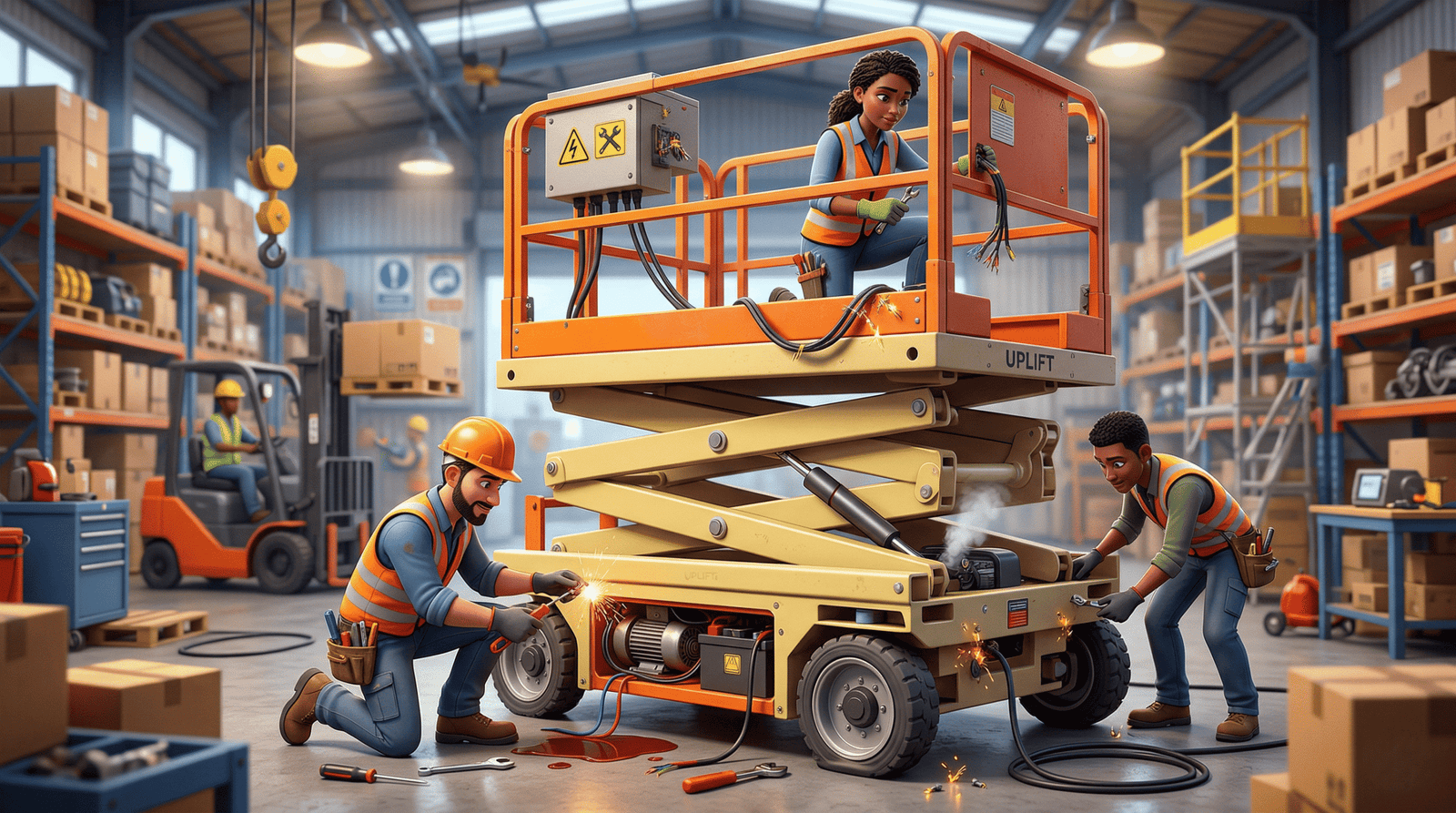
The reliability of your aerial work platforms is often what keeps you at your most productive on the job site. When a scissor lift doesn’t work right, it doesn’t just stop one job; it can slow down the whole project. Operators and site managers both need to know how to troubleshooting scissor lift problems.
If you know what to look for, you can quickly find and fix a lot of problems, from electrical problems to drops in hydraulic pressure. This guide goes into detail about the most common mechanical and electrical problems and gives you practical ways to keep your equipment running smoothly.
Top 15 Common Troubleshooting Scissor Lift Problems:
1. The Lift Won’t Turn On
One of the most annoying scissor lift problems is when a machine doesn’t work when you flip the switch. A simple mistake is often to blame for this, not a major mechanical failure. Before you call a technician, make sure the most basic power connections and emergency stops are working. They often get bumped during transport or installation.
- Look at the Emergency Stop Buttons: Check that the E-stop buttons on both the platform and the ground control are in the “on” position.
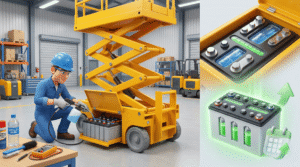
- Check the Battery Disconnect: Make sure that the main battery disconnect switch, which is usually near the battery box, is fully engaged.
- Check the Battery Voltage: Use a multimeter to make sure the batteries are charged enough to start the engine or turn on the electric motor.
2. Lifting or lowering slowly
If your scissor lift is moving slowly, it will have a big effect on how long it takes to complete a cycle. Usually, slow movement means that there isn’t enough energy or that the hydraulic flow is blocked. Taking care of this early can keep the pump from getting too hot or burning out too soon.
- Check the fluid levels: Look at the hydraulic oil reservoir; low fluid levels let air into the system, which makes it respond slowly.
- Keep an eye on the battery’s health: If the battery is low on charge, the motor can’t reach full RPM, which makes the lift cycles take longer.
- Check for Blockages: Look for bent hydraulic hoses or trash stuck in the scissor stack that could be causing mechanical resistance.
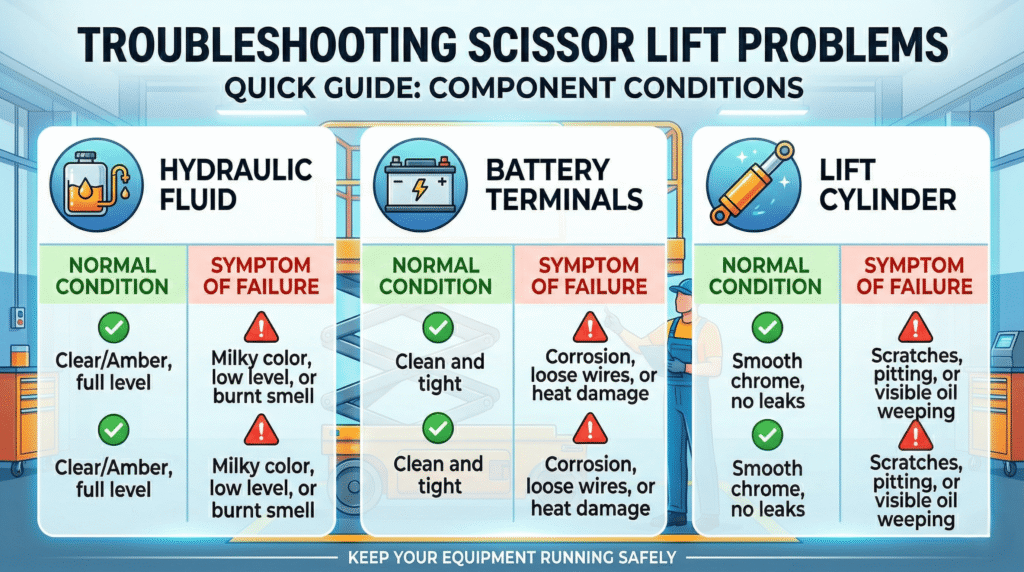
Table: Troubleshooting Scissor Lift Problems Component Conditions
| Component | Normal Condition | Symptom of Failure |
| Hydraulic Fluid | Clear/Amber, full level | Milky color, low level, or burnt smell |
| Battery Terminals | Clean and tight | Corrosion, loose wires, or heat damage |
| Lift Cylinder | Smooth chrome, no leaks | Scratches, pitting, or visible oil weeping |
3. Unexpected Jerking During Elevation
A “jumpy” lift is not only annoying, but it can also be very dangerous for workers who are up high. A balance of hydraulic pressure and mechanical lubrication keeps things running smoothly. When this balance is broken, the metal-on-metal friction or air pockets make a stuttering sound.
- Bleed the Hydraulic System: The main reason for “spongy” or jerking movements is air trapped in the lines. Follow the manufacturer’s instructions to bleed the air.
- Grease the Slide Tracks: Make sure that the wear pads and tracks where the scissor arms slide are well-lubricated with the right kind of grease.
- Look for bent scissor arms: If the steel structure is even a little bit out of line, the lift may get stuck as it rises.
4. The lift doesn’t go all the way up
Being only a few feet away from your work area is very annoying. A lift that doesn’t go all the way up usually has a safety sensor or a physical limit in the hydraulic circuit.
- Check the Load Capacity: Most new lifts have “Load Sense” systems that stop the platform from going too high if it is too heavy.
- Check the limit switches: Look for dirt or damage on the height limit switches that could be causing a “stop” signal too soon.
- Check the hydraulic pressure: A broken relief valve might be letting pressure out before the cylinders are fully extended.
5. The platform is slowly drifting down
If the platform slowly sinks while you work, you are dealing with “drift.” This means that the hydraulic seal has broken, letting fluid go around the holding valves. This is an important problem that needs to be fixed in order to keep the workplace stable.
- Check the seals on the lift cylinder: Look for leaks on the outside of the cylinder rod. If there are none, the piston seal on the inside may be worn.
- Check the Holding Valve: A small piece of debris may have gotten stuck in the check valve or solenoid that keeps the oil in the cylinder.
- Check the Manual Lowering Valve: Make sure that the emergency manual override valve is fully closed and not leaking fluid.
6. Steering Problems or Hesitation
The main benefit of a scissor lift is that it can be moved around easily with troubleshooting scissor lift problems. If the wheels won’t turn or respond slowly to the joystick, the problem is usually with the steering cylinder or the electrical signals that the platform controller sends.
- Check the steer bushings: Worn kingpins or bushings can cause the steering cylinder to get stuck in a way that it can’t get out of.
- Check the coil solenoids: The steering manifold uses electrical coils to direct oil. Look for loose wires or coils that are burned out at the base.
- Check the condition of the tires: Make sure there is no junk (like wire or shrink wrap) wrapped around the axles or steering linkages.
7. Batteries that don’t hold a charge
The battery bank is the most important part of an electric scissor lift. If the lift stops working after just an hour, it’s likely that the batteries are sulfated or the charging system isn’t giving them a full charge.
- Clean Terminal Corrosion: To get rid of “white fluff” on terminals that makes electricity harder to flow, mix baking soda and water.
- Check the Water Levels: For lead-acid batteries, make sure the plates are covered with distilled water, but don’t fill them up too much before charging.
- Check the On-board Charger: Make sure that when you plug it into a wall outlet, it really does put out the right voltage.
8. Weird Noises (Squealing or Grinding)
The machine makes loud noises to let you know that two parts are fighting. Grinding usually means that there is mechanical friction, while high-pitched squealing usually means that there is a problem with the belt or the hydraulic system.
- Find out where the noise is coming from: Is it happening while you’re driving (motor/gears) or lifting (pump/scissors)?
- Check the Motor Brushes: Worn brushes on older DC motors can make a loud grinding or humming sound.
- Check the pump couplers: If the coupler between the motor and the hydraulic pump is worn, it can make a loud rattling sound when the pump is under load.
9. Joystick not working
The joystick is the main way the operator interacts with the machine. When it stops working or only works sometimes, it’s usually because of wear and tear on the inside or damage from the outside, like rain or dust getting in which can be solved by troubleshooting scissor lift problems easily.
- Check the “Deadman” Switch: Make sure the joystick’s trigger or enable switch is clicking and making contact.
- Check the Control Cable: The “pigtail” cord that connects the platform box to the base can get pinched or frayed in the scissor stack.
- Check the calibration of the controller: Some digital controllers lose their “null” point and need a software reset to know where the center stick is.
10. The brakes won’t let go
If the lift’s engine or motor is running but the machine won’t move, the parking brakes are probably stuck. Scissor lift brakes are usually “fail-safe,” which means they stay locked until either hydraulic pressure or an electric signal tells them to let go.
- Check the Brake Release Valve: Make sure the manual brake release (used for towing) is set to “operate.”
- Check the Drive Manifold: A stuck valve in the drive circuit could be stopping oil from getting to the brake release piston.
- Check Electrical Continuity: Make sure that the brake solenoid gets the signal to open when you move the joystick.
11. Pothole Protectors Not Working
There is no room for negotiation when it comes to safety, hence troubleshooting scissor lift problems is necessary. The metal flaps that drop down to hold the lift steady are called pothole protectors. If they don’t deploy, the safety system on the machine will usually keep the platform from going higher than a certain height.
- Clear Debris from Flaps: Mud, rocks, or construction debris can easily keep the protectors in the “up” position.
- Lubricate the Pivot Points: These protectors are often close to the ground and can rust easily, so make sure the hinges are well-greased.
- Check the Deployment Linkage: Make sure the mechanical bars that push the protectors down are not bent or broken.
12. The engine won’t start (for dual fuel and diesel models)
The troubleshooting scissor lift problems with internal combustion (IC) lifts are the same as those with cars. But these machines often have problems with fuel and air because they sit around for so long.
- Check Fuel Levels/Selection: Make sure the toggle switch is set to the right type of fuel (propane or gasoline) and that the tank is full.
- Check the air filter: If it is clogged, the engine will “choke,” which means it won’t start or will stall.
- Check the spark plugs and glow plugs: Make sure the ignition parts are clean and working, depending on the type of engine.
13. The overload alarm goes off at the wrong time
Modern scissor lifts have sensors that stop them from working if the weight limit is reached. But these sensors can lose their calibration, which can make the alarm go off even when the platform is empty which can easily solved with basic troubleshooting scissor lift problems.
- Recalibrate Load Sensors: To reset the zero-point of the pressure transducers or load cells, follow the instructions in the manufacturer’s manual.
- Check for Physical Interference: Make sure that no tools or other things are stuck between the platform and the chassis.
- Check the wire harnesses: A short circuit in the sensor wiring can send a “false positive” overload signal to the computer.
14. Leaks in hydraulic fittings
Hydraulic leaks make a mess and are bad for the environment. They usually happen at “high-stress” places where hoses connect to the manifold or cylinders.
- Tighten Loose Connections: Over time, vibration can loosen fittings. A simple turn of a wrench can often stop a leak.
- Change the O-Rings: If a fitting is tight but still leaking, the O-ring inside is probably pinched or dry-rotted.
- Check the Hose Jackets: If you see “bubbles” or fraying on the hoses, it means there is a problem inside that could cause them to burst.
15. The tilt sensor stops the operation
Scissor lifts are made to work on flat ground but the same can cause serious troubleshooting scissor lift problems. The tilt sensor will stop the lift from working if it sees an angle that is too high (usually 2 to 3 degrees). This is to keep the lift from tipping over.
- Level the Machine: Move the lift to a flat surface you know about to see if the alarm goes off.
- Check the sensor mounting: Make sure the tilt sensor (which is usually inside the base cabinet) hasn’t come loose and is sitting at an angle.
- Check for a Sloped Floor: The sensor can go off even if the floor looks flat. For more tips, read our guide on how to use a scissor lift on sloped floors.
FAQs – Top 15 Common Troubleshooting Scissor Lift Problems
Why won’t my scissor lift move and why is it beeping?
A beeping sound is usually a diagnostic code. The lift probably won’t move because the pothole protectors aren’t in place, the machine is tilted, or the platform is too full. Look for a specific error code on the control box’s screen.
How often do I need to look at the hydraulic fluid in my scissor lift?
As part of your pre-operation inspection, you should check the levels of hydraulic fluid every day. Keeping the right amount of fluid in the system stops air from getting in and keeps the pump safe from cavitation damage.
Is it possible to move a scissor lift while the platform is up?
Yes, most slab scissor lifts are made to be driven slowly while they are raised, as long as the ground is level and stable. But always look at the manufacturer’s safety instructions for your model.
What does it mean when the light that says “Low Battery” is flashing?
If the battery light is flashing, it means that the voltage has dropped below a level that is safe to use. To avoid damaging the battery cells through “deep discharge,” you should stop working and charge the lift right away.
If the power goes out, how do I lower a scissor lift by hand?
There is an emergency manual lowering valve on every scissor lift. It is usually at the bottom of the lift cylinder. To safely lower the platform, pull this cable or turn the valve to let the hydraulic fluid flow back to the tank.
Why does the steering on my scissor lift feel loose or shaky?
Worn kingpin bushings or a loose steering cylinder bolt are two common causes of loose steering. Regularly lubricating the steering linkage can stop this wear and keep the machine working well.
How long do batteries for scissor lifts usually last?
If you take care of them and water them regularly, a set of deep-cycle batteries can last for three to five years. If you don’t charge them or use tap water instead of distilled water, they can last half as long.