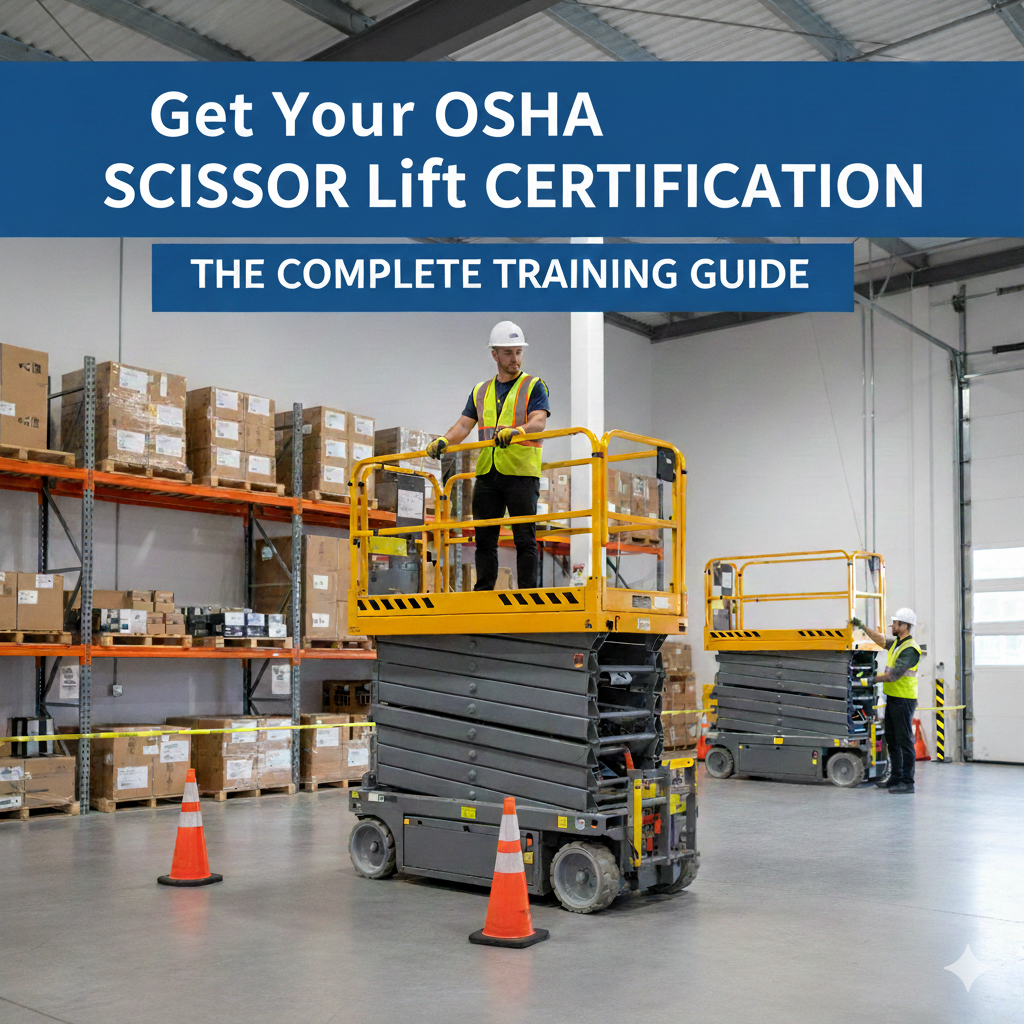
How to Get OSHA Scissor Lift Certification: The Complete Training Guide
Scissor lifts have become essential equipment in different types of works such as construction factories, warehouses, and maintenance operations as they allow a safe, efficient, and quick vertical access to work areas at height. The challenge however is the fact that these Mobile Elevating Work Platforms (MEWPs), although very handy, require operators to still exercise some critical responsibility. Hence, the OSHA Scissor Lift Certification is the necessity for your scissor lift journey.
Why OSHA Scissor Lift Certification is Important?
If one is found operating a scissor lift without a training certificate and proper knowledge of how to do it, not only is the operator put at risk, the people who are around him/her will also be at risk of injury. Also, the company will have to pay a great penalty to the Occupational Safety and Health Administration (OSHA) office.
Making sure that every operator is in possession of a valid OSHA-compliant certification is not just the most effective way of doing things; it is the law. The following detailed guide which is based on the safety measures that we implement at Scissor Lifts, will lead you through the exact preparation, taking, and renewing processes to help you gain your OSHA Scissor Lift Certification and at the same time maintain an OSHA-compliant and safe work environment.
Truth be told, scissor lifts like any other heavy industrial equipment can be accident-prone if they are not operated with care. Accidents which could result in falling off the platform, the equipment tipping over and being electrocuted are some of the real hazards that can be avoided.
OSHA Scissor Lift Certification regulations, focusing on the use of scaffolds, stipulate that the operation of such equipment is a privilege of only those who have been properly trained and are authorized. Hence, it is most essential to your health and safety culture at the worksite that you get acquainted with the entire training lifecycle, including the initial theory lesson and the practical hands-on assessment.
We will clarify for you the procedure, the regulation system, and give you sufficient information for you to make the right step necessary to be fully OSHA-compliant and give you the confidence to perform well and safely.
The Mandate: Why OSHA Scissor Lift Certification Is Non-Negotiable
The regulatory changes that have recently taken place in the area of work at height are crystal clear:
An employer/manager of a construction site/factory/warehouse is unambiguously the first person who should ensure that all his/her employees who operate scissor lifts are trained by a competent trainer thoroughly. It is not a mere suggestion; rather, it is a federal law that serves the purpose of protecting workers from serious injuries or death.
Violating this law will be a risk that no company can and should take ethically and financially. The enforcement branch of OSHA as a matter-of-fact investigation into workplace incidents with great frequency and regularly issues massive fines in case of non-compliance with the requirements of training and inspection.
A well-laid, verifiable certification program totally removes this legal risk and on the contrary, it really works towards changing the team’s attitude toward safety on the site in a very positive way.
The obligation comes from the General Industry standards (1910) and the Construction standards (1926), pointing in particular to the training requirements for scaffolds. The purpose of the training is to provide the operators not only with the mechanical skills needed to operate the lift but even more importantly, with the critical judgment which helps them recognize, prevent, and deal with common workplace hazards before this led to a fatality.
- The employer is ultimately and legally the one responsible for ensuring that all scissor lift operators have satisfactorily completed both the written and practical training components before they are allowed to commence their work tasks.
- Not providing a thorough, well-documented training program may lead to serious OSHA citations which can be classified as serious or wilful violations, and hence entail large monetary fines and possibly a very serious legal situation.
- OSHA Scissor Lift Certification serves as a proof that an individual is capable, virtually almost completely ruling out the occurrence of accidents that are mostly due to the lack of knowledge of the operator, like overloading the platform, failure to stabilize, and unsafe driving methods.
Understanding OSHA Scissor Lift Certification Regulations
Many people misunderstand what industry the scissor lifts fall under. These days, standard organizations such as ANSI categorize scissor lifts as a subset of Mobile Elevating Work Platforms (MEWPs) whereas OSHA has kept their traditional view and for decades has classified scissor lifts not as “Aerial Lifts” (like boom lifts or cherry pickers) but as a kind of mobile supported scaffold.
It is crucial to understand this differentiation as it decides the exact set of OSHA standards (Subpart L – Scaffolds) that will be suitable for everything going from the design of guardrails to the requirements for fall protection.
As an illustration, the scaffolding standard ordinarily considers a full guardrail system as the primary method of fall protection, that is why a Personal Fall Arrest System (PFAS) will typically not be necessary on a scissor lift that has well-designed guardrails, if the manufacturer does not call for it or the competent person on the site does not decide otherwise.
A deep understanding of this classification will definitely ensure that employers implement the appropriate safety procedure and inspection guidelines for their equipment.
| Classification Type | Regulatory Standard | Primary Fall Protection Requirement | Key Characteristics |
| Scissor Lift | OSHA 29 CFR 1926 Subpart L (Scaffolds) | Adequate Guardrail System | Vertical-only lift mechanism, flat work platform, high center of gravity. |
| Boom Lift/Cherry Picker | OSHA 29 CFR 1926.453 (Aerial Lifts) | Personal Fall Arrest System (Harness/Lanyard) | Articulating or telescopic boom, ability to reach horizontally. |
- The OSHA standards for Scissor Lift Certification require that the operators be trained not only on the general use of the equipment but also on the specific hazards that they can be exposed to while using the type of mobile scaffold such as problems with instability and overloading.
- Both construction and general industry standards (1926 and 1910) should be covered in the training where different work environments demand the use of lifts.
- It is especially important that the guards rails be inspected thoroughly to be sure they are complete and sound before the start of each shift.
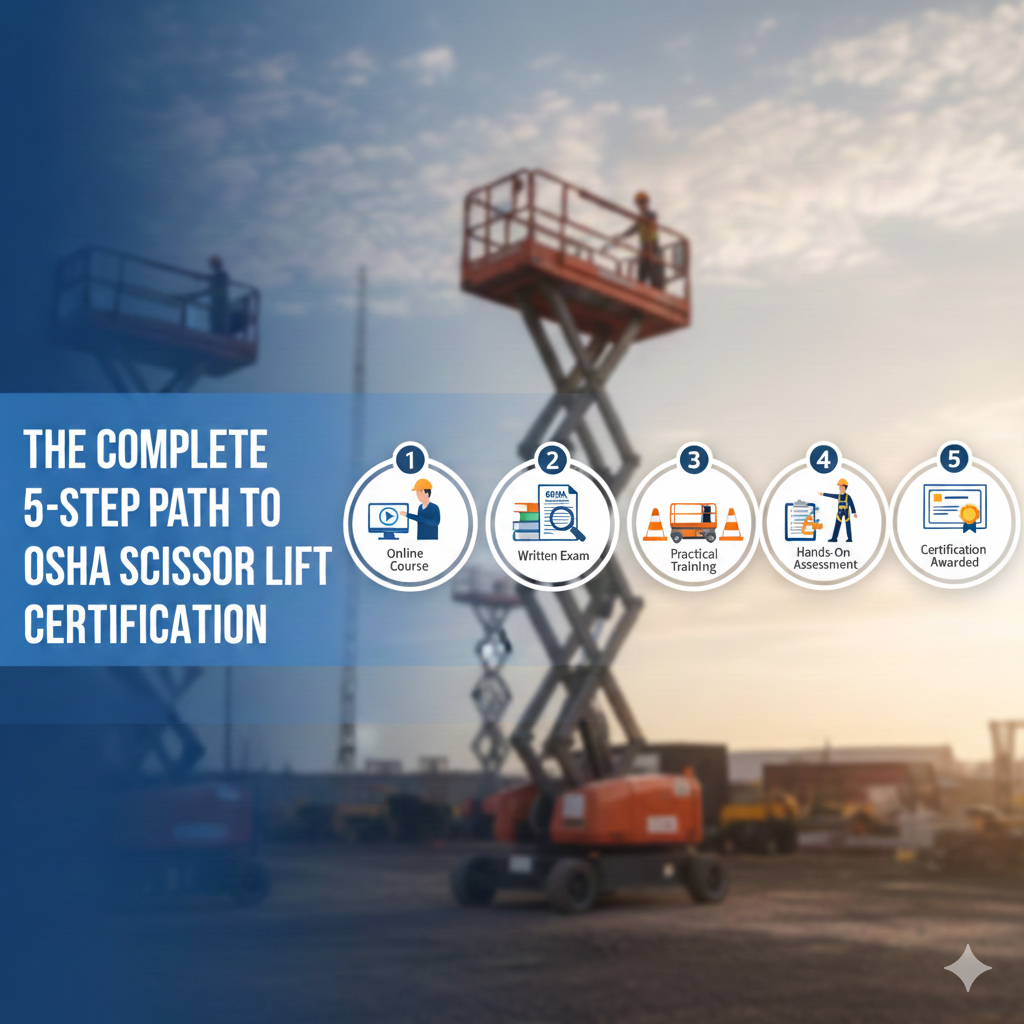
The Complete 5-Step Path to OSHA Scissor Lift Certification
Obtaining an OSHA scissor lift certification is a series of meticulously planned steps that include theoretical classes and practical sessions. It is important to note that OSHA does not issue the certificates; instead, they provide the training framework that employers have to follow, which is then delivered by a qualified instructor who, thus, certifies the trainee’s competence.
The main instruction areas are usually divided into the theoretical knowledge test and the hands-on practical examination. Hence, an operator’s comprehensive assessment will involve not only knowing the rules but also having the skills to operate the machine in a safe manner.
Here are the steps you’ve got to show for yourself: They should be done meticulously and recorded. Only then is it okay to let the employee operate the machinery:
- Identify and select a competent training program: This involves deciding on a trainer – either a capable in-house trainer, an online course provider, or a third-party safety organization – whose program is unequivocally OSHA-compliant and incorporates the latest ANSI standards (A92).
- Formal Instruction (Theoretical): The trainee is required to be at the formal training classes which can either be physical or virtual. These lectures must cover essential regulations, hazard recognition (in terms of falls, tip-overs, and crushes), manufacturer’s manuals, and safety measures. The operator has to take a written test or equivalent assessment to provide evidence that he/she has fully grasped all the principles and understood the regulatory framework covered in the theoretical module. This validates that the operator has the safety knowledge very well before he/she gets to the machine.
- Practical Hands-On Assessment: Besides the knowledge test, this is also considered the most important part. The qualified person shall witness the operator conducting the various tasks of the scissor lift in a controlled area. The candidate must show that he/she can conduct pre-shift inspection, function testing, proper maneuvering, load handling, and even be able to perform emergency shutdown.
- The Official Certification Document: The qualified person or the employer issues a documented certification record, usually in the form of a wallet card, once the candidate passes the theory and practical tests.
- Employer Authorization: It is the employer’s responsibility to confirm and authorize the operator’s use of the machine. Certification evidence has to be in the employer’s records and be available for OSHA inspectors at any time the operator is on the job.
Essential Safety Focus: What Training Must Cover
Besides the mere knowledge of the controls, effective scissor lift training is based on the awareness of hazards. Apart from the detailed travel through the types of risks that operators may face when using elevated platforms, the course will provide the steps necessary to mitigate them in full compliance with the safety mission at Scissor Lifts.
Operators most of the time directly cause accidents because either they have not recognized the hazards at the worksite or they have ignored them. Consequently, the training must focus heavily on the protocols before the operation starts and the awareness of the situation around the lift as well as the load capacity.
- Pre-Shift Inspections: It is absolutely compulsory for the operator to have been given the most detailed and thorough instructions on what to look at during the pre-shift inspection. Among others, this means looking at the fluid level, tires, controls (both platform and ground ones), emergency stops, and the most important one – check the integrity of the guardrails and the structure components surrounding them. In case a defect is discovered, the equipment should be taken out of service immediately.
- Hazard Awareness and Positioning: The course helps the participant understand choosing a safe working area, for instance, one that is flat and stable, without any obstruction, from which the fall won’t be severe, does not have slopes, or is not next to moving vehicles. Also, operators will be taught the 10-foot rule that limits the distance to electrical wires that has to be followed if the operator wishes to avoid electrocution and they will be shown how to position their lift in order to steer clear of crushing hazards when there are fixed objects overhead.
- Load and Wind Restrictions: One of the most important aspects of the lesson is that the operator understands the limitation of the manufacturer’s maximum load and strictly adhere to it at all times. Moreover, they have to be aware of and follow the instruction related to the environment particularly with the wind, the speed at which the wind is allowed, for an outdoor-rated lift will be typically less than 28 mph, otherwise, a lift-overturn could occur.
Maintaining Compliance: Recertification and Retraining Rules
OSHA scissor lift certification should not be regarded as an event that took place once and for all but rather as a continuous commitment to safety and compliance with OSHA requirements. Keeping refresher trainings and proficiency checks ensures that the operator will always be up to date not only with the machinery but also with the site conditions.
Therefore, as a general rule, the industry standard is that the certification for a scissor lift should be renewed every three years. The recertification program serves as an instrument to keep the operator away from complacency, reevaluate behaviors, and confirm fitness to safety performance.
Be that as it may, if an incident or some other trigger that demands an immediate requalification occurs, it is no longer permissible to wait for three years to do recertification.
| Compliance Action | Frequency/Trigger Event | Purpose of Action |
| Recertification | Every three (3) years. | Refreshes knowledge of regulations, manufacturer instructions, and best practices to maintain competency. |
| Retraining | Immediately upon triggering event. | Corrects observed deficiencies, introduces new equipment/hazards, and addresses the root cause of an incident. |
- Any workplace accident or near-miss involving a scissor lift necessitates immediate retraining of all operators as part of the efforts to analyze the accident and rectify the underlying behavioral or knowledge lapse.
- Observation of unsafe operations like the operator being witnessed lifting the platform while driving or overloading the platform is a condition that triggers immediate retraining aimed at correcting the operator’s improper technique.
- Employees who have been trained to operate a certain *type* of scissor lift are supposed to go through refresher training when switching to a different model of the lift (e.g. from a slab electric lift to a rough-terrain diesel unit), or to be trained in new hazards if the change of the work environment results in new risks.
OSHA Scissor Lift Certification FAQs
Does OSHA require certification for scissor lifts?
The answer is definite yes. Before employees are allowed to operate the equipment, OSHA basically requires that they be adequately trained and certified by a qualified person. The lack of this training will be interpreted as a serious infraction by the department and the employer will be subjected to large fines.
How often do I need to renew my OSHA Scissor Lift Certification?
Most industry and regulatory guides are in line with the view that the operator of a scissor lift should be re-certified or formally evaluated for competence in scissor lift operation at least once every three years. A certificate may be revoked earlier if some events (such as improper behavior or accident) occur.
What about fall protection, do I always have to wear a harness and lanyard?
Except for the situations when the guardrails are not sufficient and personal fall arrest system (PFAS) is required by the manufacturer, a harness and lanyard (PFAS) are not usually necessary on the scissor lift since the guardrails are the main way of fall protection according to the scaffolding standard.
Who is responsible for providing the scissor lift training?
Ultimately, it is the employer who is in charge of making sure that each one of the employees who are going to use scissor lifts have received proper training. Training has to be carried out by a person who is qualified in the field and is capable to train as well as evaluating the competence of employees.
What topics are covered in the OSHA Scissor Lift Training course?
A compliant training course covers two main areas: theoretical instruction (hazard recognition, regulations, lift maintenance, stability factors, pre-shift inspection) and a practical skills demonstration. Key topics include avoiding tip-overs, preventing electrocution, understanding load capacity, and safe travel procedures.
What happens if I am caught operating a scissor lift unsafely?
Being called for immediate retraining is what happens when a supervisor or anyone qualified sees an operator using the lift in a wrong or unsafe way. This is one of the cases where re-evaluating the operator’s knowledge and skills is required regardless of how recently the operator was given initial certification. Reeducation has to address the specific shortcomings which have been noticed.