The Ultimate Guide to Scissor Lifts for Infrastructure Projects (Bridges, Roads, Rail)
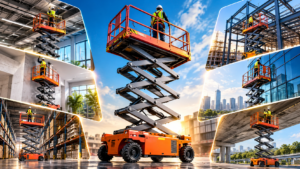
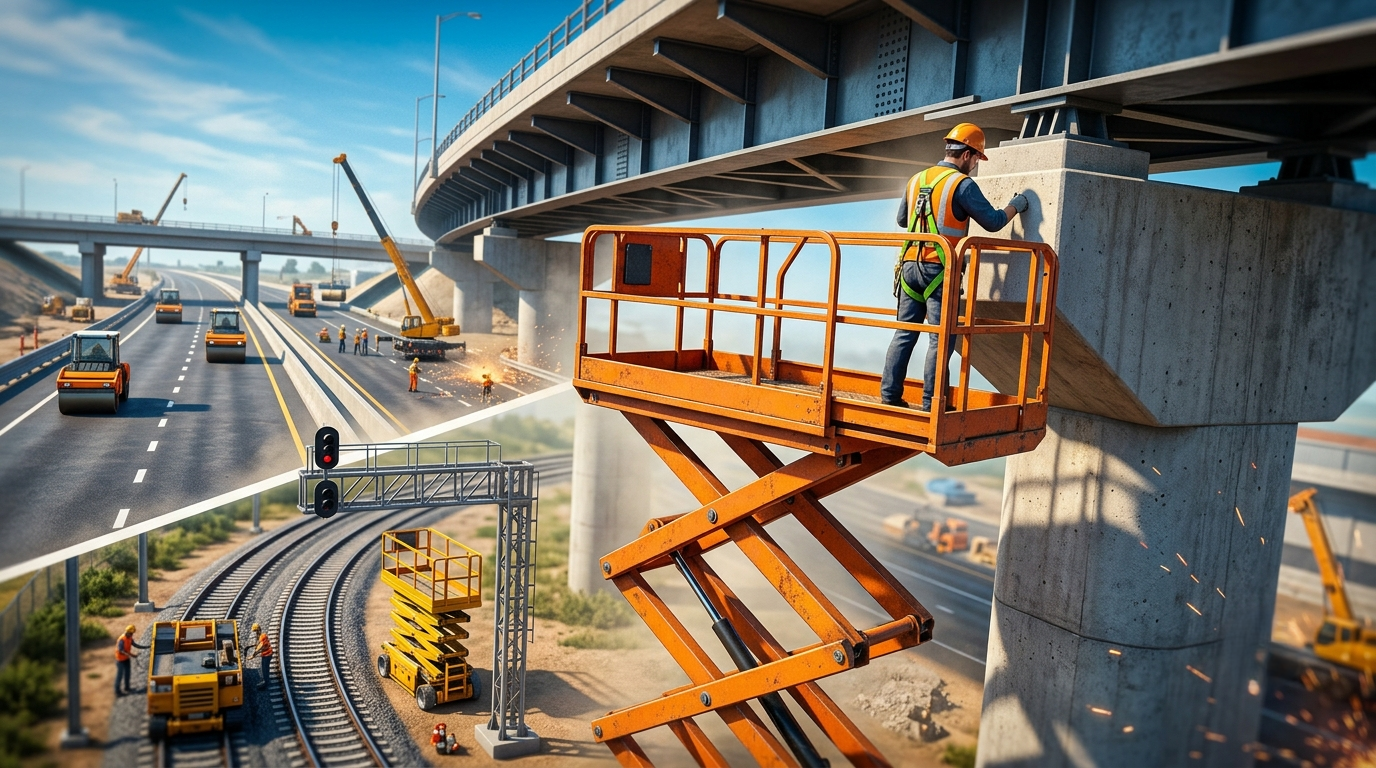
Massive civil infrastructure projects form the backbone of modern economic growth through wide highways, intricately connected bridge overpasses, and high-speed rail networks which are well supported by a variety of scissor lifts for infrastructure projects.
Heavy-duty aerial work platforms have become the must-have tool in this fast-moving and changing segment that has led to work teams completely changing how they do structural tasks at heights, with safety, job efficiency, and speed as the prime focus. Providing elevated access solutions capable of handling brutal onsite conditions, heavy lifting, and absolute worker stability at great heights is a must when dealing with huge scissor lifts for infrastructure projects.
As many governments across the world pay trillions of dollars for public works, the choice of the right mechanical lift becomes a major deciding factor in finishing projects on time and within the budget.
What used to be done with scaffolding and complex ladder structures, is now swiftly being left behind by mobile elevating work platforms (MEWPs) because of their quick delivery and greater payloads. This exhaustive guide focuses on how scissor lifts can be used especially in the transportation infrastructure sector and their operational benefits while maintaining strict compliance standards.
The Active Role of Scissor Lifts in the Modern Civil Engineering Sector
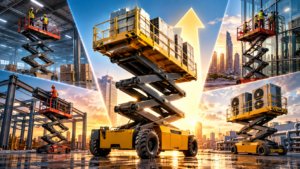
Doing such incredibly large-scale infrastructure projects requires the availability of lifting machines that will not only provide the lifting power but at the same time the very precise positioning. This is where scissor lifts come in, as they work by using a pantograph mechanism – which is a series of hinged, folding metal bars arranged in a very specific crisscross “X” pattern – to facilitate vertical movement only.
The basic difference with the articulated boom lifts that can extend out at several angles is that a scissor lift goes straight up and down, thus giving a bigger and much more stable working area that can comfortably hold several technicians along with their tools and parts.
Functional Features in the Civil Engineering Sector
- Large Payload Capacities: Top-of-the-line models can easily lift weights from 1,000 to more than 2,500 pounds, thus allowing the same time movement of workers, heavy tools, and raw material.
- Extra Large Workspace Platforms: The long deck areas are usually equipped with roll-out platform extensions, thus giving the maximum horizontal reach over a limited linear area without the need for repositioning the machine’s base.
- Top-notch Structural Stability: The interconnected geometric design greatly reduces sway and deflection at the maximum lift height level, thus giving workers the assurance they need to perform very precise mechanical tasks.
How Scissor Lifts Help in Bridge Construction and Repair
Bridge construction, inspection, and maintenance are among the hardest vertical access challenges in civil engineering. Often work is carried out under the huge concrete decks, on gigantic supporting columns, or within complex steel truss structures where ground access is almost impossible.
In these cases rough terrain scissor lifts with 4WD and heavy-duty outriggers enable workers to level the unstable terrain of embankments typically found under overpasses and across rivers.
When it comes to a structural rehabilitation project, the use of these elevated platforms is essential for carrying out concrete removal by water jet, wrapping with carbon fiber reinforcement, and replacing the bearings between the bridge superstructure and substructure.
The ability to lift the entire masonry crew along with their mixing tools and materials to the exact underside of a bridge deck minimizes downtime much more than the assembly and use of scaffolding systems.
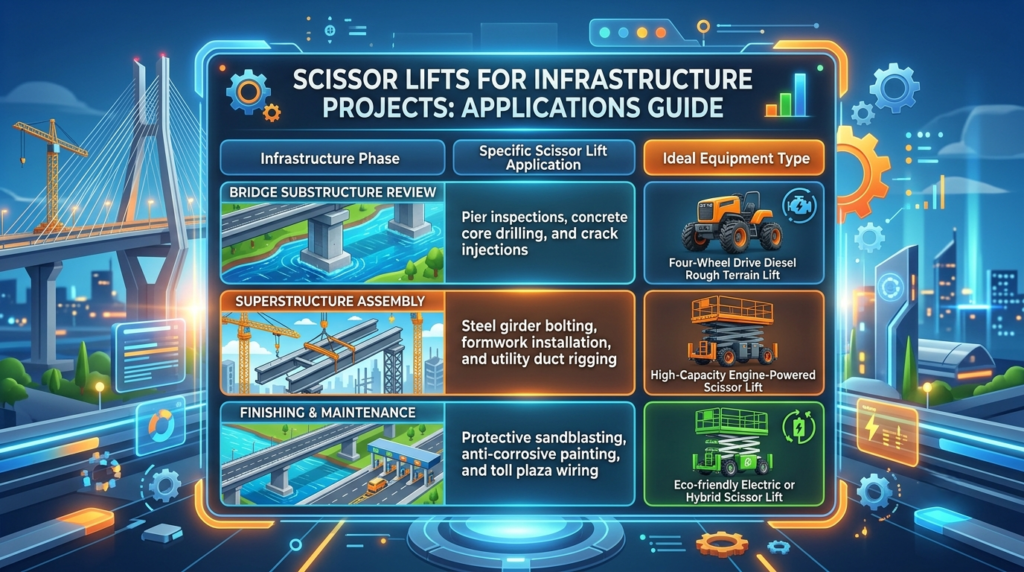
Table: Scissor Lifts for Infrastructure Projects Applications
| Infrastructure Phase | Specific Scissor Lift Application | Ideal Equipment Type |
| Bridge Substructure Review | Pier inspections, concrete core drilling, and crack injections | Four-Wheel Drive Diesel Rough Terrain Lifts |
| Superstructure Assembly | Steel girder bolting, formwork installation, and utility duct rigging | High-Capacity Engine-Powered Scissor Lifts |
| Finishing & Maintenance | Protective sandblasting, anti-corrosive painting, and toll plaza wiring | Eco-friendly Electric or Hybrid Scissor Lifts |
Major Benefits in Bridge Engineering
- Timelines for Scaffolding Removed: Staging systems erection and dismantling along bridges can take weeks; a mobile lift can be driven into position and fully set up within a few minutes.
- Improved Access to Overhead Tools: The raise-and-lower movement goes in a straight line so that workers can be kept parallel to vertical columns and pier caps at all times even during high-pressure spraying or drilling.
- Compliance with Underside Work: The spacious platform deck allows workers to install heavy electrical conduits, drainage pipes, and fiber-optic communication lines directly on the bridge underside.
Roadside and Highway Support Systems Expansion
Road infrastructure nowadays includes not only the bituminous pavement but also a large network of overhead supporting structures such as signage gantries, electronic tolling systems, smart traffic monitoring, and highway lighting systems.
All these heavy installations require the use of quick, safe vertical access capable of being rapidly closed within a couple of lanes to minimize public traffic disruption. Because of their high speed and ability to traverse roadside slopes and unpaved medians, rough terrain scissor lifts are the main option for highway work.
In one scenario, when large steel gantries for highway signage that span several lanes are being installed, a scissor lift will serve as a safe elevated platform from which workers will perform bolting, alignment, and electronic message board wiring. The large platform makes it easy for two or more technicians to handle heavy components at the same time, so that the structural hardware is well anchored before the lane is reopened to traffic.
Crucial Roadway Infrastructure Uses
- Mounting smart traffic monitors: Installing automated speed cameras, traffic flow detectors, and weather monitoring devices on existing overhead highway frameworks.
- Roadside light pole replacement: Changing the old high-pressure sodium light bulbs with energy-lights on overhead light poles in major interchanges.
- Noise barrier wall construction: Putting up heavy soundproofing panels on highway borders to reduce traffic noise in the nearby residential areas.
Supporting Railway and Transit Network Expansion
Railway infrastructure operators need highly reliable equipment that can meet strict clearance requirements and work alongside rail-mounted machinery. Scissor lifts are extensively used during the building phase as well as in the maintenance of railway networks especially for overhead line equipment (OLE) work, tunnel lining repairs, and transit station building maintenance.
Some of these advanced Scissor Lifts for infrastructure lifts are even equipped with a unique “hi-rail” system allowing them to travel on rails to reach isolated sections of the line where no road access exists.
Within long railway tunnels or closed transit stations, electric zero-emission scissor lifts become critical. They allow sufficient vertical reach to inspect brick or concrete linings for water leakage and structural cracks without polluting the enclosed transit tunnels with diesel exhaust. Also, their silent electric motors are ideal for keeping noise levels low thus protecting worker’s hearings in such highly resonant underground environments.
Necessary Railway Maintenance Activities
- Catenary wire alignment: Raising transit workers to safe heights for adjustment, tensioning, and repair of the high-voltage overhead electrification lines supplying train power.
- Signaling system calibration: Fitting and maintaining trackside signaling equipment, signal bridges, and automated switching communication systems.
- Subway tunnel retrofitting: Installation of heavy ventilation ducts, emergency lighting, and fire suppression plumbing on the curved ceilings of underground subway tunnels.
Technical Considerations: Getting the Best Infrastructure Lift
Picking the best aerial platform for a public works project requires an intimate knowledge of the site conditions and also the mechanical necessities of the project. Most times, the first decision is the type of engine and drivetrain the machinery uses.
One has to weigh up the sheer power and off-road capability of internal combustion engines against the environmentally clean, silent, and indoor-friendly aspects of electric-powered systems.
To help decision-makers in their equipment selection, the following top attributes of the two major types of scissor lifts are given below:
Diesel Engine Rough Terrain (RT) Models
- High Peak Diesel Engines: These are powered by internal combustion engines that can produce sufficient torque to enable the vehicle to climb steep project site grades in the range of 30% to 45%.
- 4WD Drivetrain: Comes with foam-filled agricultural tires, oscillating axles, and hydraulic outriggers enabling a safe drive over thick mud, loose gravel, or uneven ditches.
- Roomy Deck Configurations: Provides the largest working platforms and highest lifting capacities making them first choice for outdoor heavy structural ironwork and masonry.
Electric and Hybrid Low-Emission Units
- Zero Emission Battery Drivetrains: These are run with industrial deep-cycle batteries or advanced lithium-ion packs, completely removing harmful tailpipe emissions.
- Non-Marring Solid Tires: They are fitted with special rubber tires designed not to scratch or damage the polished concrete floors inside transit terminals and passenger concourses.
- Very Compact Footprints: They have been designed with narrow dimensions that enable the machines to go through standard industrial double-doorways and maneuver through tight utility corridors.
In-Depth Safety Measures at Civil Infrastructure Projects
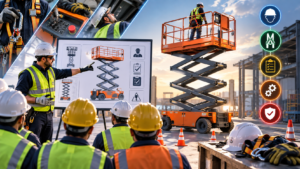
Using heavy aerial machinery on active construction zones that are located near highways or energized rail lines is a very risky operation. All personnel should follow a strict safety and hazard mitigation program that will totally eliminate the risks of tip-overs, falls, and impacts.
It is also worth mentioning that every infrastructure project should enforce complete operator certification and thorough daily machine checks before allowing any equipment to go up.
Also, continuous cold weather observation is important when working outdoors on bridges or highways. Wind can be very dangerous by pushing a raised scissor platform against it thus creating a very large overturning moment that can make the platform unstable.
Manufactured specification plates must always be checked by operators and if the wind speed limit, normally at around 28 mph (12.5 m/s), is reached then the platform must be lowered immediately.
Mandatory On-Site Safety Pose
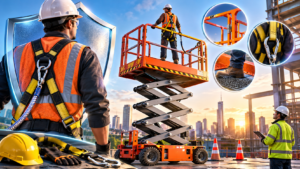
- Fall Protective Wear Is A Must: Anyone on the platform should continuously have a full-body harness fitted and attached with approved lanyards to proper anchor points fixed on the platform chassis.
- Spectacular Pre-Use Vehicle Checks: Do a complete daily structural and mechanical checklist that includes hydraulic hose checking for leaks, emergency lowering function test, and guardrail locking.
- Ground Condition Safety Is Enforced: Make sure that the machine is set on a hard, compact surface and if outriggers are extended, make sure that they are on heavy mud sills or crane pads so that loads are spread evenly.
FAQs – Benefits of Scissor Lifts for Infrastructure Projects
What is the max height of an infrastructure scissor lift?
Heavy-duty models normally provide a maximum platform height that is between 30 and 60 feet. This working reach allows access to overpasses and catenary work up to 66 feet. Engineering vertically makes sure of stability without giving up on lift capacity.
Can you use electric scissor lifts outdoors for roads?
Yes, but only if they have been certified for the wind speed limit outside. They must be run on flat surfaces like asphalt or the deck of a bridge. They cannot move in mud-heavy environments because of their low ground clearance.
How do rough terrain models handle uneven mud?
They come with 4WD high-traction systems and oscillating axles to keep the wheels in contact with the ground. Independent hydraulic outriggers automatically go out in order to level the chassis on a slope. This kind of setup guarantees a vertical movement without tipping even when on embankments.
What is the average lift weight capacity for civil works?
Safe capacities typically range between 1,000 lbs and over 2,500 lbs. They will support multiple workers simultaneously with heavy tools such as impact wrenches, conduits, and panels. It must be understood that extending roll-out platform extensions changes local weight limits.
Are scissor lifts safer than scaffolding for bridges?
They remove the very high risks of human errors during scaffold assembly. Steel guardrails are continuously built-in along with lanyard anchors. Emergency descent valves allow manual lowering in the event of power loss.
What power source is ideal for long transit tunnels?
Electric or lithium battery-only options are ideal and must be used in tunnels. This prevents the build-up of poisonous gases and keeps the labor force inside railway enclosures safe. Hybrid machines are used to travel along open rails on the diesel engine and then switch to batteries for indoor use.
How often do scissor lifts for infrastructure lifts require inspection?
Besides operator visual and mechanical walkarounds prior to each shift, regulations require complete servicing every 90 days or 150 run hours. Also, factory-certified technicians must carry out a thorough structural inspection on an annual basis.