Using Scissor Lifts in Industrial Facilities: Tips for Plant Managers
Industrial operation environments are often continually producing goods, so a plant manager should make sure operations and safety are in balance at all times in order to maintain the production line moving constantly. A dependable and very versatile solution for vertical mobility and material handling optimization is using scissor lifts in industrial facilities.
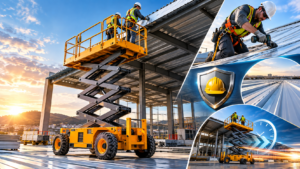
These work platforms allow for vertical movement over a large range, providing a secure and spacious working deck at height with minimalistic design of that moving network of support. Besides traditional ladders and scaffolds, a modern scissor lift is a giant step towards safer working environments with the factories, warehouses, and processing plants.
Indeed, plant managers who want to get the most benefit from their equipment must also understand the proper procedures that guide the selection, deployment, and maintenance of these vertical work platforms.
It is essential to initiate workers training program, arrange schedule for regular preventive maintenance, and properly specify the lift requirement based on different floor structures. The knowledge of the main differences between electric, hydraulic, and diesel-powered machines should also be acquired in order to support green initiatives and comply with local regulations on air pollution.
A carefully planned approach to the integration of mobile elevating work platforms (MEWPs) into your production process can be a direct path to continuous improvement and reaching zero accident records.
Selecting the Right way of scissor lifts in industrial facilities for Your Plant Floor
The particular configuration of your industrial plant floor will determine the kind of mobile elevating work platform you will need for your daily operations. It is necessary for plant managers to carry out detailed structural evaluations of their indoor surface, floor load capacities, and ceiling clearance profiles prior to dispatching a dedicated scissor lift unit.
Choosing the wrong equipment model can bring about unforeseen workflow risks, cause mechanical wear at an early stage, or even lead to major damage to the delicate flooring layers of the facility.
- Floor Structure Carrying Capacity: It is very important that the total weight of the lift unit, the internal tanks, operators, and heavy tools remains within the weight limit of concrete floors or mezzanine floor slabs that your facility uses.
- Choosing Power Sources: In enclosed indoor environments, selecting electric or battery-operated scissor lift models that use clean energy is very important for avoiding the accumulation of harmful emissions, while the use of internal combustion engines is limited to shipyards or exterior maintenance operations.
- Platform Dimensions: If facility maintenance workers usually handle wide and heavy articles or sometimes need more than one person working at height at the same time, then you should give preference to extended platforms or ones with the slide-out bridge deck.
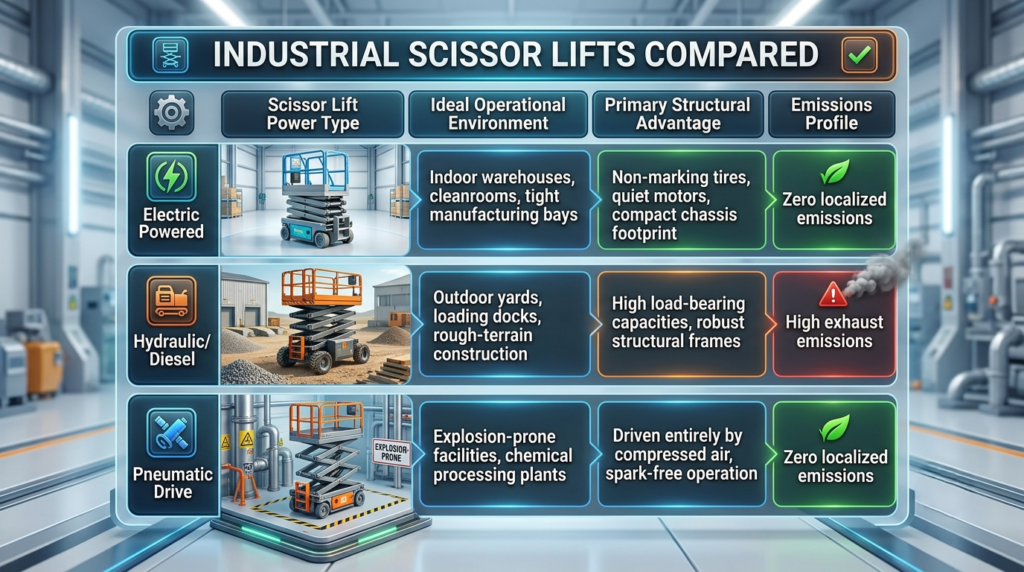
Table: Scissor lifts in industrial facilities
| Scissor Lift Power Type | Ideal Operational Environment | Primary Structural Advantage | Emissions Profile |
| Electric Powered | Indoor warehouses, cleanrooms, tight manufacturing bays | Non-marking tires, quiet motors, compact chassis footprint | Zero localized emissions |
| Hydraulic/Diesel | Outdoor yards, loading docks, rough-terrain construction | High load-bearing capacities, robust structural frames | High exhaust emissions |
| Pneumatic Drive | Explosion-prone facilities, chemical processing plants | Driven entirely by compressed air, spark-free operation | Zero localized emissions |
Implementing Comprehensive Safety and Training Standards
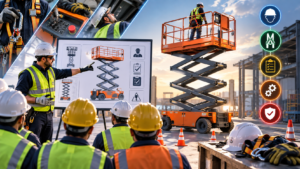
In order to use industrial scissor lifts within industrial facilities, safety is of paramount importance because the risk of accidents is inexorably increased if a lapse in training/certification is allowed. The existence of a mock class leading up to the final examination and auditing the records of each employee’s time spent in operation training is a perfect way to make sure that the plant is in compliance.
On the other hand, skipping training on safety measures increases drastically the risks of tipping over, crushing by overhead structures, and unexpected downtime of the facility resulting in costly damage.
- Impose Training Authorization: Make sure operators have undergone training that covers all aspects of the equipment operation according to the latest OSHA and ANSI regulations including practical tests on the plant floor.
- Incorporate Fall Protection: Make it a rule that workers standing on an elevated lift platform must wear body harnesses which have been inspected and are securely attached to approved anchor points whether or not the platform is equipped with guardrails.
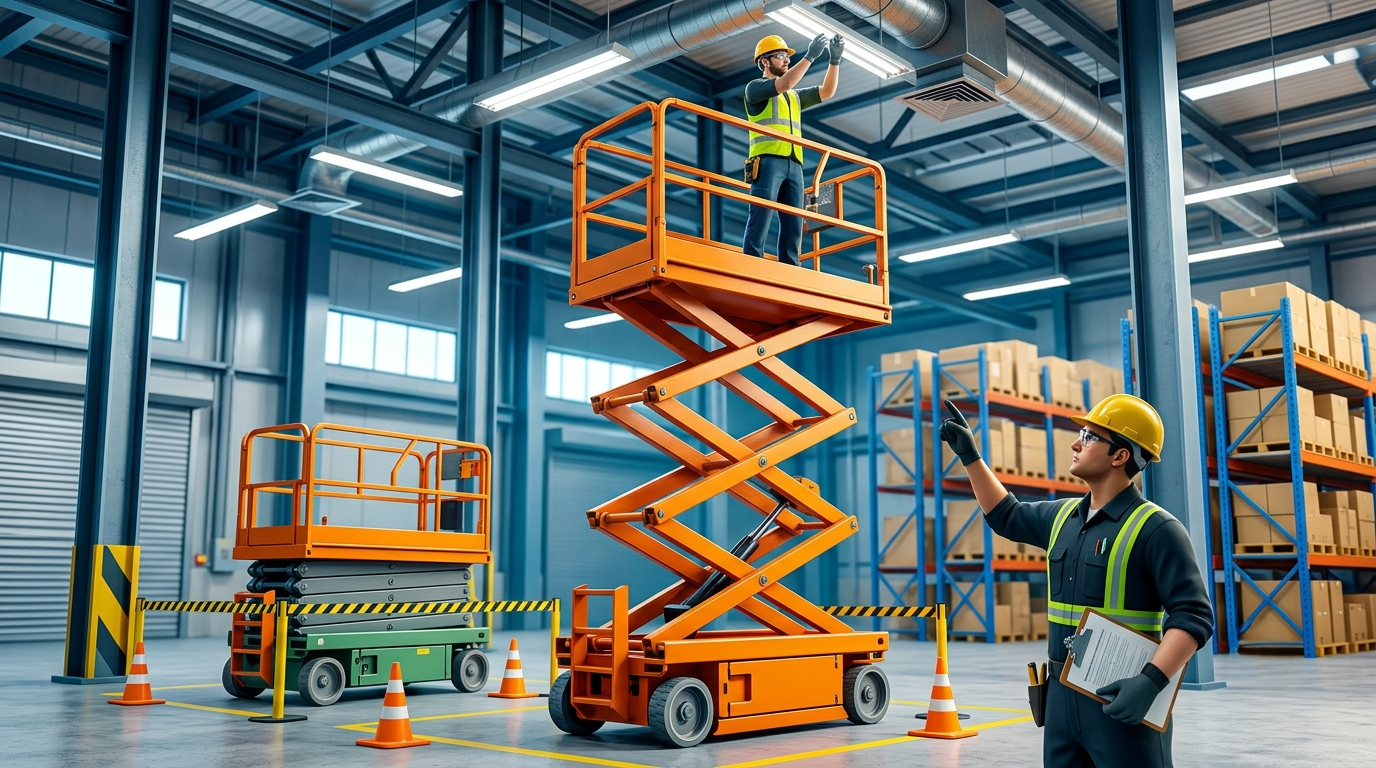
- Set Up Facility Ground Exclusion Zones: Put safety cones, barrier tapes or even fencing around lifts to stop employees at the ground level from entering hazardous areas beneath the lifts.
Optimizing Preventative Maintenance and Pre-Operation Inspections
Since equipment breakdowns constitute the highest cause of industrial accidents, plant managers would benefit from regularly scheduled maintenance and an initial, comprehensive pre-operation inspection carried out by each operator prior to being allowed to start the task. Identification of potential issues while the lift is still on the ground reduces any major risks of the breakdown occurring while elevated at height.
- Regularly Check Oil and Other Fluids: One of the most important safety checks to be carried out daily by operators is the inspection of fluid levels in all mechanical systems, such as hydraulic oil reservoirs and electronic battery electrolyte balances.
- Never Forget to Visually Inspect the Luxury Arms: Deformation, deep rusting, unknown lubricant, etc. – all can be noticed during inspection time.
- Perform the Emergency Lowering Actions: Ensuring that both platform, and ground release valves are operational is a basic safety measure that should be regularly performed by operators when carrying out pre-start checks.
Enhancing Workflow Productivity with Strategic Lift Placement
Strategically positioning the lift points while components or equipment are being brought in for assembly or during material handling can save a substantial amount of time when the operation is done under a lean setup. Besides adopting a well thought out layout, proper charging stations, storage racks, and corridors should also be considered so as to enhance the scissor lift operation success.
Main plant pathways should always remain free from obstacles so that material handling workers can make quick runs to and from storage and assembly areas without being slowed down.
- Designate Transport Lanes: Provide easily accessible transport lanes that are designed to allow the scissor lift to move freely without the risk of injury and without any obstacles such as low-hanging beams or extension cords.
- Combine Battery Charging with Well-Ventilated Areas: Construct charging stations within areas of the plant that are easily accessible and adequately ventilated. Equip these stations with fire safety equipment.
- Choose Integrated Material Racks: Workers will need to frequently climb down to retrieve the correctly desired kit if their tool racks and other apparatus are not attached to the platform thereby making integrated racks a smarter choice.
Understanding Lift Configurations and Structural Engineering
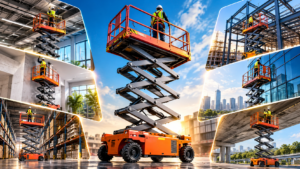
Lift configurations may be single-stage or double-stage whilst scaffolds can be fixed or mobile. Their internal drive configurations, structural lever design, and geometric engineering parameters are probably the strongest factors contributing to the mechanical efficiency of a scissor lift.
Thus, a concrete knowledge of how structural stability is affected under various loading conditions is a must for satisfactory acquisition and rental of equipment
- Allow for Structural Deflection: Understand that structural deflection will be experienced in all lift parts, including the scissor legs, base frame, and pinned joints. To reduce mechanical stress, it is critical to ensure equal load distribution across arm pairs.
- Observe the Work Motion Profile: Current industrial lifts are governed by highly optimized trapezoidal motion profiles that control platform velocity, thereby eliminating any sudden jerk-induced damage to the fragile cargo during the ascent or descent.
- Ensure Self-Locking Mechanisms: Look for state-of-the-art roller screw or self-locking lead screw arrangements that will retain the platform even under sudden internal power failure.
Frequently Asked Questions (FAQs) – Unleash the power of Scissor Lifts in Industrial Facilities!
What are the safety rules for using scissor lifts in industrial facilities?
Operators must have valid, current recognized OSHA/ANSI certifications. Workers standing on elevated platforms must wear full-body harnesses secured to approved anchors. The area underneath any elevated lift must be strictly cordoned off.
How often do these industrial lifts require maintenance?
Pre-shift visual inspections of fluid levels, brakes, and emergency stops are done on a daily basis. Monthly performance reviews of electrical and hydraulic lines should be done to ensure fault detection system efficiency. An annual thorough structural certification is performed by a suitably qualified technician.
Can you use a scissor lift on sloped facility floors?
Standard scissor lifts intended for indoor use must only operate on flat level concrete floors. Slopes introduce high-risk situations that may lead to tip-over of vertical platform lifts. Special rough-terrain types equipped with leveling outriggers are needed to work on inclines.
Electric vs. hydraulic scissor lifts: Which is better indoors?
Electric: Best option for cleanrooms and tight areas since they are very quiet, emissions free and do not require ventilation.
Hydraulic: While hydraulic lifts have the advantage of being able to lift extremely heavy loads, they are very dangerous in the case of a leak as the fluid may spill onto the floor making it very slippery and hazardous.
Pneumatic: Due to its availability of air supply and inherent safety, pneumatic lift is the most suitable for hazardous zone pantries.
How do you determine the safe weight capacity of a lift?
Compute the total weight in consideration of operators, heavy tools, and raw materials. Stay well within the Safe Working Load Limit (SWLL) boundaries when it comes to combined load. Never go beyond the rated capacity indicated on the machine’s data plate.
Is a safety harness required if the lift has guardrails?
Guardrails provide a means of fall protection that is generally recognized by OSHA as being adequate. However, site safety rules often call for a secondary personal fall arrest system (PFAS). Harnesses protect persons from getting thrown out of the dangerous fall zone due to sudden bumps or jolts above.
What happens if an elevated lift suddenly loses power?
Don’t lose your cool and don’t climb back down through the scissor arms. Personnel on the ground should reach for the manual auxiliary lowering valve at the base. Unit will broker down the platform smoothly and safely to the floor level.