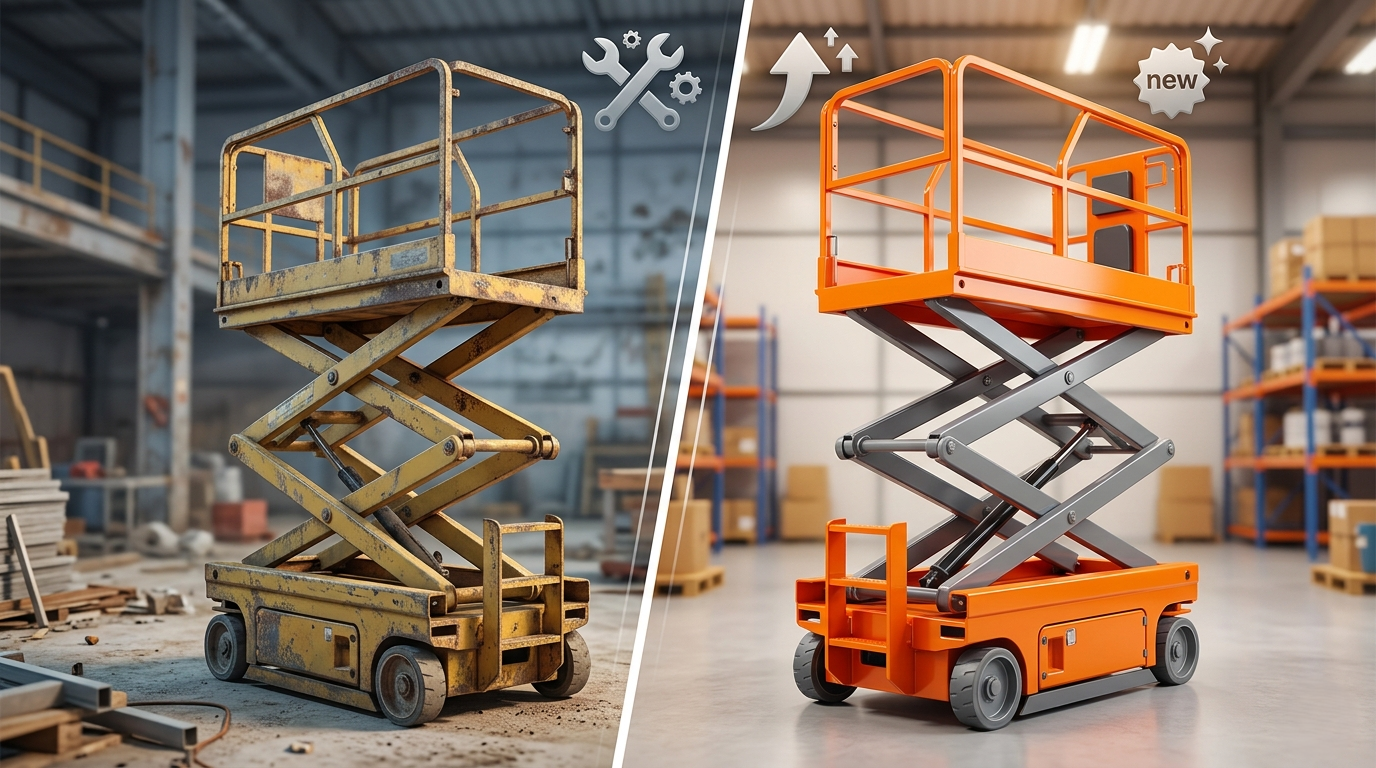
When Should You Replace a Scissor Lift Instead of Repairing It?
Deciding when to replace a scissor lift instead of continuously repairing one is among the biggest financial and operational decisions fleet managers and construction supervisors will face.
Generally, a carefully maintained piece of aerial equipment can reliably serve a company for a decade or even 15 years, but after a certain point, constantly investing money in old machines can be a mistake. You should always strive to strike a balance between operational uptime, employee safety, and budgetary efficiency.
If the majority of your team’s time is spent resolving the scissor lift being unresponsive, dealing with recurring leaks, or fixing breakdowns that no one expected, it’s time to do a thorough review of the equipment’s long-term potential.
Unscheduled maintenance of an aerial platform costs your business twice – the first is the actual price of the specialist parts and labor, and the second is the indirect loss of work productivity which can lead to replace a scissor lift.
In very demanding sectors such as industrial warehousing, construction, and aerospace maintenance, a single day of unexpected downtime might completely mess up the planned project timelines. We will discuss the structural, financial, and regulatory factors that indicate that you should get a new model instead of going for another repair.
Top Reasons to Replace a Scissor Lift Instead of Repairing It:
1. The Cost of Cumulative and Frequent Repairs
The surest way to tell that a piece of equipment has reached the absolute end of its useful life is the increase in the frequency of maintenance bills. Routine servicing and replacing of some components is a normal part of machinery ownership, but continuous breakdowns indicate overall failure.
When critical sub-systems start failing one after another – for example, an electrical short circuit happening right after a hydraulic pump replacement – the unit is telling you that its components are structurally degrading.
You have to consider the whole economic life of the machine and not just each repair invoice as a separate event when figuring out when to replace a scissor lift rather than repair it.
Fleet managers use the “classic 50% Rule” to make the decision objectively: if the estimated cost of an upcoming repair exceeds 50% of the machine’s current resale value, then a replacement is the financially better choice most of the time. Besides, you need to weigh the aggregate maintenance expenses over the past 12-24 months against the price of a new, warrantied piece of machinery.
Economic Warning Signs:
- Annual repairs alone end up costing as much as making financing payments for an advanced new aerial lift.
- The equipment keeps having identical faults, like electrical troubles or valve failures, even though certified technicians have replaced the parts with factory ones.
- By following your maintenance logs, you discover that the equipment stays longer in the service bay than it is working.
2. Severe Wear, Corrosion, and Structural Damage
Parts like valves, switches, and hoses that are good for hours of work between repairs can be replaced as part of the normal servicing, while changes to the safety of a machine due to damage are fundamental and not easily remedied.
Scissor stacks, work platforms, and base chassis are designed to handle heavy stresses and will be distorted, weakened, or even cracked over the years of use, exposure to the weather, or impacts.
Visual inspection is extremely helpful when trying to determine the overall structural condition. Rust is very dangerous after it starts causing metal pits around critical scissor pins, pivot points, or load-bearing welds. If an off-center overload causes a chassis to twist, or bends become visible on the scissor arms, these are signs that the unit’s stability is compromised.
When choose to replace a scissor lift even for a small section or trying to get a component re-welded is not just a bad investment, it is also a huge safety violation of the original manufacturer design specs as no new standards would be met.
Physical Indicators of Structural Obsolescence:
- Rust causing structural corrosion or pitting of the main scissor arm welds, chassis frame, and around heavy-duty cylinder mounting pins.
- Structural cracks or stress fractures can be seen with the unaided eye in the steel of the base frame and worker platform floor plate.
- Uneven weight distribution caused by bent, distorted, or misaligned scissor arms which also lead to binding during the raising and lowering of the platform.
3. Persistent Failures in the Hydraulic and Electrical Systems
The hydraulic mechanism provides the strength needed to lift the platform of the aerial work vehicle. Hydraulic pressure and proper fluid quality determine a smooth, controlled ride with no surprises on the way up.
When, however, components like hydraulic cylinder walls, seals, and pumps are not replaced, the machinery becomes inefficient quickly. If you are still incurring a cost of parts replacement or leak maintenance regularly, you might be dealing with a very aged system.
Also, electrical problems are generally very difficult and costly to fix in old machines. Failing control boards, broken electrical connectors, and damaged wiring harnesses make it unpredictable and dangerous to use the equipment.
Once you notice the slowest moving lift, battery dying really fast in electric models, and the inability to reach the the highest point – you should know that the machine is worn out.
Systemic Performance Failures:
- Extensive resealing is done but hydraulic fluid keeps leaking from multiple points such as valves, cylinders, connections.
- Vertical lift speed is greatly reduced, or the platform cannot be lifted to its maximum height.
- Electric battery packs lose voltage quickly, or diesel engines are out of power even after attempts have been made to replace parts.
4. Availability of Replacement Parts and Factory Support
As the global manufacturing landscape changes very rapidly and scissor lift designs evolve, older models are gradually eliminated by their original manufacturers. Once a particular model has been discontinued, time starts running out for the supply of genuine factory replacement components.
Usually, after a machine passes the 10-to-15-year bracket, looking for everything from specialized control joysticks to patented structural pins becomes a never-ending logistical struggle.
Once a machine is “extinct” in that there are no factory parts at all, keeping it in your fleet will be a series of risky compromises. Going for untested aftermarket modifications or scavenging parts from retired machines opens up liability problems and unpredictable field behavior.
If your service technicians have to wait weeks or months for custom-machined parts or those coming from overseas, the downtime caused will more than offset any savings you got from not replacing a machine.
Parts Sourcing Red Flags:
- Manufacturers themselves have officially declared your lift model as “end-of-life” (EOL), with no manufacturing or stocking of mechanical components.
- Safety-critical items like proprietary control systems or specialized electrical modules are unavailable through authorized global distribution channels.
- Routine ordering of very basic components leads to backlog situations stretching over several weeks, with resulting operational deadlocks on projects.
5. Evolving Safety Regulations and Industry Compliance
Safety protocols and regulations for aerial work platforms are frequently revised to incorporate new engineering discoveries and accident prevention information. For example, recent ANSI A92 standards in the United States have had a major impact on how scissor lifts must be designed and operated.
Old machines which had been made under older codes do not have the features which are mandatory by law on new sites.
Today, aerial platforms come equipped with numerous safety features such as automatic pothole protection gates, accurate load-sensing systems which stop the machine when overloaded, and advanced tilt-cutout sensors. The cost or complexity that would be involved in retrofitting an old machine to meet these standards often means it physically cannot be done.
Running machinery that is not compliant with OSHA or ANSI codes not only puts your company at risk of hefty fines but can also lead to significant legal consequences if there is an accident on the worksite.
Key Safety Elements to Review:
- Automatic pothole protection systems that stabilize the chassis when the platform is raised.
- Factory-installed load sensing systems that automatically disable further functions when the weight limit has been exceeded.
- Modern control panels equipped with reliable emergency stops, dual-activation switches, and manual lowering methods.
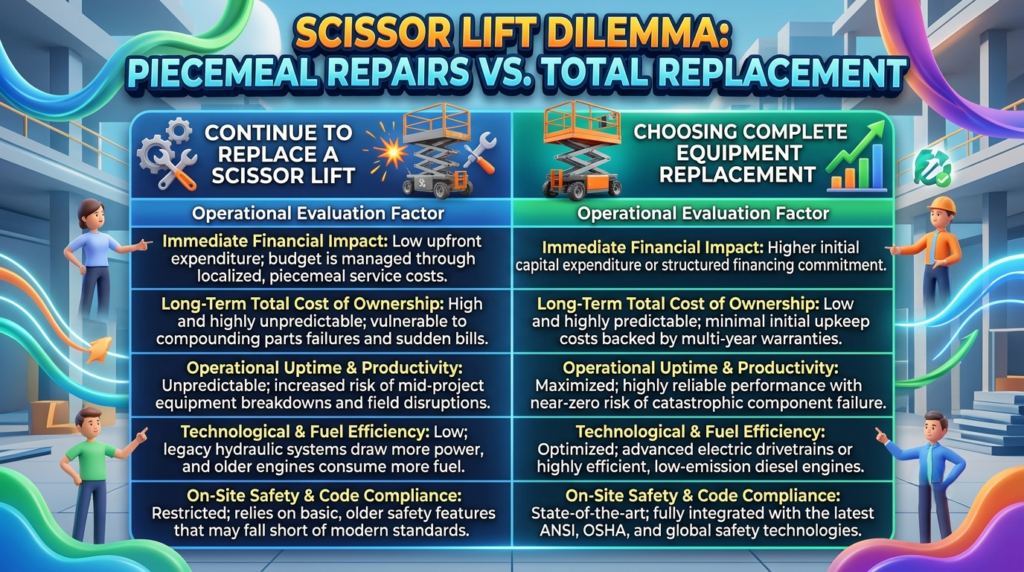
Financial Comparison: Repair vs. Replace a scissor lift
Here is a very brief overview of how deciding to fix or buy new a scissor lift can affect your business, when translated into various operational dimensions:
| Operational Evaluation Factor | Continue to Replace a Scissor Lift | Choosing Complete Equipment Replacement |
| Immediate Financial Impact | Low upfront expenditure; budget is managed through localized, piecemeal service costs. | Higher initial capital expenditure or structured financing commitment. |
| Long-Term Total Cost of Ownership | High and highly unpredictable; vulnerable to compounding parts failures and sudden bills. | Low and highly predictable; minimal initial upkeep costs backed by multi-year warranties. |
| Operational Uptime & Productivity | Unpredictable; increased risk of mid-project equipment breakdowns and field disruptions. | Maximized; highly reliable performance with near-zero risk of catastrophic component failure. |
| Technological & Fuel Efficiency | Low; legacy hydraulic systems draw more power, and older engines consume more fuel. | Optimized; advanced electric drivetrains or highly efficient, low-emission diesel engines. |
| On-Site Safety & Code Compliance | Restricted; relies on basic, older safety features that may fall short of modern standards. | State-of-the-art; fully integrated with the latest ANSI, OSHA, and global safety technologies. |
FAQ’s – Replace a Scissor Lift
How long does a commercial scissor lift usually last?
Under the right conditions and with regular preventive maintenance customarily approved by the manufacturer, a quality commercial scissor lift can be expected to have a useful operational life of 10-15 years. However, environmental factors can have a major impact on this longevity; a machine regularly used outdoors in harsh, high-debris environments or exposed to chemically corrosive agents will naturally degrade faster than a unit that is used only occasionally on smooth, climate-controlled indoor warehouse floors.
How do I calculate if a scissor lift repair is worth the investment?
The 50% rule is a common fleet management framework to make decisions on repairs and upgrades based on data. You start from a total quote of parts and labor and simply compare this to the current resale value of the used scissor lift. Should the costs to repair the machine surpass half of its market value – or if repair expenses over the last 2 years are closing in on the price of a new one – it makes financial sense to replace the existing unit.
Can a cracked or bent scissor lift chassis be safely welded and repaired?
From a structural integrity standpoint, the main load-bearing chassis and scissor arms of a lift with deep cracks or severe structural deformations, as well as distinct bending, cannot be repaired for safety by welding. Scissor lifts are made of special high-strength steel alloys and are engineered to very precisely prevent tipping or collapse when under load. Therefore, aftermarket welding should not only be considered as a violation of safety regulations but the procedure also voids all manufacturer warranties and liabilities.
What are the operational dangers of running an outdated scissor lift model?
There are three main risks a business faces by continuing to use an old model of scissor lift: worker accidents resulting from equipment failure, getting penalized for not being compliant with updated ANSI/OSHA standards, and overall loss in productivity at the site. Older machinery does not have modern automated safety features, such as load-sensing systems and pothole protection, hence the chance of tip-overs is very high.
Why is it so difficult to source parts for older scissor lift models?
Manufacturers stop production on legacy lines in order to focus their attention and resources on newer generation equipment areas. As the global inventory of parts is cleared out, it becomes increasingly difficult to procure original parts such as control boards and hydraulic manifolds. Fleet managers have to contend with great downtime or resort to uncertified aftermarket parts.
Do new scissor lift models offer a measurable return on investment (ROI)?
Actually, the decision to go for a brand new scissor lift is one that can augment and speed up ROI immediately through multiple operational channels. Examples are integration of highly efficient electric drive motors which greatly extend battery duty cycles, elimination of sizeable unscheduled repair costs, minimal costly project delays on job sites, and advanced onboard diagnostics for operators to quickly address and isolate minor issues before they develop.
How do I properly document a scissor lift as completely unserviceable?
Retiring a scissor lift safely and officially from your production fleet must be done through the heavy equipment technician who has been certified performing an annual thorough inspection and documenting in a report the structural or mechanical failures which render the equipment unserviceable. Company records should be marked with the machine’s serial number as being permanently retired and the safety compliance tags are to be removed. At this point, physical disabling or selling to a licensed equipment salvage yard is the only way to make sure the machine is never erroneously placed back into active use.